
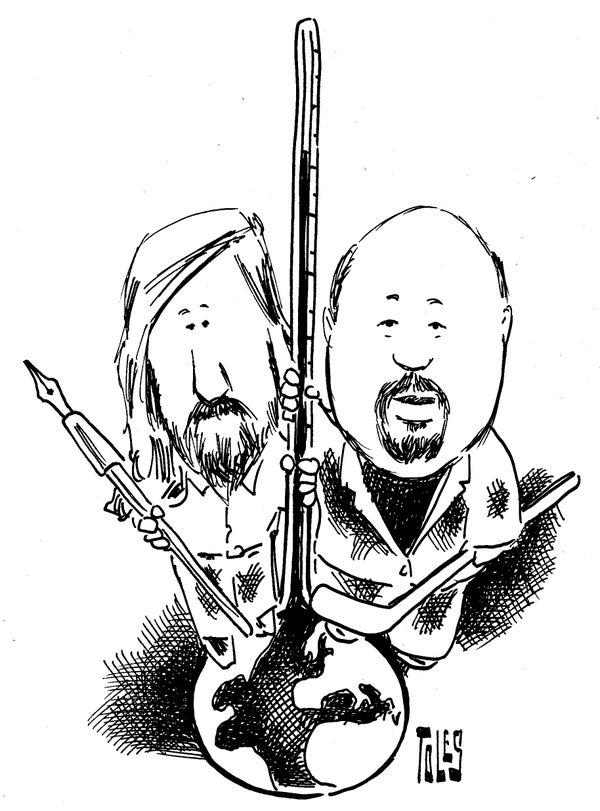
This is a powerful team: atmospheric scientist Michael Mann and political cartoonist Tom Toles. Both are standouts in their fields. Both have been trying to alert the world to the threat of climate change even as they are attacked by political and business leaders. And both recently realized that if they combined their talents they might find a way to break what they see as a concerted effort to fool the public. So they created a concise and fiercely illustrated new book called The Madhouse Effect: How Climate Change Denial Is Threatening Our Planet, Destroying Our Politics, and Driving us Crazy.
The American public and politicians “are so divided it’s become difficult to even talk about issues like climate change,” Mann said at an evening event on September 29. “We decided to frame things with humor and satire to lower the barriers.”
Mann made his comments at a panel discussion that he and Toles held at the American Museum of Natural History in New York City, moderated by Jeffrey Sachs, an economist at Columbia University and a senior advisor to the U.N. The effort to discredit climate science, Toles said, “has become the most radical divorce between straightforward facts and a political constellation of denial and disinformation I’ve ever seen.”
On supporting science journalism
If you're enjoying this article, consider supporting our award-winning journalism by subscribing. By purchasing a subscription you are helping to ensure the future of impactful stories about the discoveries and ideas shaping our world today.
In addition to explaining the basics about climate science and why people should care, the book has dozens of previously drawn and new cartoons by Toles, which he called “a collection of ‘Wanted’ posters of the bad actors.”
Actually the cartoons cut to the core of the issues that Mann untangles in the prose. Scientific American put together a slide show with one cartoon from each of the eight chapters that, together, capture the overall story (see above).. Each cartoon carries the name of the chapter in which it appears.
At one point during the talk Sachs, Mann—who is director of the Earth System Science Center at The Pennsylvania State University—and Toles, a Pulitzer Prize-winning cartoonist for The Washington Post, were asked what individuals could do to help lessen future climate change. All three said: vote. “We are facing a watershed moment,” Mann said, referring to the upcoming U.S. presidential election. He and his fellow speakers, without naming names, said that voting for one candidate would give the country and the world a chance to rein in climate change, and voting for the other candidate would doom the planet. What the U.S. does in the next few years, Sachs noted, is crucial to the entire globe.
Despite the book’s written and drawn takedowns, it ends with an unexpectedly upbeat chapter called "A Path Forward." “There are lots of reasons for cautious optimism that we can still respond to the problem,” Mann explained at the museum. “If we act quickly.”