
This article is from Proof Positive, our friendly math newsletter that's delivered to your inbox every Tuesday afternoon. Sign up today and read it first.
Like probably every child, I used to love playing with light switches and turning lamps on and off again in quick succession. At some point, my mother intervened and told me to stop. But what if you ignored that warning—for the purposes of a mathematical thought experiment?
On supporting science journalism
If you're enjoying this article, consider supporting our award-winning journalism by subscribing. By purchasing a subscription you are helping to ensure the future of impactful stories about the discoveries and ideas shaping our world today.
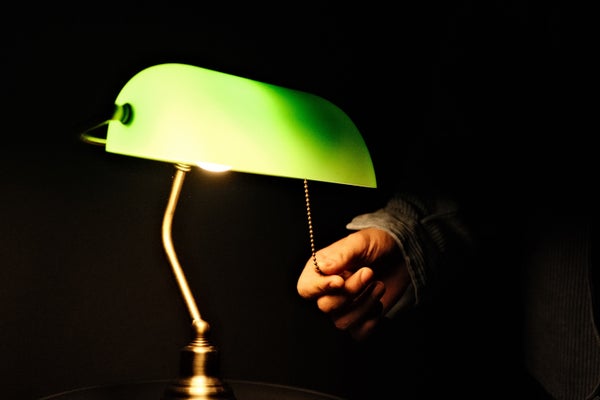
It goes like this: You turn a lamp on, then off a minute later, then back on again after 30 seconds, then off after 15 seconds, and so on. Each time you flip the switch, you halve the time intervals so that the lamp turns on or off faster and faster. After two minutes, will the lightbulb be on?
This supposedly simple question has produced heated discussion. In principle, the time intervals become smaller and smaller until they amount to zero after two minutes. British philosopher James F. Thomson, who wrote about the thought experiment in 1954, noted: “It seems impossible to answer this question. It cannot be on, because I did not ever turn it on without at once turning it off. It cannot be off, because I did in the first place turn it on, and thereafter I never turned it off without at once turning it on. But the lamp must be either on or off. This is a contradiction.”
In principle, versions of this puzzle date back to 1703, when Italian scholar Guido Grandi was concerned with infinite series. These denote sums with infinitely many additions, such as: 1 + 1⁄2 + 1⁄4 + 1⁄8 + ... No matter how many terms you add in this series, the result is always less than 2. Mathematicians therefore say the limit of the series is 2. For that reason, in the thought experiment described, it only takes two minutes to flick the switch of a lamp an infinite number of times.
Grandi devoted much of his work to another strange series: 1 – 1 + 1 – 1 + 1 – ... The idea is that you alternately subtract and add 1 over and over again. (Going back to our thought experiment, you can associate 1 with the switching on of a lamp and –1 with the switching off.) If you try the arithmetic here, you will quickly find that if you consider an even number of summands, the result will be 0, but if you consider an odd number, the result is 1. But what about infinity? Is infinity an even or an odd number?
The Grandi Series and a Compromise Solution

The sum of 1 + 1⁄2 + 1⁄4 + 1⁄8 + ... is never greater than 2.
Tobias Vogel (Toby001) via Wikimedia Commons (CC BY-SA 3.0)
Grandi proposed another way to frame this problem. By placing parentheses strategically, you can obtain an infinite sum of zeros: (1 – 1) + (1 – 1) + (1 – 1) + ... With this arrangement, the limit of the series should be 0, so the lamp is off at the end. But of course, you could move those brackets one place to the right and get another limit: 1 + (–1 + 1) + (–1 + 1) + (–1 + 1) + ... = 1, meaning the lamp would be on at the end. So again you have two results to choose from: 0 or 1.
To make everything even more confusing, Grandi found another possible result: 1⁄2. For this, Grandi wrote down the infinite series and gave the name S to the limit: S = 1 – 1 + 1 – 1 +... Then he excluded the first summand and stated: S = 1 – (1 – 1 + 1 – 1 +...) = 1 – S. That led to the simple equation S = 1 – S, so S = 1⁄2 follows. And today many experts are convinced that this result is correct.
Reimagining the Thought Experiment
But what does this mean for Thomson’s lamp? Is the room half lit and half dark at the end of the two minutes? For every moment, no matter how short, before the time span has expired, one can describe the state of the lamp. But at exactly two minutes, the result remains a mystery. To shed more light on this, physics philosophers John Earman and John D. Norton moved the thought experiment into a somewhat more real setting.
Suppose a metal ball is dropped on an induction cooktop. First the ball is in the air for a minute, then 30 seconds, then only 15, and so on. It bounces infinitely for two minutes, generating an electrical pulse in the plate each time. That plate connects to a lamp that lights up with each contact. In this scenario, the ball comes to a halt after two minutes as a result of gravity on the metal plate, so the lamp is on at the end. Put another way, the series limit is 1.
But you can reverse the situation: Imagine that the ball does not close the circuit between the lamp and the induction field but rather opens it. In that case, the lamp is turned off whenever the ball lands on the plate. Thus, after two minutes have elapsed, the lamp is dark. According to this interpretation, the limit of the Grandi series is 0. Norton and Earman therefore concluded that the Thomson lamp is not a paradox but rather a problem that is incompletely described.
This article originally appeared in Spektrum der Wissenschaft and was reproduced with permission. It was translated from the original German version with the assistance of artificial intelligence and reviewed by our editors.