A Matter of Time

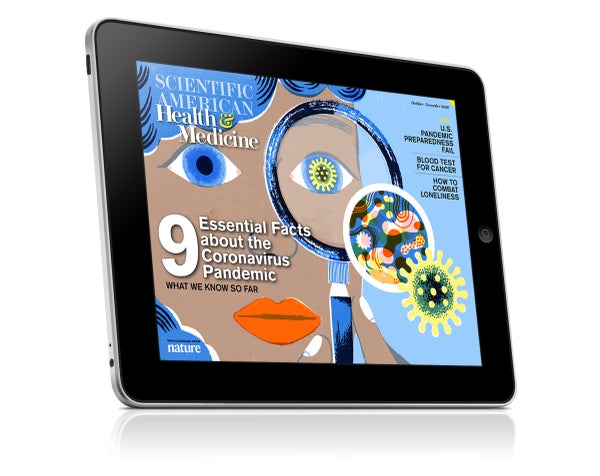
9 essential facts about the coronavirus pandemic

Scientific American Health & Medicine October 2020

Scientific American Health & Medicine October 2020

Join Our Community of Science Lovers!

The past six months have felt like an eternity for those of us isolating and staying home. And I imagine they’ve also felt like a stressful slog to every essential worker who has showed up day in, day out, to keep people fed and healthy. But for science and medical research, six months is a relative blink of an eye. Scientific understanding about new diseases such as SARS-CoV-2 usually takes years, not months. Consider that HIV was first isolated and identified in 1983, and nearly 40 years later we still don’t have a bona fide cure—although we’re getting closer—but thanks to major advancements in antiretroviral therapy, most people who contract the disease can lead long and healthy lives. Some early advice about how to avoid the novel coronavirus was barely more than a best guess based on previous knowledge (for example, we now know that surface transmission of the virus is rare). In this issue’s cover story, Scientific American editor in chief Laura Helmuth provides a definitive list of the hard-won certainties we’ve gleaned about COVID-19 in six short months (see “Nine Important Things We’ve Learned about the Coronavirus Pandemic So Far”).

Also in this issue, Amy Maxmen profiles the global history of so-called pandemic games that epidemiologists use to model and predict how global diseases might arise and, most important, how we can prepare to mitigate them. Despite such exercises, she details how the U.S. has so badly bungled its handling of the virus (see “Two Decades of Pandemic War Games Failed to Account for Donald Trump”). She posits that powerful treatments and vaccines might be the solution for countries with rampant outbreaks. But of course, such remedies take time.

Andrea Gawrylewski is chief newsletter editor at Scientific American. She writes the daily Today in Science newsletter and oversees all other newsletters at the magazine. In addition, she manages all special editions and in the past was the editor for Scientific American Mind, Scientific American Space & Physics and Scientific American Health & Medicine. Gawrylewski got her start in journalism at the Scientist magazine, where she was a features writer and editor for "hot" research papers in the life sciences. She spent more than six years in educational publishing, editing books for higher education in biology, environmental science and nutrition. She holds a master's degree in earth science and a master's degree in journalism, both from Columbia University, home of the Pulitzer Prize.

More by Andrea Gawrylewski
SA Health & Medicine Vol 2 Issue 5This article was published with the title “A Matter of Time” in SA Health & Medicine Vol. 2 No. 5 ()
doi:10.1038/scientificamerican102020-1gIbryj9yWeK5PZWRe2NCz

It’s Time to Stand Up for Science

If you enjoyed this article, I’d like to ask for your support. Scientific American has served as an advocate for science and industry for 180 years, and right now may be the most critical moment in that two-century history.

I’ve been a Scientific American subscriber since I was 12 years old, and it helped shape the way I look at the world. SciAm always educates and delights me, and inspires a sense of awe for our vast, beautiful universe. I hope it does that for you, too.

If you subscribe to Scientific American, you help ensure that our coverage is centered on meaningful research and discovery; that we have the resources to report on the decisions that threaten labs across the U.S.; and that we support both budding and working scientists at a time when the value of science itself too often goes unrecognized.

In return, you get essential news, captivating podcasts, brilliant infographics, can't-miss newsletters, must-watch videos, challenging games, and the science world's best writing and reporting. You can even gift someone a subscription.

There has never been a more important time for us to stand up and show why science matters. I hope you’ll support us in that mission.

Thank you,

David M. Ewalt, Editor in Chief, Scientific American

Subscribe