A New Reality Up North

Climate change is dramatically altering life at the top of the world

Arctic fulmar

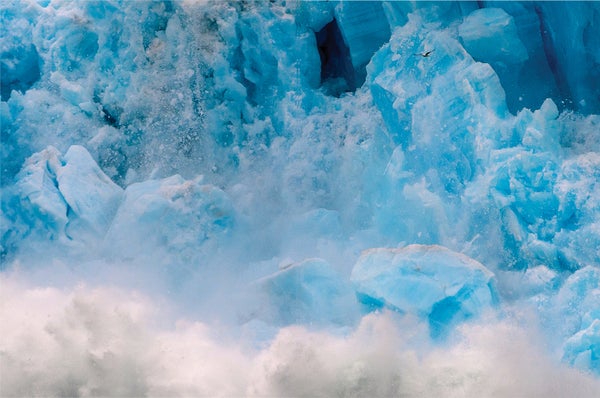
Arctic fulmar flying over calving glacier, Northern Spitsbergen, Svalbard, Norway.

David Yarrow Getty Images

Join Our Community of Science Lovers!

On Banks Island in Canada's Northwest Territories, more than 4,000 slow-motion landslides are creeping downhill as thawing permafrost slumps and crumbles. In Siberia, warming earth is allowing underground methane seeps to breach the surface and explode, leaving craters up to 40 meters wide.

Across the Arctic, striking change is the new normal, as is incursion by countries and businesses. Construction, oil and natural gas extraction, shipping and tourism are all on the rise. Climate and human activity are leaving a mark on nature and on the four million people who live in the region.

As interactions widen, science will be important for informing agreements and policies, especially concerning disaster preparedness, environmental protection, economic opportunity, food security, human health and community resilience. Indigenous peoples may be among the most valuable experts. For years they have closely tracked shifting temperatures and receding ice cover, trekked mountains and forests, followed caribou herds, fished seas and maintained biodiversity. Their communities and cultures are also the ones most affected by coming development.


On supporting science journalism

If you're enjoying this article, consider supporting our award-winning journalism by subscribing. By purchasing a subscription you are helping to ensure the future of impactful stories about the discoveries and ideas shaping our world today.


Some indigenous leaders say the Arctic should be governed by cooperative organizations and rules that transcend political boundaries. For example, land and marine spatial planning across large expanses could lay out rights for people, environmental protection and means for constructive dialogue. Ultimately, they say, sustainable use of the future Arctic depends on a healthy environment and a healthy community.

Credit: Katie Peek (graphics); Mark Fischetti (text); Morgan Trimble Getty Images (beaver); Adrian Wojcik Getty Images (Longyearbyen); Sources: NOAA’S Earth System Research Laoratory (air and sea-surface temperatures); U.S. National Snow and Ice Data Center (sea ice); NOAA’S National Centers for Environmental Inforamtion (snow cover); Merritt R. Turetsky University of Guelph (permafrost); Uma S. Bhatt University of Alaska Fairbanks (tundra greening); Karen E. Frey Clark University (primary productivity); Food and Agriculture Organization of the United Nations (cod habitats); State of the Arctic Marine Biodiversity Report, chapter 3.4: “Marine Fishes.” Conservation of Arctic Flora and Fauna (CAFF) 2017 (cod abundances); Birdlife International, 2018 (murre breeding locations); Arctic Biodiversity Assessment 2013. CAFF, Arctic Council, 2013 (murre trends; polar bear trends; reindeer and caribou trends)  

Mark Fischetti was a senior editor at Scientific American for nearly 20 years and covered sustainability issues, including climate, environment, energy, and more. He assigned and edited feature articles and news by journalists and scientists and also wrote in those formats. He was founding managing editor of two spin-off magazines: Scientific American Mind and Scientific American Earth 3.0. His 2001 article “Drowning New Orleans” predicted the widespread disaster that a storm like Hurricane Katrina would impose on the city. Fischetti has written as a freelancer for the New York Times, Sports Illustrated, Smithsonian and many other outlets. He co-authored the book Weaving the Web with Tim Berners-Lee, inventor of the World Wide Web, which tells the real story of how the Web was created. He also co-authored The New Killer Diseases with microbiologist Elinor Levy. Fischetti has a physics degree and has twice served as Attaway Fellow in Civic Culture at Centenary College of Louisiana, which awarded him an honorary doctorate. In 2021 he received the American Geophysical Union’s Robert C. Cowen Award for Sustained Achievement in Science Journalism. He has appeared on NBC’s Meet the Press, CNN, the History Channel, NPR News and many radio stations.

More by Mark Fischetti

Katie Peek is a science journalist and data-visualization designer with degrees in astrophysics and journalism. She is a contributing artist for Scientific American.

More by Katie Peek
Scientific American Magazine Vol 321 Issue 2This article was published with the title “A New Reality” in Scientific American Magazine Vol. 321 No. 2 (), p. 37
doi:10.1038/scientificamerican0819-37

It’s Time to Stand Up for Science

If you enjoyed this article, I’d like to ask for your support. Scientific American has served as an advocate for science and industry for 180 years, and right now may be the most critical moment in that two-century history.

I’ve been a Scientific American subscriber since I was 12 years old, and it helped shape the way I look at the world. SciAm always educates and delights me, and inspires a sense of awe for our vast, beautiful universe. I hope it does that for you, too.

If you subscribe to Scientific American, you help ensure that our coverage is centered on meaningful research and discovery; that we have the resources to report on the decisions that threaten labs across the U.S.; and that we support both budding and working scientists at a time when the value of science itself too often goes unrecognized.

In return, you get essential news, captivating podcasts, brilliant infographics, can't-miss newsletters, must-watch videos, challenging games, and the science world's best writing and reporting. You can even gift someone a subscription.

There has never been a more important time for us to stand up and show why science matters. I hope you’ll support us in that mission.

Thank you,

David M. Ewalt, Editor in Chief, Scientific American

Subscribe