
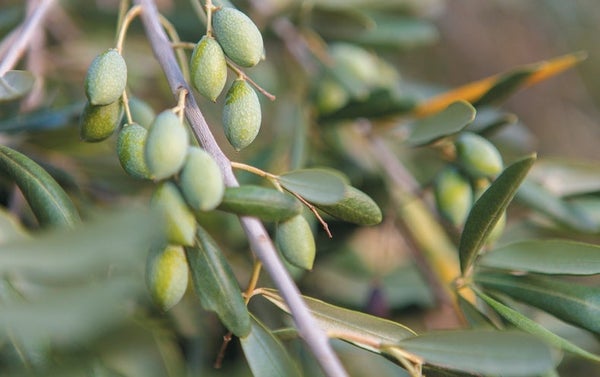
An aggressive plant pathogen that wipes out olive trees is projected to cost Italy billions of euros over the next 50 years. Xylella fastidiosa—a bacterium named for its pickiness when grown in the laboratory—was detected in southern Italy in 2013. It is now designated a “quarantine organism” in the European Union: infected trees, some hundreds of years old, must be cut down to prevent the disease from spreading in places such as Italy's Apulia region.
“We are obliged to destroy Xylella-positive plants, but people in Apulia don't want to destroy them,” says Valeria Scala, a plant pathologist at Italy's Council for Agricultural Research and Economics. As scientists, she says, “we have to live between two worlds.” So Scala and her colleagues are looking for ways to fight Xylella without killing every infected tree. Using a machine-learning algorithm to sift through the trees' metabolic data, they are learning which trees tend to get sicker than others—and how to choose trees to treat instead of chopping them down. The work is detailed in Frontiers in Plant Science.
Xylella makes complex fatty acids called lipids to use as key signaling molecules, and the trees manufacture their own lipids in response to infection. The researchers collected twig samples from 66 trees and used their algorithm to compare lipid profiles along with infection status, tree variety, and whether each tree had been treated with Dentamet, a metallic mixture that relieves Xylella symptoms but is not a cure.
On supporting science journalism
If you're enjoying this article, consider supporting our award-winning journalism by subscribing. By purchasing a subscription you are helping to ensure the future of impactful stories about the discoveries and ideas shaping our world today.
The team found that one particular lipid type appeared at greater concentrations in infected plants. An olive variety native to hard-hit Apulia showed higher levels of this lipid when infected than did a widespread variety known for its hardiness. For both tree types, Dentamet kept infected individuals' lipid levels lower.
Study co-author Massimo Reverberi, a molecular plant pathologist at Sapienza University of Rome, says the two tree varieties behaved a bit like people with stronger or weaker immune systems fighting off the flu. “Our hypothesis is that it's ‘personal’ in some ways,” he says. Further developing the algorithm could help the researchers diagnose infection severity by measuring lipid concentrations. Less severe infections could then be managed with Dentamet, and only the worst cases would have to be culled. Knowing how trees respond to Xylella infection will also direct the search for additional treatments and identify more resistant tree varieties, Scala adds.
University of Salento chemist Francesco Paolo Fanizzi, who was not involved in the new study, says it represents “a promising methodology that could give some relief to this painful economic situation in the southern part of Apulia.” “We have to survive together with bacteria,” he adds.