
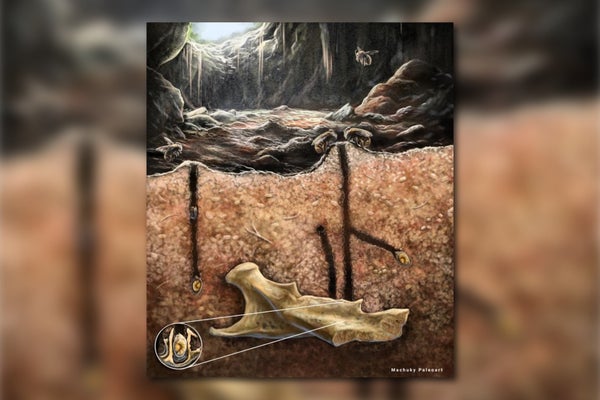
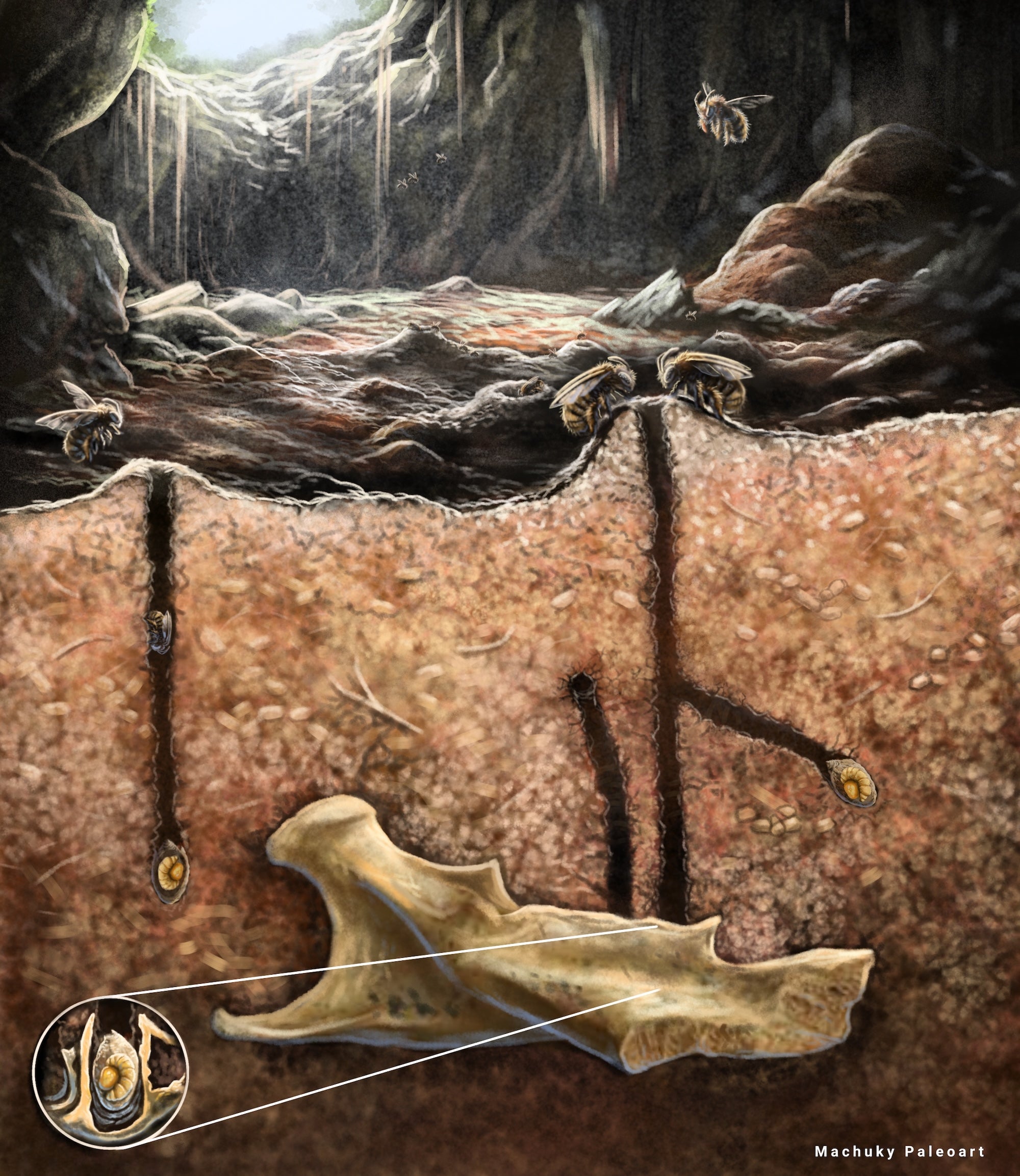
Thousands of years ago in what is now the Dominican Republic, there was a cave full of bones. And those bones were full of bees.
In a paleontological first, researchers have discovered that bees used the jawbones of now extinct mammals as burrows. It’s not clear what species of bee was exploiting this grisly opportunity—only its smooth-walled nests were left behind, nestled in the tooth pockets of ancient rodents and sloths. Such behavior has never been documented before, says Lázaro W. Viñola López, a postdoctoral researcher at the Field Museum and one of the discoverers. “It was something completely unexpected,” he says.
When Viñola López and his colleagues climbed past the jagged entrance of the cave, called Cueva de Mono, they were on the hunt for fossilized lizards, which they found—in excess. They also encountered tens of thousands of bones of extinct rodents and sloths, leading them to conclude that they’d stumbled on the killing field of an ancient family of owls that probably nested in the cave and regurgitated onto the cave floor. Although it is difficult to precisely date the fossils, similar deposits have been found that come from as early as 20,000 years ago. The cave fossils include species that went extinct around 4,500 years ago, the researchers report in Royal Society Open Science.
On supporting science journalism
If you're enjoying this article, consider supporting our award-winning journalism by subscribing. By purchasing a subscription you are helping to ensure the future of impactful stories about the discoveries and ideas shaping our world today.

Photograph and CT scan of a fossilized jawbone showing the bee burrow trace in purple.
From “Trace Fossils within Mammal Remains Reveal Novel Bee Nesting Behaviour,” by Lázaro W. Viñola López et al., in Royal Society Open Science, Vol. 12; December 1, 2025 (CC BY 4.0)
In the dirt filling the empty tooth sockets of the rodent and sloth jawbones, Viñola López and his colleagues noticed strange cuplike structures they eventually realized had been made by bees. The hard, smooth walls of the cups were the result of a waterproof layer that solitary bees add to their brood cells, where the insects’ larvae develop.
More than 90 percent of bee species live solo, and most make their burrows in the ground. “Modern bees, as far as I know, aren’t known to nest in caves, nor are they known to nest in these sediment-filled cavities of bones,” says Emory University paleontologist Anthony J. Martin, who was not involved in the study but researches burrows and tracks, both known as trace fossils, left behind by ancient animals. He called the finding “a two-for-one surprise.”
Viñola López and his colleagues suspect the bees made use of the bones not long after the owls burped them up and might have done so because soils in the surrounding forests were thin.
Jorge Machuky
The bee-nest-filled bones were found in three of five soil layers, suggesting the bees used the cave over long time periods. There were also single tooth cavities filled with up to six different nests. “It’s probably multiple bees coming and doing communal nesting,” Viñola López says.
The bones might have provided an extra bit of protection from predators such as parasitic wasps. “It’s kind of like a thermos,” Martin says. “They had this outer protective layer that was provided by the bone, and then they had their brooding cell, which was in the sediment, so they had double protection.”