
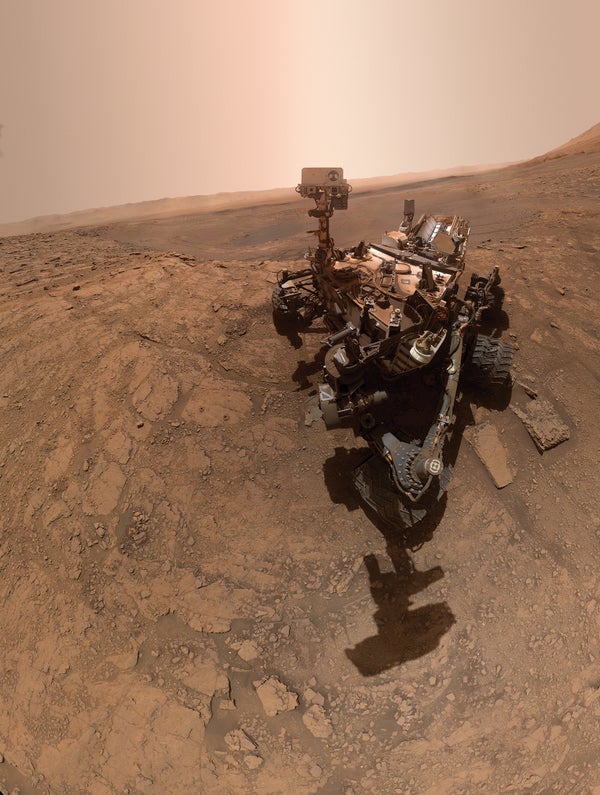
Of all the discoveries made by NASA’s Curiosity Mars rover, the most epochal has been that its landing site, Gale Crater, once held a massive and long-lasting lake. Now, however, a new study suggests this “lake” may have only been a series of smaller, transient puddles.
Curiosity landed and began exploring Gale Crater in 2012. Mere months later, at the base of 5.5-kilometer Mount Sharp in the crater’s center, the rover found layers of mudstone—suggestive of sediments that had settled in standing water—as well as flow-rippled rocks from an ancient stream. As Curiosity ascended Mount Sharp’s base, it also detected water-altered minerals strewn across the mountain. The conclusion seemed almost inescapable: About 3.7 billion years ago Gale had harbored a large reservoir for perhaps millions of years, during which it could have been a microbial haven. And Mount Sharp slowly formed below the waves from sediments swept into the lake.
A new interpretation, published in Science Advances by University of Hong Kong planetary scientists Jiacheng Liu, Joe Michalski and Mei-Fu Zhou, posits instead that Mount Sharp arose in the open air from windblown sediments and was then weathered by water: short-lived ponds formed by rainfall sent liquid trickling through the sediment. Microbes could have still thrived in those scant surface waters but only for a relatively brief time—within a few tens of thousands of years, any ponds on Mount Sharp and at its base would have vanished. These conclusions come from chemical patterns in a group of sedimentary rocks, called the Murray formation, that Curiosity sampled along its path up Mount Sharp.
On supporting science journalism
If you're enjoying this article, consider supporting our award-winning journalism by subscribing. By purchasing a subscription you are helping to ensure the future of impactful stories about the discoveries and ideas shaping our world today.
“Jiacheng took a very close look at the elemental abundances and mineral occurrences, as measured by the rover, from the base of the crater up through more than 400 meters of [exposed rock layers] visited during the first eight years of the mission,” Michalski says. The analysis revealed a gradual change as the rover climbed: Elements such as iron, which are more easily washed away by water, became scarcer at higher altitudes; less soluble elements such as aluminum became more prevalent. This pattern is broadly consistent with rainfall-driven “top-down” weathering seen in many rock formations on Earth.
“If true, this result would call into question our understanding of the origin of sedimentary-rock mountains on Mars,” says Edwin Kite, a planetary scientist at the University of Chicago, who was unaffiliated with the study. But, he adds, confirming the “ground truth” at Gale Crater requires tools Curiosity lacks, such as a very high-resolution x-ray spectrometer to better assess shifting elemental abundances. Curiosity’s sister rover, Perseverance, carries just such an instrument—but is located thousands of kilometers away, in Jezero Crater.
For now, in the absence of more conclusive data, the Curiosity team is sticking by its original interpretation, says Kirsten Siebach, a Rice University planetary scientist and member of the Curiosity and Perseverance science teams. “I’m not convinced it’s time to change our story of Gale Crater,” she says, “but as we gather new evidence we always have to be open to refining our past conclusions.”