
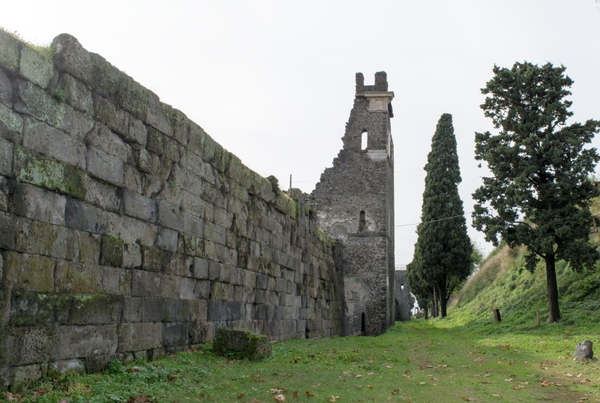
In 89 B.C.E., Pompeii was under siege. An invading army of tens of thousands of soldiers led by Lucius Cornelius Sulla, an influential commander and later dictator of Rome, stormed the town’s walls with slings and catapults. The siege, a success for Sulla, subdued the rebellious city back beneath the thumb of the Roman Republic.
Recently discovered damage on Pompeii’s fortification walls likely resulted from this fateful siege—and some of it may have come from a deeply mysterious ancient “machine gun,” researchers reported recently in Heritage.
Excavations and surveys conducted since 2024 have revealed several clusters of gouges in Pompeii’s northern fortification walls that were pristinely preserved by the eruption of Mount Vesuvius in C.E. 79. The marks, which are sandwiched between towers once used to scout for armies and to allow archers and other artillery-throwers to fend off enemy incursions, are arrayed in a way that suggests they may have been left by a repeating dart-thrower called a polybolos.
On supporting science journalism
If you're enjoying this article, consider supporting our award-winning journalism by subscribing. By purchasing a subscription you are helping to ensure the future of impactful stories about the discoveries and ideas shaping our world today.
“It was an antipersonnel weapon used to strike archers emerging from the battlements above and the postern below,” says study lead author Adriana Rossi, an engineer at the University of Campania Luigi Vanvitelli in Italy. The machine “had been described in detail but had never before been unearthed in any archaeological find or material evidence.”
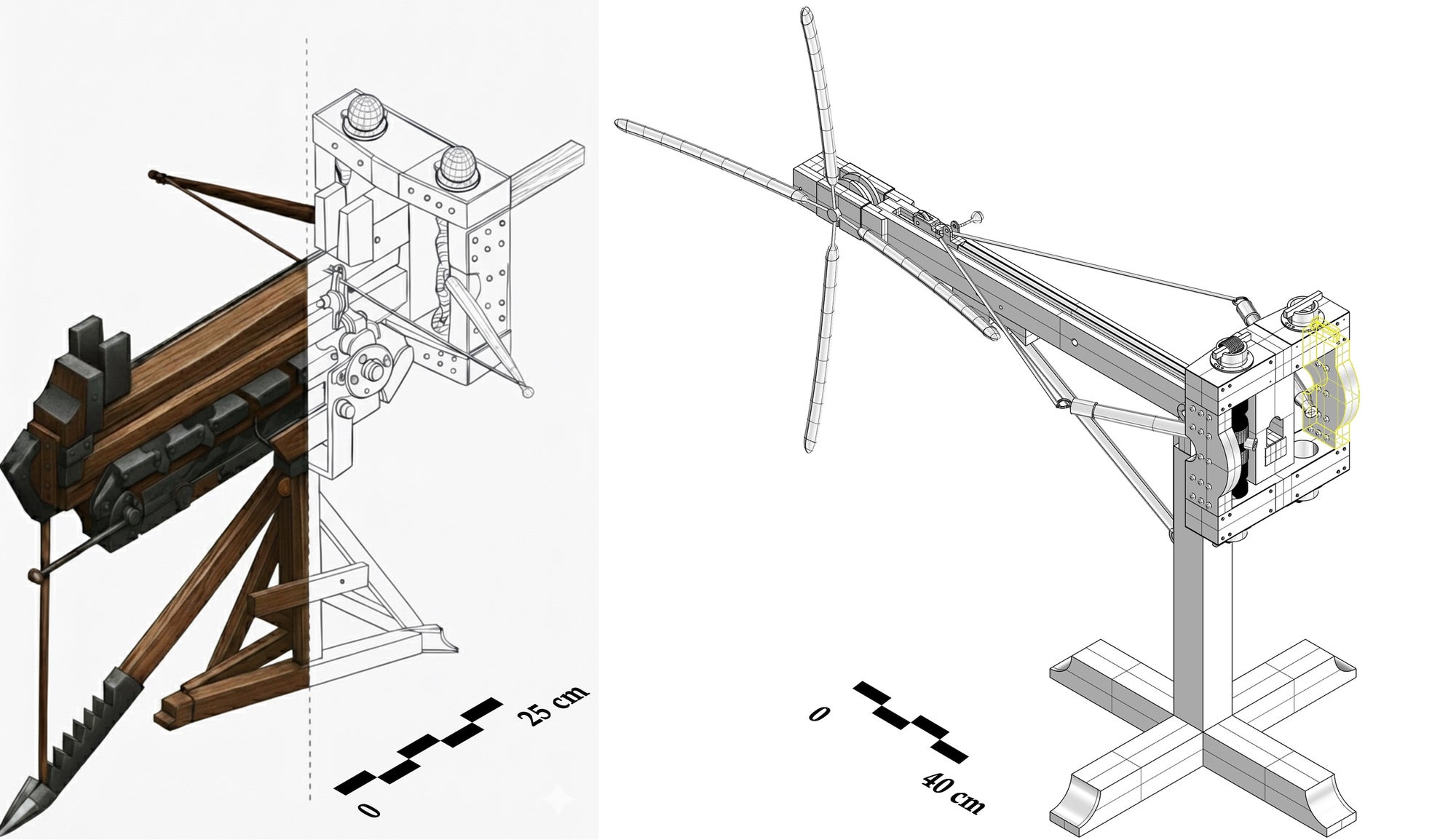
Renderings of what an ancient weapon called a polybolos might have looked like.
“From Pompeii to Rhodes, from Survey to Sources: The Use of Polybolos,” by Adriana Rossi et al., in Heritage, Vol. 9, No. 3. Published online February 28, 2026 (CC by 4.0)
Philo of Byzantium, an ancient Greek engineer, was the first to describe the machine in the third century B.C.E. in his work Belopoeica, in which he critiqued it as impractical. “It would be the kind of machine that was probably treated as either a novelty or proof of concept,” says historian Michael Taylor, a Roman Republic military expert at the University at Albany, who was not involved with the research.
Like other Roman catapults, the polybolos was equipped with a “torsion mechanism” likely made of fiber, hair or thin rope that enabled it to launch iron-tipped darts at a high velocity, Taylor says. “Basically, it looks like a giant crossbow.” But unlike your standard Roman catapult, it came equipped with “something akin to a bicycle chain” that enabled it to automatically reload. And according to Philo’s Belopoeica, it would leave a distinct “fanlike” pattern if shot at walls.
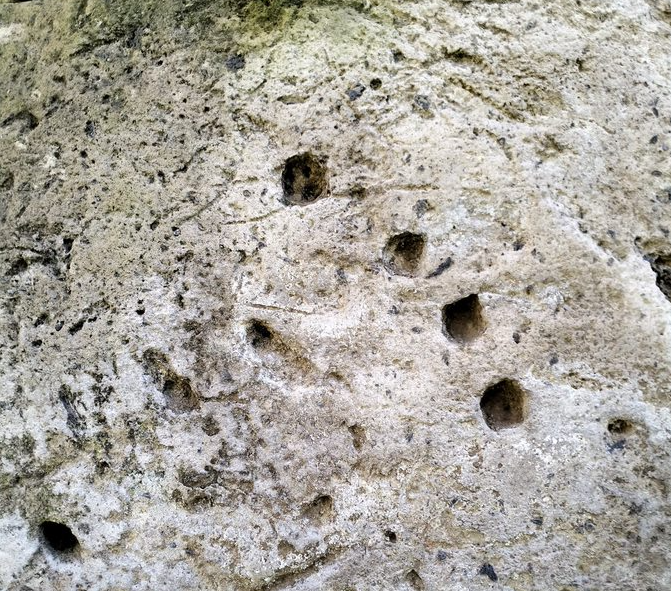
A close-up of damage to one of the fortification walls of Pompeii shows a pattern that could indicate it was created by a repeating weapon.
“From Pompeii to Rhodes, from Survey to Sources: The Use of Polybolos,” by Adriana Rossi et al., in Heritage, Vol. 9, No. 3. Published online February 28, 2026 (CC by 4.0)
Using mathematical and three-dimensional modeling, the researchers scrutinized the damage on Pompeii’s walls and ultimately found that the angles and grooves didn’t match typical sling bullets or catapult shots. The arrangement of the marks seemed to match the fanlike spray of a repeating weapon.
Taylor finds one cluster particularly compelling: it resembles “what you’ll sometimes see with a machine-gun burst.” He suspects, though, that the damage could have been caused by a regular catapult firing and adjusting its aim rather than an automatic weapon. But, he says, the study’s hypothesis is “intriguing,” and “if anyone was going to come up with a bespoke repeating catapult, it would be Sulla. He seems to have a personal interest in very specialized catapults beyond the sort of standard stuff that would have been used by the Romans.”