
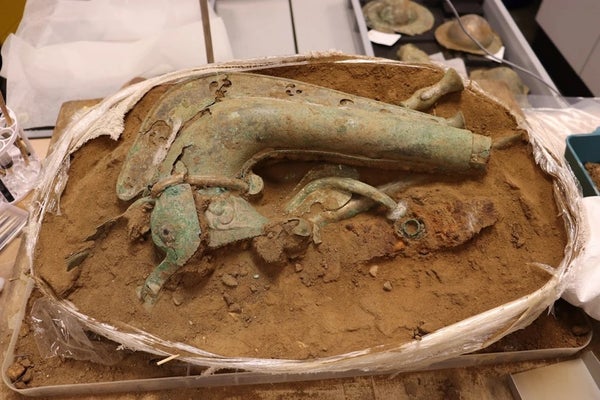
It was supposed to be a routine excavation. But archaeologists who were called in last year to inspect a site before construction began at a residential property in West Norfolk, England, made a truly remarkable discovery: an approximately 2,000-year-old battle trumpet.
The Iron Age instrument, known as a carnyx, might once have been used by Celtic tribes in their war against the encroaching Roman Empire—and perhaps even by the forces of the warrior queen Boudica.
Boudica led the Iceni tribe that once occupied parts of present-day Norfolk and is most famous for leading an ultimately unsuccessful battle against the Romans around C.E. 60 or 61. The archaeologists place the trumpet’s age at around the same time as the queen.
On supporting science journalism
If you're enjoying this article, consider supporting our award-winning journalism by subscribing. By purchasing a subscription you are helping to ensure the future of impactful stories about the discoveries and ideas shaping our world today.
The carnyx is one of only three of its kind from Britain and is “one of the most complete found in Europe,” according to a statement from Historic England. It was found alongside a collection of other metal objects, including five shield bosses and a bronze boar’s head that was likely used as a military standard.

Excavated boar standard.
© Norfolk Museums Service
“I’ve been doing archaeology for over 40 years, and I’ve never seen anything like this,” said Mark Hinman, CEO of Pre-Construct Archaeology, which originally found the objects, to the Guardian. He described the discovery as “a once-in-a-lifetime” find.
“We are absolutely within the heartland of the Iceni—whether it was they who buried the hoard or not, we just don’t know,” Hinman said. Still, the artifacts are “of such quality” that “any important people from the Iceni and other groups would have known these objects.”