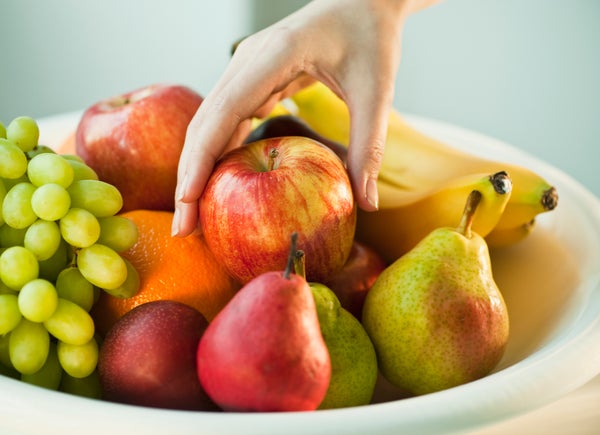
Are Some Fruits More Fattening Than Others?

It’s time to clear up some confusion about fruit, sugar, fructose and how this all fits together into a healthy diet

Join Our Community of Science Lovers!

It’s the beginning of the year and that means there’s a new crop of diet books out. You’d think we’d have learned by now that the next diet gimmick is not going to be the answer to our weighty woes. Believe me, the reason 2/3 of the population is overweight is NOT that no-one has yet written the right diet book.

But hope springs eternal, as does the January crop of New Year New You offerings. I was reviewing one of them this week and came across the claim that avoiding certain fruits can help you lose weight.


On supporting science journalism

If you're enjoying this article, consider supporting our award-winning journalism by subscribing. By purchasing a subscription you are helping to ensure the future of impactful stories about the discoveries and ideas shaping our world today.


Specifically, the author recommends staying away from fruits that are high in fructose because, he explains, fructose is converted by the liver into fat. The high-fructose fruits on this author’s hit list include bananas, pineapples, grapes, and watermelon. Good "low-fructose" fruits include citrus fruit, berries, melons, and stone fruits like peaches.

I think we need to clear up some confusion about fruit, sugar, fructose, and how this all fits together into a healthy diet. (For one thing, some of the alleged high-fructose fruits have less fructose than the so-called low-fructose fruits...but I’m getting ahead of myself.)

»Continue reading “Are Some Fruits More Fattening Than Others?” on QuickAndDirtyTips.com

It’s Time to Stand Up for Science

If you enjoyed this article, I’d like to ask for your support. Scientific American has served as an advocate for science and industry for 180 years, and right now may be the most critical moment in that two-century history.

I’ve been a Scientific American subscriber since I was 12 years old, and it helped shape the way I look at the world. SciAm always educates and delights me, and inspires a sense of awe for our vast, beautiful universe. I hope it does that for you, too.

If you subscribe to Scientific American, you help ensure that our coverage is centered on meaningful research and discovery; that we have the resources to report on the decisions that threaten labs across the U.S.; and that we support both budding and working scientists at a time when the value of science itself too often goes unrecognized.

In return, you get essential news, captivating podcasts, brilliant infographics, can't-miss newsletters, must-watch videos, challenging games, and the science world's best writing and reporting. You can even gift someone a subscription.

There has never been a more important time for us to stand up and show why science matters. I hope you’ll support us in that mission.

Thank you,

David M. Ewalt, Editor in Chief, Scientific American

Subscribe