
Earth and the rest of the solar system’s planets live inside the heliosphere, a protective bubble that is blown up by our sun’s winds. Other stars also have such bubbles, which astronomers call astrospheres.
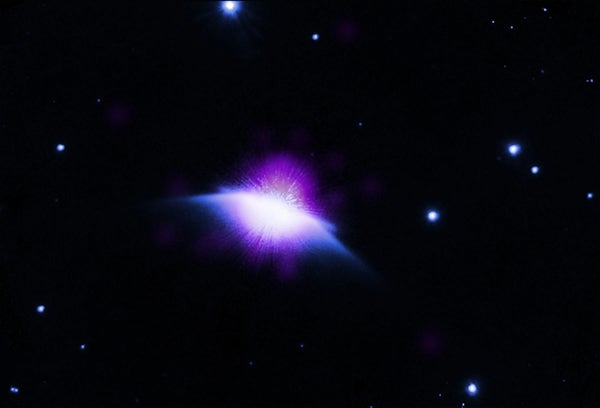
Now NASA’s Chandra X-ray Observatory has captured a very young sunlike star blowing up its bubble some 120 light-years away. Called HD 61005, this star has about the same mass and temperature of the sun but is just 100 million years old—our home star is about five billion years old.
Because HD 61005 is still in its infancy, it produces a strong solar wind, boosting its bubble. Currently, the star’s astrosphere has a diameter that’s equivalent to around 200 times the distance between Earth and the sun—not quite as large as the heliosphere.
On supporting science journalism
If you're enjoying this article, consider supporting our award-winning journalism by subscribing. By purchasing a subscription you are helping to ensure the future of impactful stories about the discoveries and ideas shaping our world today.
“We have been studying our Sun’s astrosphere for decades, but we can’t see it from the outside,” said astronomer Carey Lisse of Johns Hopkins University in a statement. “This new Chandra result about a similar star’s astrosphere teaches us about the shape of the Sun’s, and how it has changed over billions of years as the Sun evolves and moves through the galaxy.”
HD 61005 is surrounded by a lot of dense dust, which is a remnant of the star’s formation. The star produces x-rays as its stellar wind hits the cooler interstellar medium surrounding the star. The sun might have experienced a similar developmental stage in its infancy, the researchers say.
The observations were described in a paper that was posted on the preprint server arXiv.org and accepted for publication in the Astrophysical Journal.