Beyond Intelligence

Getty Images

Join Our Community of Science Lovers!

At 14 years old, I switched schools to a much larger, public institution and was required to take intelligence and reasoning tests so the guidance counselors could place me in the appropriate-level courses. I remember little about those tests—perhaps they contained spatial reasoning questions, perhaps basic logic questions. At the end, the results declared my aptitude, and I was channeled into high school life.

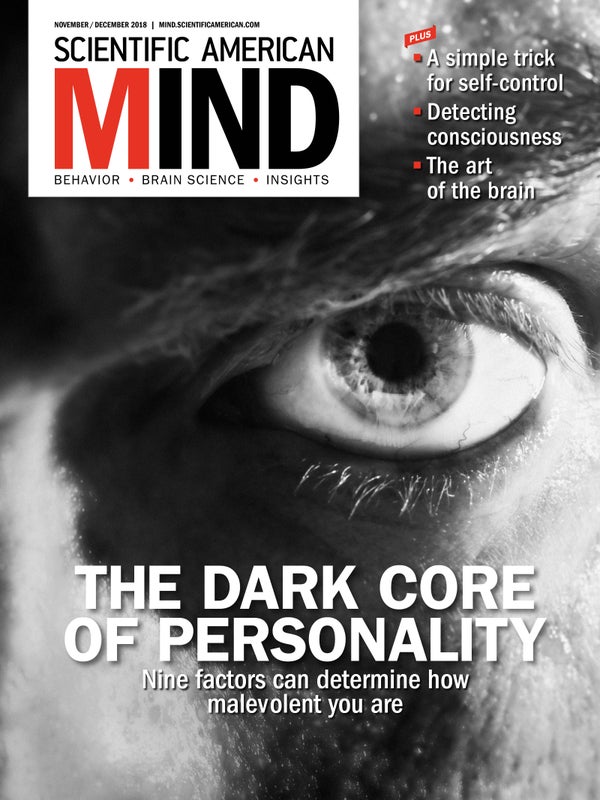
For more than a century we’ve known that under the correct conditions we can accurately determine individual cognitive ability. But in the future, might we also assess a child’s nature using newfound tests, such as the one described by Scott Barry Kaufman in “The Dark Core of Personality”? Would we provide different resources to students who scored high in the malevolence category, for example? Would we steer them away from careers in politics or medicine? For more insight, read Kaufman’s piece and take the nine-question quiz to determine how wicked you are.

Elsewhere in this issue, researchers are investigating the power of ritual to alter behavior (see “Need More Self-Control? Try a Simple Ritual”). Anouk Bercht interviews neuroscientist Steven Laureys about the latest tools for detecting consciousness in comatose patients (see “How Can We Tell If a Comatose Patient Is Conscious?”). And in one of my favorite features of the year, we present the colorful winners of the Art of Neuroscience competition, an annual contest directed by the Netherlands Institute for Neuroscience (see “Prize-Winning Images of the Brain”). Human behavior can indeed be smart, ugly, altruistic or mean, but all brains have their beauty.


On supporting science journalism

If you're enjoying this article, consider supporting our award-winning journalism by subscribing. By purchasing a subscription you are helping to ensure the future of impactful stories about the discoveries and ideas shaping our world today.


As always, we love to hear from you!

Andrea Gawrylewski is chief newsletter editor at Scientific American. She writes the daily Today in Science newsletter and oversees all other newsletters at the magazine. In addition, she manages all special editions and in the past was the editor for Scientific American Mind, Scientific American Space & Physics and Scientific American Health & Medicine. Gawrylewski got her start in journalism at the Scientist magazine, where she was a features writer and editor for "hot" research papers in the life sciences. She spent more than six years in educational publishing, editing books for higher education in biology, environmental science and nutrition. She holds a master's degree in earth science and a master's degree in journalism, both from Columbia University, home of the Pulitzer Prize.

More by Andrea Gawrylewski
SA Mind Vol 29 Issue 6This article was published with the title “Beyond Intelligence” in SA Mind Vol. 29 No. 6 ()
doi:10.1038/scientificamerican112018-12J6YLXuJpxMyXOelpk9qa

It’s Time to Stand Up for Science

If you enjoyed this article, I’d like to ask for your support. Scientific American has served as an advocate for science and industry for 180 years, and right now may be the most critical moment in that two-century history.

I’ve been a Scientific American subscriber since I was 12 years old, and it helped shape the way I look at the world. SciAm always educates and delights me, and inspires a sense of awe for our vast, beautiful universe. I hope it does that for you, too.

If you subscribe to Scientific American, you help ensure that our coverage is centered on meaningful research and discovery; that we have the resources to report on the decisions that threaten labs across the U.S.; and that we support both budding and working scientists at a time when the value of science itself too often goes unrecognized.

In return, you get essential news, captivating podcasts, brilliant infographics, can't-miss newsletters, must-watch videos, challenging games, and the science world's best writing and reporting. You can even gift someone a subscription.

There has never been a more important time for us to stand up and show why science matters. I hope you’ll support us in that mission.

Thank you,

David M. Ewalt, Editor in Chief, Scientific American

Subscribe