
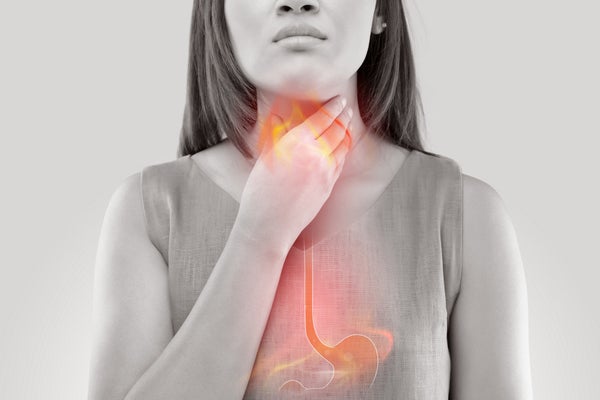

Lisa writes: “I recently came across a diet that’s supposed to help with acid reflux. In this diet, you cut way back on carbohydrates and replace those calories with fat. The theory is that your body sometimes cannot absorb certain carbs, so they sit in your gut and ferment, thereby causing gas to bubble up into the stomach and esophagus. If you cut back on these fermentable carbs, your acid reflux will go away.”
The diet that Lisa is asking about is essentially a branded variation of the low FODMAP diet I’ve talked about before. In the low FODMAP diet, you reduce your intake of foods that are high in certain fermentable carbohydrates. It is true that humans lack the enzymes needed to digest certain carbohydrates. That doesn’t cause them to “sit in your gut.” They travel through the stomach (which is far too acidic to allow any fermentation to take place), enter the small intestine (where most carbohydrate digestion and absorption takes place), and then on into the large intestine.
On supporting science journalism
If you're enjoying this article, consider supporting our award-winning journalism by subscribing. By purchasing a subscription you are helping to ensure the future of impactful stories about the discoveries and ideas shaping our world today.
There, if you’re lucky, the beneficial bacteria in your gut will digest them by fermenting them. I say “if you’re lucky” because this bacterial processing of indigestible fibers produces several beneficial compounds, which I talked about in my recent episode on Postbiotics. The fermentation of fiber also produces gas. Lots and lots of gas.
People vary in their ability to tolerate these fermentable carbs. Many people with IBS get great relief from a low-FODMAP diet and the latest research suggests that this is a very effective therapy for disorders that involve the large intestine.
Reflux, on the other hand, happens at the other end of the digestive tract. There’s about 20 feet of small intestine between the large intestine, where the bacteria do their work, and the esophagus, where reflux symptoms are generally experienced. It’s a little hard to imagine those gas bubbles working their way six meters upstream to your esophagus, especially when there is a much shorter path to the outside world, if you follow my meaning.
But what if a bunch of those carbohydrate-digesting, gas-producing bacteria were hanging out in the small intestine, instead of in the large intestine where they belong? That would potentially put those gas producers in closer proximity to the stomach. And this does happen. It’s known as SIBO (Small Intestine Bacterial Overgrowth) and may affect up to 15% of the population.
»Continue reading “Can a Low-Carb Diet Cure Reflux?” on QuickAndDirtyTips.com