
The traditional astrophysical recipe for life as we know it is quite simple: Get a rocky, gas-shrouded world in a “habitable zone” orbit around a star so that it’s not too hot or too cold. Then just add liquid water to its surface and let the primordial soup simmer for millions of years as energy from starlight gradually cooks up the chemical building blocks of life.
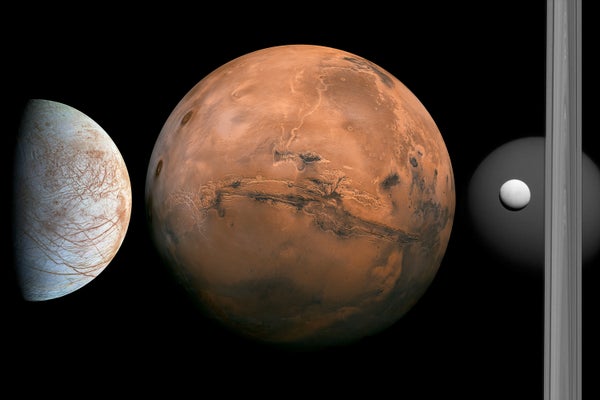
But astrophysicists have come to realize this classical habitable zone scenario may overlook opportunities for life farther out from a star. After all, Saturn’s moon Enceladus, Jupiter’s moon Europa and even Mars are known or believed to harbor vast amounts of water in their dark interior. Life on these worlds would have to lurk underground for reasons other than thirst alone because their surface is scarcely shielded by an atmosphere and constantly bombarded with lethal cosmic rays.
A recent study, however, supports the idea that, in such places, cosmic rays can actually benefit life belowground rather than just banishing it from the surface. Led by Dimitra Atri, a researcher at New York University Abu Dhabi, the study team has introduced the concept of a “radiolytic habitable zone,” a region within a world where the energy unleashed by cosmic rays is enough to sustain life. Published in the International Journal of Astrobiology, the study provides a new framework for calculating how much living matter could be supported at various depths inside Mars, Europa, Enceladus and similar places well outside the standard, starlight-based habitable zone.
On supporting science journalism
If you're enjoying this article, consider supporting our award-winning journalism by subscribing. By purchasing a subscription you are helping to ensure the future of impactful stories about the discoveries and ideas shaping our world today.
Cosmic rays are high-energy particles that move at nearly the speed of light and are typically produced by supernovae and other extreme astrophysical events. They carry so much energy, in fact, that they can break off electrons from, or ionize, atoms and molecules in their path—which damages DNA and other delicate cellular machinery. Earth’s substantial atmosphere and geomagnetic field block most (but not all) of this bombardment, and the sunless interiors of worlds without these properties still get protection from overlying material.
Atri and his colleagues wondered, however, whether the ionizing effects of cosmic rays could confer additional benefits to those alien environments. In a series of computer simulations, they found that cosmic rays that reach the depths of such places can break apart water molecules that may exist there as liquid or ice. This process, called radiolysis, releases electrons that can then power an organism’s biochemistry—that is, its metabolism. “Galactic cosmic rays are basically cooking food for these microbes,” Atri says.
The effect isn’t entirely theoretical: Atri and his co-authors cite the real-world example of the bacterium Candidatus Desulforudis audaxviator, which was found in a gold mine deep below South Africa and powers its metabolism using electrons released by ionizing radiation from surrounding rocks. This process, Atri notes, is decidedly different from that used by another bacterium, Deinococcus radiodurans, which can endure extreme levels of ionizing radiation. “D. radiodurans is all about damage control. It lets radiation tear up its DNA, then fixes everything afterward. But the gold-mine bug actually feeds off radiation by-products.... That’s the kind of thing that could actually exist on Mars right now,” Atri says. “It’s really two different survival strategies. One repairs the damage; the other turns the damage into dinner.”
It’s likely that Desulforudis audaxviator is far from the only bacterium on Earth that is reliant on ionizing radiation, according to Lígia F. Coelho, an astrobiologist at Cornell University, who was not involved with the study. “We still don’t know much about the subsurface of our own planet in terms of microorganisms,” she says. “There is certainly a universe of microorganisms that are tailored to use these secondary energy sources that we still don’t know about—because we also don’t yet have the technology to detect or to study them very well.”
As a next step, Atri and his colleagues plan to move past computer models by testing their theory in the lab using a planetary simulation chamber that can emulate environmental conditions on alien worlds by changing the temperature, pressure and composition of its contents. If those results are positive, they could help shape current investigations and future missions seeking signs of life in the innards of Mars, Europa and Enceladus. Our existing Mars exploration has “just been scratching the surface—literally,” Atri says, adding that our knowledge of Europa and Enceladus is even more superficial. “We need a mission which can actually go there and dig a little bit deeper.”
According to Atri’s calculations, the best place for microbes to live on Mars would be between one and two meters below the surface. That depth is fortuitously within reach of the European Space Agency’s Rosalind Franklin ExoMars rover, which is set to launch to the Red Planet no earlier than 2028 and will carry a drill that can penetrate up to two meters below the planet’s surface.
“It’s important not to be biased by what we believe is good or bad for life based on our own experience in our own planet,” Coelho says. “I think papers like this really help the modelers in unbiasing their models and opening the possibilities for other kinds of life and other kinds of context.”