
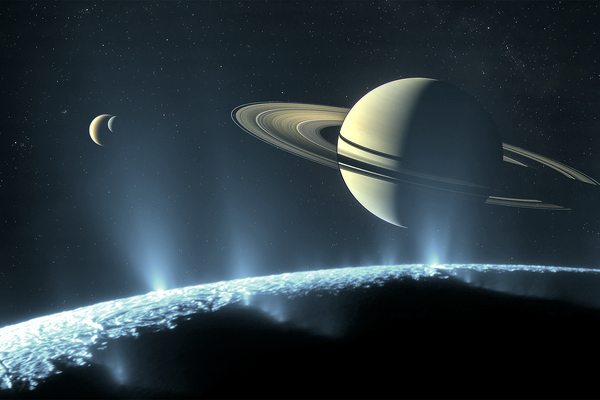
Saturn’s ocean-covered moon Enceladus constantly spews water into space through fractures in its icy crust. The spacecraft Cassini determined the composition of these jets in the mid-2000s and found molecules that included carbon dioxide and ammonia, both crucial for life on Earth. And now, in a study published on Thursday in Nature Astronomy, scientists have reanalyzed the Cassini samples and revealed Enceladus’s great chemical diversity—making this small icy moon the top candidate for finding alien life in our own solar system.
The study’s lead author, Harvard University biophysicist Jonah Peter, was intrigued by previous findings that Enceladus was likely rich in organic compounds, most of which had not been identified. To figure out the moon’s true chemical makeup, Peter and his colleagues at NASA’s Jet Propulsion Laboratory reexamined data collected in 2011 and 2012 by the agency’s Cassini-Huygens mission, which flew a spacecraft through Enceladus’s spectacular water plumes multiple times. Cassini’s samples, analyzed by the spacecraft’s onboard mass spectrometer (an instrument that identifies compounds by their molecular weight), had initially revealed five types of molecules in the jets: water, carbon dioxide, methane, ammonia and molecular hydrogen.
For the new analysis, Peter and his colleagues took Cassini’s data even further: they used a statistical analysis technique to compare the jet samples’ molecular signatures with those of billions of potential combinations of known compounds. This allowed them to determine the plume’s most likely components.
On supporting science journalism
If you're enjoying this article, consider supporting our award-winning journalism by subscribing. By purchasing a subscription you are helping to ensure the future of impactful stories about the discoveries and ideas shaping our world today.
“Searching for compounds in the plume is a bit like putting the pieces of a puzzle back together,” Peter says. “We look for the right combination of molecules that reproduce the observed data.”
The team concluded that the icy jets included the five already identified molecules—but also some bigger, heavier compounds, including hydrocarbons such as hydrogen cyanide and ethane, as well as traces of partially oxidized compounds such as methanol.
The new results relied on a “smart and robust” statistical method to reveal these larger molecules, says Michel Blanc, a planetary scientist at the Research Institute in Astrophysics and Planetology in Toulouse, France, who worked on the Cassini mission. These compounds didn’t show up in the initial Cassini analysis because the onboard instruments weren’t equipped to identify them, he says. “Nobody in the Cassini-Huygens team had imagined that the small moons of Saturn could be chemically active and generate heavy molecules: that was, without doubt, the greatest surprise and likely the most important discovery of Cassini,” Blanc adds.
Together with previously detected components such as water and ammonia, these newly discovered molecules could serve as building blocks and fuel for microbes, and they could potentially support an independent origin of life. Since the discovery of Enceladus’s oceans, this moon has been a “prime target” in the search for the fundamental building blocks of life, Peter says.
Peter was especially excited to detect the presence of hydrogen cyanide, or HCN, because it is “one of the most important and versatile building blocks of life,” he says. When combined with other molecules, HCN can help form nucleobases and amino acids, the precursors to more complex biochemistry such as proteins and RNA. Lab simulations have shown that these transformations are possible in environments that are similar to Enceladus’s ice shell, Peter notes. “Many molecules important for the origin of life could have formed at Enceladus and could still be forming at Enceladus today,” he says.
The plumes’ diverse chemical composition points to high potential for oxidation-reduction, or “redox,” reactions, which are often regarded as a key element in the synthesis of the building blocks of life—and in the biochemical processes that allow living organisms to breathe oxygen and photosynthesize.
The Cassini samples have now revealed the presence of both oxidized and reduced compounds in Enceladus’s plumes. This is a “very exciting” result, says Kate Craft, a planetary scientist at the Johns Hopkins University Applied Physics Laboratory, who was not involved in the new study. These molecules could mix together, potentially through hydrothermal activity on the moon’s seafloor, and could theoretically create “a habitable environment where life can be supported or might originate,” Craft adds.
Scientists have no evidence to indicate such a process has actually occurred. In fact, it’s not clear if or where these oxidized and reduced compounds might be meeting. And Craft points out that researchers still don’t know exactly how the erupting water makes its way through the moon’s ice shell.
Still, the findings may inform ongoing and planned missions to ocean worlds that are similar to Enceladus—including Jupiter’s watery moon Europa, which likely has many of the same properties, Craft says. These questions will be further explored by the European Space Agency’s Jupiter Icy Moons Explorer (Juice) spacecraft, which is currently on its way to the Jupiter system.
The new findings also build a strong case for revisiting Enceladus in future space missions, Blanc says. Now that researchers know of the moon’s stunning molecular diversity, they could use a mass spectrometer that is capable of studying bigger molecules to examine its complex chemical environment—and perhaps reveal the true habitability of this explosive moon.