
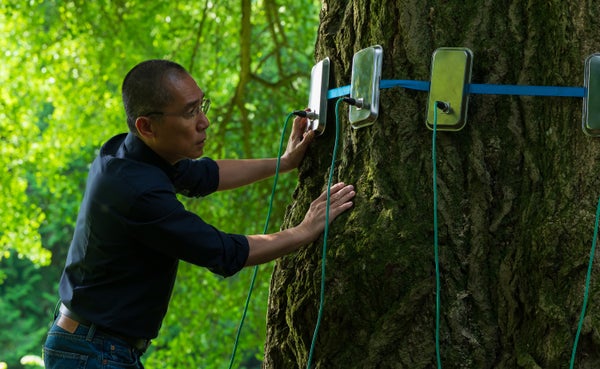
Does a ginkgo tree have an inner world? In the film Silent Friend, the protagonist, a neurologist who studies brain activity in infants, attempts to quantify the internal signaling of a ginkgo tree on a university campus. By the end of the movie, he’s using computer-generated visualizations to look at how the tree responds to its environment—not exactly becoming its “friend” but getting a touch closer to understanding the tree’s experience of its surroundings. The film isn’t based on a real study—if plants do have anything like consciousness, scientists have yet to formally describe it—but it’s an imaginative exploration of how consciousness might manifest in different forms of life.
Ildikó Enyedi—Silent Friend’s writer and director and a self-described amateur science enthusiast—says that the film was largely inspired by real research that has shown that consciousness isn’t solely a human phenomenon. Coming closer to the internal worlds of plants, Enyedi says, “helps us to move out from this instinctive position that our perception is the default.”
Researchers tend to define consciousness loosely as the ability to experience—the subjective, ineffable feeling of being alive. This involves some combination of being awake and aware, having internal awareness (such as mental imagery and inner thoughts), and being connected to the world with an ability to perceive stimuli.
On supporting science journalism
If you're enjoying this article, consider supporting our award-winning journalism by subscribing. By purchasing a subscription you are helping to ensure the future of impactful stories about the discoveries and ideas shaping our world today.
Many cultures around the world have long thought of nonhuman animals as having something like consciousness; some even presume plants have it, too. But in the Western scientific tradition, starting with philosopher René Descartes, the idea of nonhuman consciousness has been questioned—and frequently dismissed.
When the New Age movement started to take hold internationally in the 1970s, some scientists tried to test whether plants really could “think.” Documented and popularized by the 1973 book The Secret Life of Plants, this research came to some far-fetched conclusions, purporting to show that plants “enjoy” classical music and can “read your mind.” Many of the studies referred to in the book weren’t reproducible, though, and scientists rejected them for their lack of rigor. Some claim the studies severely damaged the credibility of future investigations of how plants sense and react to their environments. Still, Enyedi says that this wave of research, which occurred when she was a teenager in the 1970s, got her interested in different definitions of consciousness that could apply outside of the animal kingdom.

A still from Silent Friend.
Courtesy of 1-2 Special
The start of the 21st century saw a shift in consciousness research, when scientists began using the tools of neuroscience to try to understand consciousness. Techniques such as electroencephalography (EEG), which relies on electrical signals, and functional magnetic resonance imaging (fMRI), which utilizes blood flow, were employed to measure how the brain responds to its environment. With this data, scientists can draw inferences about consciousness.
Today researchers understand that plants, animals, human adults and young children have different perceptive worlds. Maybe plants don’t hear or see like humans do, but studies show that they can respond to sounds and mimic shapes and colors. Plants can even “communicate” with one another using underground fungi networks, according to recent research; these hidden networks convey nutrients from one plant to another and transfer messages that initiate chemical defense responses against pests. Other tantalizing clues—such as early evidence that plants can “pay attention” to stimuli via the synchronization of internal electric signals, causing them to activate resilience during a drought or identify potential hosts, among other responses—are pushing scientists to continue investigating how plants experience the world.
Anil Seth is a neuroscientist at the University of Sussex in England whose work focuses on the cognitive processes of consciousness.* He says that just because plenty of creatures can’t, for instance, speak or recognize themselves in a mirror, that doesn’t mean scientists should assume they’re not conscious in their own way.
“We're trying to get indicators [of consciousness] that are meaningful for the populations we might apply them to,” Seth says. Brain activity, speech or movement are indicators of consciousness in humans. But “different indicators might be more meaningful for nonhuman animals, plants, AI systems, synthetic biology systems like organoids, and so on.”
Silent Friend attempts to link the mysteries of human and plant sensory worlds using the trappings of science but with an added creative component. While the film embraces artistic embellishments of the science, Seth, with whom Enyedi consulted during the early creative phases of the film, feels it’s an example of how the arts can push the consciousness conversation in new directions.
The fundamental challenge of studying consciousness remains: it’s hard to tell what consciousness is when you can only experience your own version of it. Scientists, in their quest to gather reliable data, have had to boil down consciousness to only factors that can be measured through experiments. “The data about experiences are necessarily indirect,” Seth says. “Part of the reason why film and books are so good [is] because they can do more to flesh out the nature of experiences, in some ways.”
*Editor’s Note (5/21/26): This sentence was edited after posting to correct Anil Seth’s field of study.