
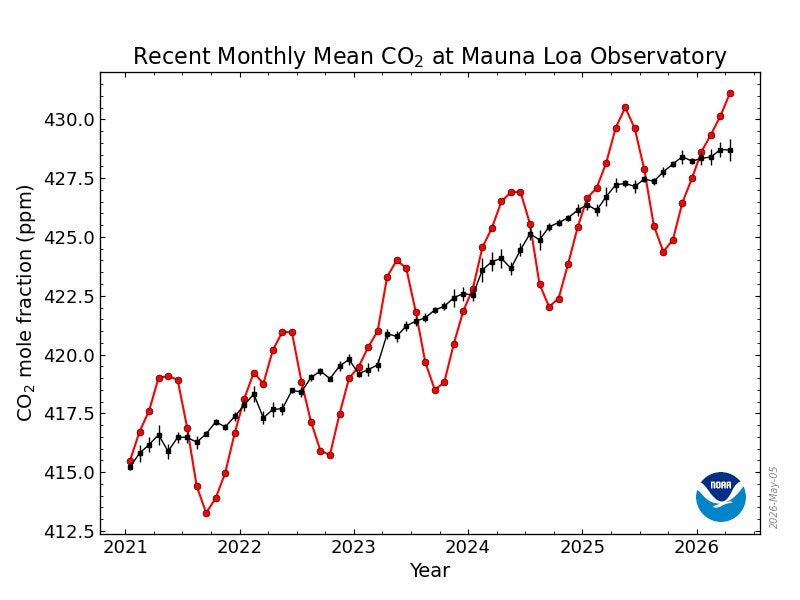
The amount of carbon dioxide detected in the atmosphere hit a record high in April. CO2 levels averaged about 431 parts per million (ppm) over that month, according to data collected at the National Oceanic and Atmospheric Administration’s Mauna Loa Observatory in Hawaii.
Greenhouse gases, such as carbon dioxide, are measured as a proportion of the total atmosphere. The numbers are presented as the number of molecules of a particular gas out of a million total molecules, or ppm.
Climate scientist Zachary Labe of Climate Central, a nonprofit that researches climate change, says the new record is “depressing” but not unexpected.
On supporting science journalism
If you're enjoying this article, consider supporting our award-winning journalism by subscribing. By purchasing a subscription you are helping to ensure the future of impactful stories about the discoveries and ideas shaping our world today.
“It’s just another sign that carbon dioxide continues to increase in our atmosphere as our planet continues to warm,” he says. “For many climate scientists, this is just ‘here it is again, another record in the wrong direction.’”
Labe explains that the amount of CO2 in the atmosphere tends to peak in April each year as decaying plants release greenhouse gases after winter. Some of that CO2 gets reabsorbed by plants as they grow during the warmer months. But NOAA’s data show a worrying trend, with the average monthly amount of CO2 steadily increasing.
NOAA
The Mauna Loa Observatory has been directly observing atmospheric CO2 and keeping record of its levels for the longest out of any other U.S. facility. Mauna Loa first began keeping track of the gas’s presence in the atmosphere in 1958. That year the April level of CO2 was under 320 ppm.
The record comes as the observatory faces the risk of having its funding cut. A budget proposal on NOAA’s website for the 2027 fiscal year, which begins in October 2026, proposes cutting funding to numerous climate monitoring facilities, including Mauna Loa.
Other methods can trace carbon levels in the atmosphere further back in history. For example, climatologists can analyze small bubbles of gas trapped in ice cores to study the Earth’s atmosphere hundreds of thousands of years ago. On its website, NOAA cites analyses that show that, in pre-industrial-revolution times, atmospheric CO2 was at 280 ppm or less. Even during interglacial periods, when Earth trended toward warmer temperatures and higher CO2 levels, the amount of the gas in the atmosphere seemed to have topped out at around 300 ppm.
Although the amount of CO2 in the atmosphere has continued to rise, there was a reduction in U.S. emissions in 2023 and 2024. That trend, however, was reversed in 2025, at least partially because of the increased electricity demand from artificial intelligence data centers.
Still, Labe says there are reasons for optimism as the use of renewable energy sources such as solar and wind expands.