
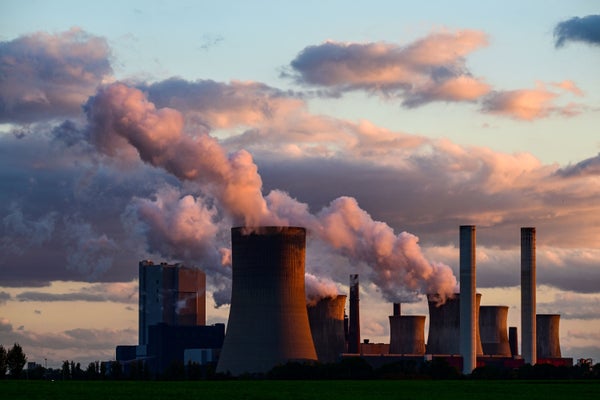
Global carbon dioxide emissions from fossil fuels are projected to increase 1% in 2022, hitting a new record of 37.5 billion tonnes, scientists announced today at the United Nations Climate Change Conference of the Parties (COP27) in Sharm El-Sheikh, Egypt. If the trend continues, humanity could pump enough CO2 into the atmosphere to warm Earth to 1.5 °C above pre-industrial temperatures in just nine years. The 2015 Paris climate agreement set this aspirational limit, seeking to avoid the most serious consequences for the planet.
“Nine years is not very long,” says Corinne Le Quéré, a climate scientist at the University of East Anglia in Norwich, UK, and a member of the Global Carbon Project, which conducted the analysis. There is clearly no sign of the kind of decrease that is needed to meet international goals, she says, and even with aggressive action, climate models suggest the world is likely to at least temporarily cross the 1.5 °C threshold sometime in the 2030s.

Credit: Nature
On supporting science journalism
If you're enjoying this article, consider supporting our award-winning journalism by subscribing. By purchasing a subscription you are helping to ensure the future of impactful stories about the discoveries and ideas shaping our world today.
The emissions increase comes as the world grapples with an energy crisis spurred by the war in Ukraine, while also continuing to recover from the COVID-19 pandemic. One contributing factor, scientists say, is a spike in coal consumption, driven in part by European efforts to make up for the loss of natural-gas shipments from Russia. Oil consumption has also increased owing to renewed air travel as governments lift restrictions. Although substantially lower than the 3% annual increases in total fossil CO2 emissions experienced during the early 2000s, this year’s projected 1% increase is more than double the average growth rate of the past decade.
The fastest emissions growth comes from India, where rising coal and oil consumption are driving an estimated 6% increase compared with 2021 (see ‘Emissions update’). Notably, emissions from China — the world’s largest emitter — are projected to fall by nearly 1%; the country’s coal use is projected to remain flat this year owing to strict COVID-19 lockdowns that have curtailed economic growth. Overall, though, scientists estimate that emissions from coal burning will increase by around 1% and could set a new record, driven mostly by a renewed reliance on coal-fired power plants in India and Europe.
A call for accelerated action
Although alarming, the latest numbers come as little surprise at COP27, says Richard Newell, who leads Resources for the Future, an environmental think tank based in Washington DC. The world still relies on fossil fuels for around 80% of its energy, Newell says, and “simple arithmetic shows you, if you have a growing economy and an economy dependent on fossil fuels, your emissions are going to grow”.
Nonetheless, early signs of the clean-energy transition are emerging. In particular, the power sector is becoming cleaner in many countries, partly because of an expansion in increasingly affordable wind and solar resources, as well as a shift from coal — the dirtiest of the fossil fuels — to natural gas. The rise of emissions from coal in Europe this year is likely to be “a short-term blip”, Newell says. “Over the long-term, the energy crisis has accelerated the transition toward clean energy.”
The Global Carbon Project’s analysis suggests that meeting the goals laid out in the Paris agreement would require a drop in carbon emissions of around 1.4 billion tonnes per year, or nearly 4% annually, with emissions zeroing out around mid-century. That is similar to the emissions reductions witnessed in 2020, when governments around the world locked down in the face of the COVID-19 pandemic, Le Quéré says. “This highlights the scale of the concerted actions that are needed to tackle climate change.”
But with the energy system becoming cleaner each year, there are paths forward, says Glen Peters, a climate-policy researcher at the Center for International Climate Research in Oslo who is part of the Global Carbon Project. Climate policies being implemented by governments are working to some degree, Peters says, “but this really needs to accelerate much more rapidly”.
This article is reproduced with permission and was first published on November 11 2022.