
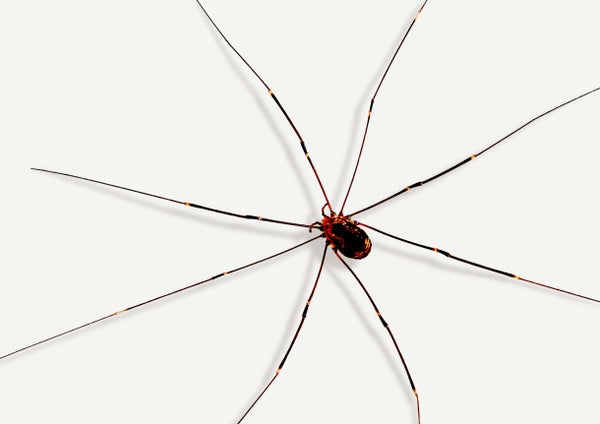
The modern-day homes of cave-dwelling arachnids called harvestmen trace the long-gone southern limits of glaciers at the peak of the last major ice age, about 22,000 years ago, recent research suggests. “We can now potentially look at the distribution of this species just to reconstruct this glacial maximum,” says Stefano Mammola, an ecologist at the Italian National Research Council's Water Research Institute. Mammola is lead author on the new work, published last August in the Journal of Zoological Systematics and Evolutionary Research.
Harvestmen, sometimes called daddy longlegs, are often mistaken for spiders. Some large-pincer harvestman species live in cold, humid caves in the Pyrenees, the Alps and the Balkan Peninsula, forming a narrow band across Europe. Mammola and his collaborators compared this range with geologists' models of glacier cover during the last ice age and found the band almost exactly matched the maximum southern edges of the glaciers, with only slight variations.

Source: “Tracking the Ice: Subterranean Harvestmen Distribution Matches Ancient Glacier Margins,” by Stefano Mammola et al., in Journal of Zoological Systematics and Evolutionary Research, Vol. 57; January 17, 2019. Credit: Mapping Specialists
On supporting science journalism
If you're enjoying this article, consider supporting our award-winning journalism by subscribing. By purchasing a subscription you are helping to ensure the future of impactful stories about the discoveries and ideas shaping our world today.
Mammola says the creatures would likely not have survived if ice had covered their caves, but they also probably could not have withstood the warmer temperatures farther from the glaciers' edge. (The cave temperatures have since warmed, but Mammola says this happened slowly enough for the arachnids to adapt.) “There was a balance between cool conditions and a cave that wasn't totally covered,” he notes. “What you see now is just the shadow of a larger ancestral distribution.”
Mercedes Burns, a biologist at the University of Maryland, Baltimore County, who studies harvestmen but was not involved in the study, says it makes sense the arachnids' range still matches that ancient outline. “Their idea of using presence of these species to track long-term changes in geography is a good one,” Burns says. “These species are indicators of geographic change since they don't move much over a lifetime or over a generation.” She adds that researchers have shown some plant species to similarly reflect ancient geography.
Mapping the distribution of cave species such as harvestmen or other arthropods, Mammola says, could act as additional evidence for researchers investigating past climate conditions.