
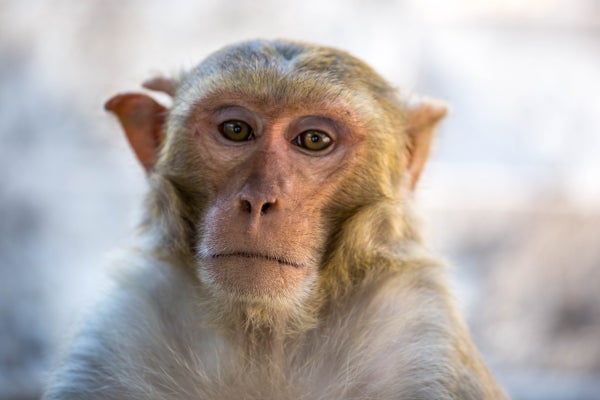
The U.S. Centers for Disease Control and Prevention has instructed staffers to end all monkey research, according to a report in Science. The decision will affect studies involving some 200 macaques; the fate of the animals is unknown.
The affected monkeys, housed at the CDC’s headquarters in Atlanta, were used in studies of infectious diseases, including HIV and hepatitis. The CDC reportedly plans to end its research involving the animals by the end of the year.
“It’s very concerning,” says JoAnne Flynn, a distinguished professor and chair of the department of microbiology and molecular genetics at the University of Pittsburgh, who has developed nonhuman primate models of tuberculosis.
On supporting science journalism
If you're enjoying this article, consider supporting our award-winning journalism by subscribing. By purchasing a subscription you are helping to ensure the future of impactful stories about the discoveries and ideas shaping our world today.
“In infectious disease, things really need to be tested in a system that’s very similar to humans,” she says, stressing that primates are only used as animal models in research when other models, such as mice or cell cultures, aren’t effective.
The CDC’s decision comes as other federal agencies have moved to reduce reliance on animal research since President Donald Trump returned to power in January. Instead of using nonhuman primate models or other animals, the agencies aim to invest more in new chip-based and cellular models.
“CDC is committed to the highest standards of ethical and humane care and to minimizing the use of laboratory animals in accordance with the principles of animal welfare in scientific research known as ‘replacement, reduction and refinement,’” a CDC spokesperson told Scientific American. “As a part of long-standing agency practice and in alignment with the administration’s priorities, CDC regularly evaluates its research project portfolio, including nonhuman primate studies, and strives to use nonanimal research methods whenever feasible while ensuring the integrity of research that protects public health and safety.”
According to Science, the CDC’s current deputy chief of staff alerted employees to the decision to end primate research at the agency. And that order reportedly came from Secretary of Health and Human Services Robert F. Kennedy, Jr., who has made curbing animal research a part of his Make America Healthy Again agenda.
“I’m concerned that the research being done at the CDC will just be completely halted, even if the animals are in the middle of a study. That means we lost a lot of research knowledge,” Flynn says.
Even so, another primate researcher points out that “the studies at the CDC represent only a very small proportion of ongoing research studies in the U.S. at [National Institutes of Health–funded] research centers and universities,” says Nancy L. Haigwood, a professor and former director of the Oregon National Primate Research Center at Oregon Health & Science University. “These other studies will continue because they have been peer-reviewed to justify the experiments, meaning that the experiment can only be performed in nonhuman primates and not in the lab or other models.”