
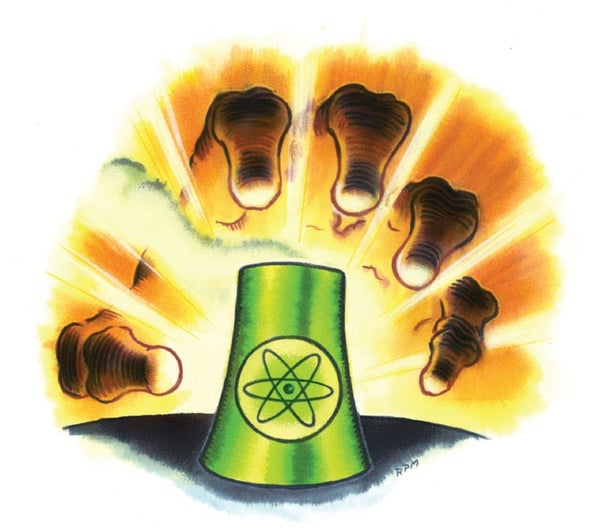
Thirty years ago, at 1:24 A.M. on April 26, 1986, explosions blew the lid and roof off the Chernobyl Unit 4 nuclear reactor in Ukraine, in the former Soviet Union, blasting radioactive material into the atmosphere. The outflow, driven by a raging fire within the reactor core, blew in all directions during the following week. Ultimately an area of 3,110 square kilometers was contaminated with cesium 137, to a level requiring evacuation.
Superficially, it is reasonable to leap to the conclusion that fear generated by the Chernobyl disaster turned the public against nuclear power—so strongly that even now, three decades later, there is serious doubt that it will ever be a major alternative to climate-threatening fossil fuels. In the 15 years before the Chernobyl accident, an average of about 20 new nuclear power reactors came online each year. Five years after the accident, the average had dropped to four a year.
But the full story is more complex. The effects of Chernobyl on people, though significant, were not devastating. Beyond the evacuation area, it is estimated that the radiation will cause tens of thousands cases of cancer across Europe over 80 years. That may sound like a large number, but it is a mostly undetectable addition to the background cancer rate. One exception is thyroid cancer, caused by the ingestion of radioactive iodides: there have been visible epidemics—only 1 to 2 percent fatal, fortunately—in the most affected regions of Belarus, Russia and Ukraine.
On supporting science journalism
If you're enjoying this article, consider supporting our award-winning journalism by subscribing. By purchasing a subscription you are helping to ensure the future of impactful stories about the discoveries and ideas shaping our world today.
Despite the projected cancer deaths from Chernobyl and the 2011 Fukushima Daiichi disaster in Japan, however, nuclear power still appears safer than coal, measured in terms of average deaths per unit of electric energy generated. According to a 2010 study by the National Research Council, if the U.S.'s then 104 nuclear reactors had been replaced in 2005 with coal plants, the increased air pollution would have caused thousands of additional premature deaths annually.
People also tend to worry more, however, about the long-term impact of radiation than they do about the effects of air pollution. A survey of the psychological well-being of Ukraine's population 20 years after Chernobyl found that an extra radiation dose equivalent to one year's natural background exposure was correlated with reduced life satisfaction, an increase in diagnosed mental disorders and a reduction in subjective life expectancy.
Such worries contributed to the drop in new plant construction post-Chernobyl, but there were other reasons. One was that the growth of electric power consumption in developed countries slowed dramatically at around the same time because the price of electricity stopped falling. In 1974 the U.S. Atomic Energy Commission was projecting that the U.S. would require the equivalent of 3,000 large nuclear power reactors by 2016. Today it would take just 500 such plants to generate as much electricity as we consume on average—although more capacity would be required for times of peak consumption.
Another factor is that, contrary to the claims of boosters in the 1950s that nuclear power would be “too cheap to meter,” it is quite expensive. Fuel costs are low, but construction costs are huge, especially in North America and Europe—$6 billion to $12 billion per reactor. This expense has been driven in part by more stringent safety standards but also by the fact that, with fewer plants being built, there are fewer construction workers qualified to build them, resulting in costly construction delays for corrections of mistakes. The future of nuclear power is now largely in the hands of China. About half of the nuclear power reactors under construction starting in 2008 are located there, and China's nuclear industry is beginning to propose projects in other countries. China's rate of construction is still far below that of the U.S. and Western Europe in the 1970s, however, and the world is consuming electric power at three times the rate it did then. The International Energy Agency projects that the nuclear share of China's electricity generation will grow to only 10 percent by 2040.
On the scale needed to shift human energy use away from fossil fuels, therefore, nuclear power has become a helpful but relatively marginal player. Chernobyl damaged its prospects, but it was not the only reason for the technology's decline.
