Colonialism Casts a Shadow on Fossil Science

Paleontologists from a small number of countries control much of the world’s fossil data

Youyou Zhou

Join Our Community of Science Lovers!

Rich countries overwhelmingly dominate paleontology research, even when the fossils do not originate there, a new study shows. Researchers analyzed 26,409 paleobiology papers from 1990 to 2020 and found that scientists in high- or upper-middle-income countries contributed to 97 percent of fossil research. And those from former colonial powers disproportionately controlled fossils from their former colonies. For example, French researchers conducted a quarter of all paleontology studies in Morocco, Tunisia and Algeria; German scientists carried out 17 percent of research on fossils from Tanzania; and 10 percent of studies on South African and Egyptian fossils were conducted by British investigators.

“This was very eye-opening,” says Nussaïbah B. Raja-Schoob, a paleontologist at the Friedrich Alexander University of Erlangen–Nuremberg in Germany, who co-led the study, published in Nature Ecology & Evolution. “With colonialism, certain countries already had an advantage. After independence, the knowledge wasn’t transferred back, so a lot of countries had to start from scratch and with less money.”

Credit: Youyou Zhou; Source: “Colonial History and Global Economics Distort Our Understanding of Deep-Time Biodiversity,” by Nussaïbah B. Raja et al., in Nature Ecology & Evolution; February 2022

On supporting science journalism

If you're enjoying this article, consider supporting our award-winning journalism by subscribing. By purchasing a subscription you are helping to ensure the future of impactful stories about the discoveries and ideas shaping our world today.
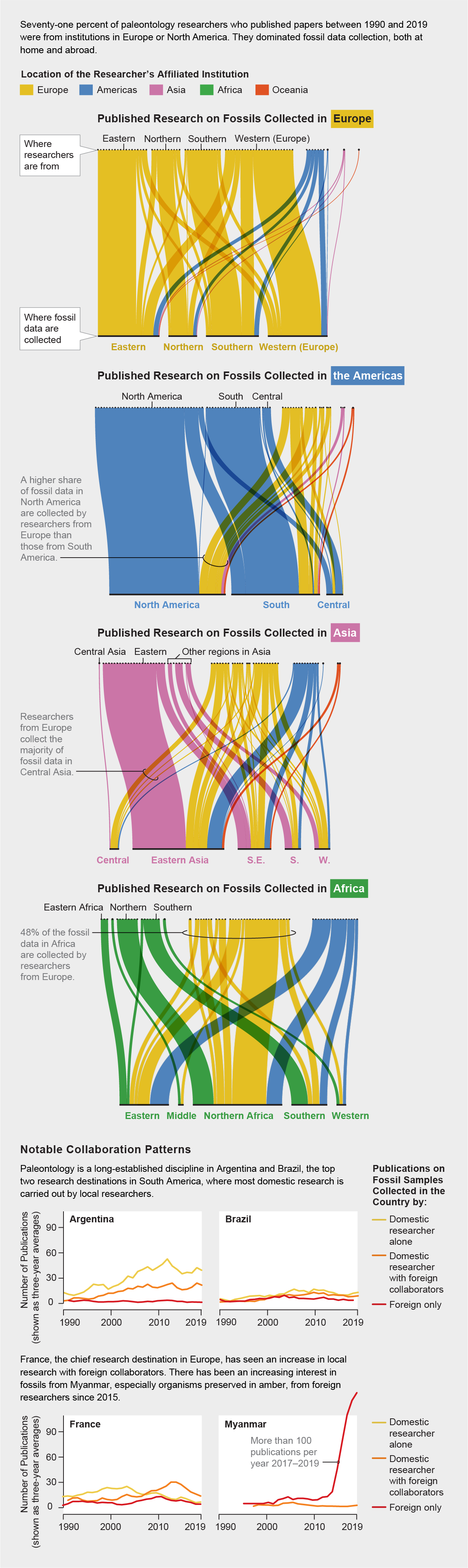

Charts show where researchers come from to collect fossils in each world region and highlight notable collaboration patterns.

Clara Moskowitz is chief of reporters at Scientific American, where she covers astronomy, space, physics and mathematics. She has been at Scientific American for more than a decade; previously she worked at Space.com. Moskowitz has reported live from rocket launches, space shuttle liftoffs and landings, suborbital spaceflight training, mountaintop observatories, and more. She has a bachelor’s degree in astronomy and physics from Wesleyan University and a graduate degree in science communication from the University of California, Santa Cruz.

More by Clara Moskowitz

Youyou Zhou is a New York-based data journalist working with graphics and code. She produces data-driven, visual, interactive and experimental journalism that breaks free of word-based formats. Follow her on Twitter @zhoyoyo

More by Youyou Zhou
Scientific American Magazine Vol 326 Issue 4This article was published with the title “Colonialism Shadows Fossil Science” in Scientific American Magazine Vol. 326 No. 4 (), p. 84
doi:10.1038/scientificamerican0422-84

It’s Time to Stand Up for Science

If you enjoyed this article, I’d like to ask for your support. Scientific American has served as an advocate for science and industry for 180 years, and right now may be the most critical moment in that two-century history.

I’ve been a Scientific American subscriber since I was 12 years old, and it helped shape the way I look at the world. SciAm always educates and delights me, and inspires a sense of awe for our vast, beautiful universe. I hope it does that for you, too.

If you subscribe to Scientific American, you help ensure that our coverage is centered on meaningful research and discovery; that we have the resources to report on the decisions that threaten labs across the U.S.; and that we support both budding and working scientists at a time when the value of science itself too often goes unrecognized.

In return, you get essential news, captivating podcasts, brilliant infographics, can't-miss newsletters, must-watch videos, challenging games, and the science world's best writing and reporting. You can even gift someone a subscription.

There has never been a more important time for us to stand up and show why science matters. I hope you’ll support us in that mission.

Thank you,

David M. Ewalt, Editor in Chief, Scientific American

Subscribe