Congo’s Mount Nyiragongo Volcano Erupts, Sending Thousands Fleeing

The peak is one of the world’s most active volcanoes, last erupting in 2002

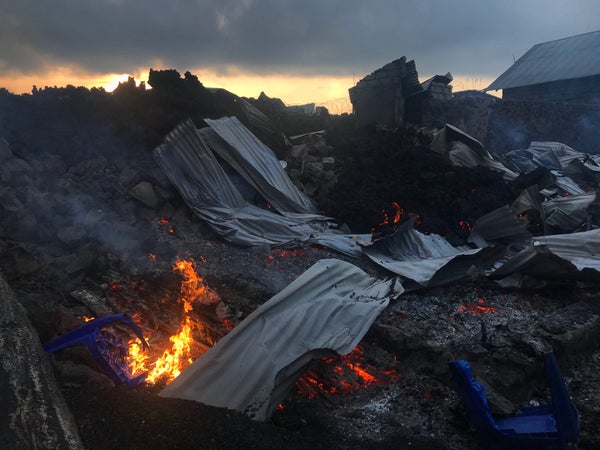
Smoldering ashes seen at Mount Nyiragongo following volcanic eruption.

Smoldering ashes are seen early morning in Goma in the Democratic Republic of Congo on May 23, 2021, following the eruption of Mount Nyiragongo.

Join Our Community of Science Lovers!

The Congo’s Mount Nyiragongo erupted Saturday night (May 22), sending thousands of people fleeing across the border into Rwanda and filling the skies with orange-red smoke. By Sunday morning, the lava flow had slowed, stopping just short of the area’s major transit hub Goma, and so far no directly related injuries or deaths have been reported.

The 11,385-foot-tall (3,470 meters) volcano is topped with a giant lava-filled crater measuring some 1.3 miles (2 kilometers) wide and 820 feet (250 m) high, Britannica reports.

The last time this volcano erupted, in January 2002, lava covered nearby Goma—the capital of North Kivu province and home to about 2 million people—and left possibly 250 individuals dead and more than 100,000 without homes, according to news reports. Before that, in 1977 the volcano blew its top, sending lava across Goma and killing 2,000 people, according to Britannica.


On supporting science journalism

If you're enjoying this article, consider supporting our award-winning journalism by subscribing. By purchasing a subscription you are helping to ensure the future of impactful stories about the discoveries and ideas shaping our world today.


During Saturday’s eruption, “the lava halted near Buhene on the outskirts of Goma … the city was spared,” said General Constant Ndima, as reported by Al Jazeera. Even so, some 3,500 Congolese people fled across the border into Rwanda, the Ministry in charge of emergency management wrote on Twitter

“Panic spread as we were in contact with the residents of the north of the city who from their roofs could see the path of the lava as it made its way to the airport,” said Patient Iraguha, a resident of Rwanda who works in Goma, as reported by The Washington Post.

Though one of the world’s most active volcanoes, Mount Nyiragongo may not have been properly monitored, according to news reports.The World Bank recently cut funding to Goma Volcano Observatory due to allegations of corruption, BBC News reported

In fact, on May 10, the observatory issued a report of increased seismic activity around the volcano; and last year, observatory director Katcho Karume told BBC the crater lake on Mount Nyiragongo had been filling up quickly and upping the chances of an eruption, BBC News reported.

Copyright 2021 LiveScience, a Future company. All rights reserved. This material may not be published, broadcast, rewritten or redistributed.  

Jeanna Bryner is executive editor of Scientific American. Previously she was editor in chief of Live Science and, prior to that, an editor at Scholastic's Science World magazine. Bryner has an English degree from Salisbury University, a master’s degree in biogeochemistry and environmental sciences from the University of Maryland and a graduate science journalism degree from New York University. She has worked as a biologist in Florida, where she monitored wetlands and did field surveys for endangered species, including the gorgeous Florida Scrub Jay. She also received an ocean sciences journalism fellowship from the Woods Hole Oceanographic Institution. She is a firm believer that science is for everyone and that just about everything can be viewed through the lens of science.

More by Jeanna Bryner

LiveScience is one of the biggest and most trusted popular science websites operating today, reporting on the latest discoveries, groundbreaking research and fascinating breakthroughs that impact you and the wider world.

More by LiveScience

It’s Time to Stand Up for Science

If you enjoyed this article, I’d like to ask for your support. Scientific American has served as an advocate for science and industry for 180 years, and right now may be the most critical moment in that two-century history.

I’ve been a Scientific American subscriber since I was 12 years old, and it helped shape the way I look at the world. SciAm always educates and delights me, and inspires a sense of awe for our vast, beautiful universe. I hope it does that for you, too.

If you subscribe to Scientific American, you help ensure that our coverage is centered on meaningful research and discovery; that we have the resources to report on the decisions that threaten labs across the U.S.; and that we support both budding and working scientists at a time when the value of science itself too often goes unrecognized.

In return, you get essential news, captivating podcasts, brilliant infographics, can't-miss newsletters, must-watch videos, challenging games, and the science world's best writing and reporting. You can even gift someone a subscription.

There has never been a more important time for us to stand up and show why science matters. I hope you’ll support us in that mission.

Thank you,

David M. Ewalt, Editor in Chief, Scientific American

Subscribe