
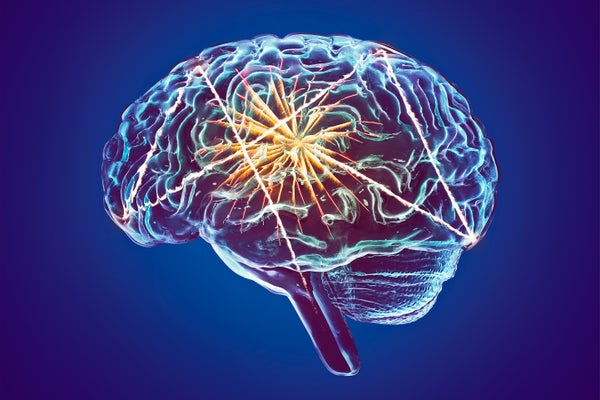
The neuron, the specialized cell type that makes up much of our brain, is at the center of today’s neuroscience. Neuroscientists explain perception, memory, cognition and even consciousness itself as products of billions of these tiny neurons busily firing their small “spikes” of voltage inside our brain.
Not only do these energetic spikes convey pain and other sensory information to our conscious mind, but they also are, in theory, able to explain every detail of our complex consciousness.
In principle, at least. The details of this “neural code” have yet to be worked out.
On supporting science journalism
If you're enjoying this article, consider supporting our award-winning journalism by subscribing. By purchasing a subscription you are helping to ensure the future of impactful stories about the discoveries and ideas shaping our world today.
Although neuroscientists have long focused on spikes traveling throughout brain cells, “ephaptic” field effects may really be the primary mechanism for consciousness and cognition. These effects, resulting from the electric fields produced by neurons rather than the cells’ synaptic firings, may play a leading role in our mind’s workings.
In 1943 American scientists first described what is now known as the neural code or spike code. They provided a detailed description of how logical operations can be completed through the “all or none” nature of neural firing—similar to how today’s computers work. Since then, neuroscientists around the world have engaged in a vast endeavor to crack the neural code in order to understand the specifics of cognition and consciousness—to little avail.
“The most obvious chasm in our understanding is in all the things we did not meet on our journey from your eye to your hand,” confesses neuroscientist Mark Humphries of the University of Nottingham in England in his 2021 book The Spike, a deep dive into this journey. “All the things of the mind I’ve not been able to tell you about, because we know so little of what spikes do to make them.”
Brain researchers have long acknowledged that there are a number of ways other than firing by which neurons could communicate, including a little-known mechanism called ephaptic coupling. This coupling results from the interaction of electromagnetic fields at the medium and large scales of the brain, alongside much smaller-scale fields accompanying synaptic spikes (which themselves result from a type of highly localized electromagnetic field activity) operating at nanometer scales.
Retinal neurons, for example, operate without any neural firing. These cells employ a type of electrodiffusion, the diffusion of charged particles without synapses, the connection points between neurons. Electrodiffusion passes along a signal to the optic nerve at very fast rates and with high bandwidth. We couldn’t see without it.
The “ephaptic” in “ephaptic coupling” simply means “touching.” Though not well known, ephaptic field effects result from the textbook electric and magnetic interactions that power our cells. Intriguing experimental results suggest these forces play a bigger role in the brain than once suspected and perhaps even have a part in consciousness.
Ephaptic field effects first came to my attention in a significant way with a remarkable 2019 paper from the Case Western Reserve University laboratory of Dominique Durand. That lab demonstrated that the mouse cortex was affected without synaptic connections—by definition, through ephaptic field interactions. The researchers identified this surprising effect after they cut a slice of mouse hippocampus in half and then measured the voltage potential going up and down the slice. There was almost no change in the measured voltage even after the slice was fully severed, demonstrating strong influence from ephaptic fields.
The influence did, they found, wane after a certain distance, as one would expect. Once the cut slices were separated by 400 microns or more, the ephaptic field effect mostly disappeared.
Peer reviewers considered these results so unusual that they required the investigators to replicate the results not once but twice before they approved publication of the study. One scholar stated at the time of the paper’s publication that the findings of Durand and his colleagues “should probably (and quite literally) electrify the field.”
Another team compared the speed of ephaptic field effects in various tissues and found that the speed of propagation of ephaptic fields in gray matter is about 5,000 times faster than neural firing.
This means that what would take normal spike pathways one second to send through the brain could be delivered 5,000 times during that same interval with ephaptic effects. If we cube this increase over the volume of the brain, we get an information density up to a staggering 125 billion times higher from ephaptic fields than from synaptic firing.
A key caveat to this statement is that this information density is only a potential one, and it is not necessarily the case that it can actually be reached. More research will need to be done to see how much of this vast ephaptic potential is realized by our brains.
Abundant evidence shows that synaptic firing is essential for moving, hearing, touching, and much else. But given the vastly greater information density in the ephaptic fields and the pervasiveness of ephaptic field effects, it would be exceedingly strange if evolution hadn’t grasped this effect for important brain functions. Indeed, it seems that it has, in sundry ways.
The late Walter Freeman, a legendary neuroscientist at the University of California, Berkeley, stated in a 2006 paper that traditional synaptic-firing speeds could not explain the speed of cognitive functions he had observed over the years in rabbits and cats. The recent spate of ephaptic effect findings suggests a solid mechanism to explain these speeds. Building on these findings, philosopher Mostyn Jones and I published a theoretical paper in 2023 suggesting that ephaptic field effects may in fact be the primary mechanism for consciousness and cognition, rather than neural firing.
A 2024 paper by Costas Anastassiou of Cedars-Sinai Medical Center in Los Angeles, Christof Koch of the Allen Institute in Seattle, and their colleagues provides strong support for the importance of ephaptic effects. They find that, indeed, ephaptic coupling can explain the “fast coordination” required for consciousness “even in the absence of very fast synapses.”
This single paper could take the field of ephaptic field science from the fringes of neuroscience to the forefront. Its findings regarding the speed and pervasiveness of ephaptic field effects may presage a fundamentally new understanding of how cognition and consciousness work.
This is an opinion and analysis article, and the views expressed by the author or authors are not necessarily those of Scientific American.