
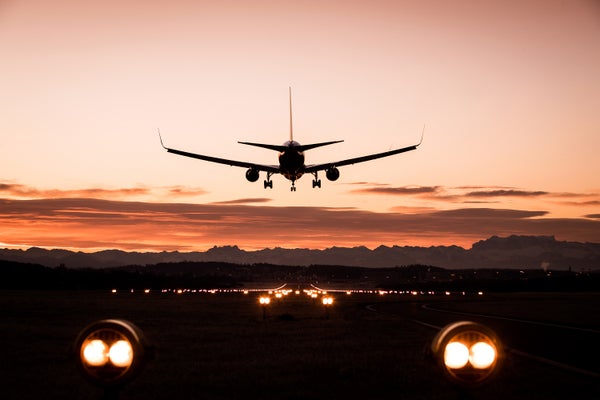
On the evening of July 18, commercial SkyWest Flight 3788 was preparing to land at Minot International Airport in North Dakota, and the pilot suddenly made an extreme turn to avoid colliding with a military plane crossing his path.* The pilot later landed the SkyWest plane safely and entered the cabin to apologize to passengers for having to make an “aggressive maneuver.” According to a video taken by a passenger, which was confirmed by NBC News, the pilot said that an air-traffic controller had instructed him to turn right upon approach, but as the pilot looked in that direction, he saw what he described as a B-52 bomber on a “converging course” with the SkyWest plane. The pilot aborted the approach and made the aggressive turn instead.
The pilot also noted that the air-traffic control tower that serves the airport does not have radar and that its controllers depend on their own vision of planes near the airfield to make decisions. He added that the nearby Minot Air Force Base does have radar, and he wondered why no one from that operation had given him a warning. It is not uncommon for small airports to lack radar or to rely on communication from larger airports nearby that do have radar, whether commercial or military.
This incident occurred six months after a military Black Hawk helicopter crashed into an American Airlines passenger jet near Ronald Reagan Washington National Airport, killing 67 people. Scientific American recently ran a story investigating whether artificial intelligence could improve air-traffic-control (ATC) safety or even replace air-traffic controllers. The near collision for SkyWest makes the question even more pertinent.
On supporting science journalism
If you're enjoying this article, consider supporting our award-winning journalism by subscribing. By purchasing a subscription you are helping to ensure the future of impactful stories about the discoveries and ideas shaping our world today.
That story, by Adrienne Bernhard, noted that “short-staffed and overworked ATC workers try to monitor thousands of flights each day. Their work relies on many systems that have remained virtually unchanged for decades: runway lights are supported by technology first rolled out in the 1980s, and controllers in some towers still use paper to track aircraft movements. But perhaps the most analog aspect of ATC is that human beings are needed to guide pilots at every stage of flight.” Our article added that “given the meteoric rise of AI applications, the control tower may be ripe for full automation in the near future. Human intervention would be the exception, not the rule.”
An AI system is being tested at London’s Heathrow Airport and at Singapore Changi Airport. In our story, Bernhard wrote that “AI control would raise legal and ethical questions. Could AI be blamed for an accident? How risk-averse would an automated ATC system be? How risk-averse should it be?” The article also noted that “aviation experts aren’t confident that the benefits would outweigh possible new problems resulting from increased automation in the tower. For one thing, AI currently lacks the creativity, intuition or adaptability needed to deftly handle any emergency that deviates from historical flight data. Automated technology adds another layer of unpredictability to a system already mired in uncertainty. Forcing pilots and controllers to become more dependent on technology could erode their ability to make quick decisions. And increased digitization of ATC systems could make them vulnerable to cybersecurity threats.”
*Editor’s Note (7/22/25): This sentence was edited after posting to correct the date of the incident.