
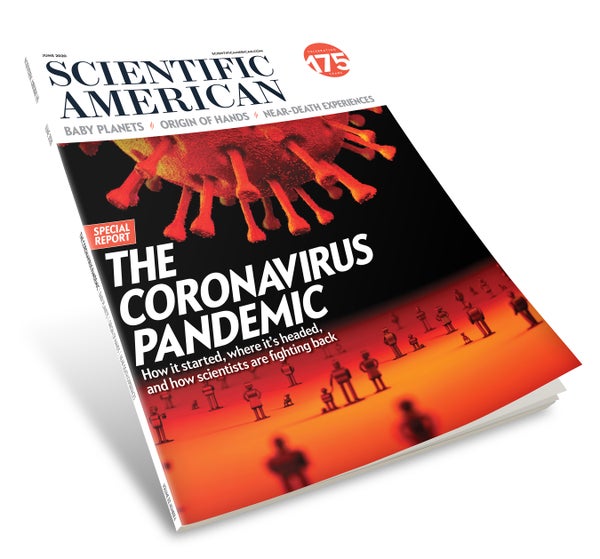
Since I last sat down to write From the Editor a few short weeks ago, the toll of the coronavirus pandemic has been staggering: at press time, more than 180,000 deaths globally and countless lives upended. Most of the planet is still on lockdown. At times it seems unreal, although it shouldn't. Many public health experts warned for a long time that something like this would happen without our taking precautionary measures.
The crisis reminds us that knowledge matters and throws into stark relief the ways that science works slowly and assiduously, over decades of painstaking research in epidemiology and virology, as well as urgently and frenetically, in the midst of tragedy and disaster, to help the world prepare for and respond to epidemics. That work is by no means perfect or complete, but it is our only hope to stop the suffering.
This month we lead with a special report that traces years of study of coronaviruses to current efforts in biomedicine to halt the pandemic. Beijing-based science writer Jane Qiu profiles the Chinese virologist who tracked down dozens of deadly SARS-like viruses in bat caves. Reporters Michael Waldholz and Charles Schmidt cover the race for COVID-19 treatments and a vaccine. And journalists Jillian Mock and Lydia Denworth write about the lasting impacts on frontline health workers and what comes next.
On supporting science journalism
If you're enjoying this article, consider supporting our award-winning journalism by subscribing. By purchasing a subscription you are helping to ensure the future of impactful stories about the discoveries and ideas shaping our world today.
Other columns and departments in the issue focus on the pandemic as well. Our editorial calls for ending deforestation to reduce our exposure to the zoonotic viruses behind some of the world's worst outbreaks. Graphic Science presents a stunning data visualization of the SARS-CoV-2 virus's genetic evolution as it spread around the globe. There's more, and all of our coronavirus coverage is freely available online at sciam.com/coronavirusoutbreak.
If you need relief from the plague beat (and we all do), turn to the back half of the features section for a series of articles that will carry you away to a land of awe and wonder. Astronomer Meredith A. MacGregor describes how Chile's ALMA telescope has helped reveal detailed patterns in the debris disks around stars where planets are forming. Paleontologist John A. Long and evolutionary biologist Richard Cloutier explain how the discovery of an extraordinary 375-million-year-old fossil overturned the conventional wisdom about when and how the elements of human hands evolved in lobe-finned fishes. And neuroscientist Christof Koch explores the biologically mysterious commonality of near-death experiences and how researchers might uncover what is happening in the mind when we see that bright light.
I want to thank the Scientific American team for its hard work on this issue—it's not easy to cover such an epic and rapidly evolving situation in a monthly print magazine. I also want to thank all the health care workers, researchers and experts who took the time to share their stories. It's been a painful month, and we owe a debt to everyone trying to bring this pandemic to an end.
Read more about the coronavirus outbreak from Scientific American here. And read coverage from our international network of magazines here.