
Something weird is happening on the dwarf planet Ceres, which at 950 kilometers wide is the largest object in the Asteroid Belt. Since its arrival in Ceres’s vicinity earlier this spring, NASA’s Dawn spacecraft has glimpsed mysterious, highly reflective bright spots dotting the surface. No one yet knows what exactly they are or how they got there.
Periodically snapping pictures as it gradually spirals down to a low-altitude “survey” orbit, Dawn has provided a slow-motion zoom-in on the dwarf planet, allowing imaginations to run wild as experts and laypeople alike seek to discern structures and patterns in the low-resolution images. Consequently, many possible explanations for the bright spots have emerged, some more plausible than others, and the ideas shift with each new vista Dawn beams home. The spots could be salts deposited by briny vapors from gushing geysers or, less likely, plumes from water-spewing “cryovolcanoes.”
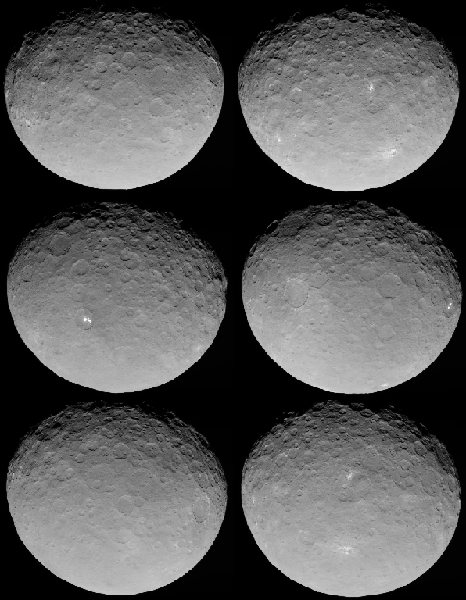
Now some scientists think the spots may be reflections from water ice, after viewing Dawn’s newest images. These pictures—taken from an altitude of 13,500 kilometers and at a resolution of 1.3 kilometers per pixel—capture a full rotation of Ceres. That relatively high resolution allowed researchers to determine that the brightness and flatness of some of the spots closely matches what would be expected of ice. It also revealed that what looked to be one or two large bright spots in a crater actually is a complex of many much smaller spots. “As our pictures have increased in resolution, the brightest spot broke into two spots, and now we can see a whole field of tiny spots in that crater,” says Christopher Russell, principal investigator for the Dawn mission at the University of California, Los Angeles. “We are now sure that the light could be sunlight bouncing back from the surface, similar to what we would expect from a reflection from ice on the surface.”
On supporting science journalism
If you're enjoying this article, consider supporting our award-winning journalism by subscribing. By purchasing a subscription you are helping to ensure the future of impactful stories about the discoveries and ideas shaping our world today.
The presence of exposed ice on Ceres would be a surprise, because ice should be unstable on the dwarf planet’s airless surface, turning from a solid into a gas and drifting into space rather than sticking around. That process, however, may be exactly what the Herschel Space Observatory saw last year when it observed tenuous wisps of water vapor around Ceres.
Mark Sykes, director of the Planetary Science Institute and a Dawn co-investigator, says that if the spots are water ice, the ice probably isn’t very pure because otherwise “Herschel would have detected much more water vapor near Ceres.” Sykes speculates that the largest spot complex, as-yet-unnamed but informally dubbed the “Great White Spots,” might mostly be salty crusts left behind after mineral-rich water ice vaporizes away.
But the Great Whites are only one collection of spots out of many dotting the dwarf planet’s surface, and each group has significantly different features. Some are near immense cracks that stretch nearly a quarter of the way around Ceres, and others are connected to bright rays of what seem to be ejected material, suggesting a linkage to ancient or recent world-shaking impacts of comets or asteroids.
The spots “are all over and range from big and bright to tiny and wispy,” says Mike Brown, an astronomer and planetary scientist at the California Institute of Technology who is not part of the Dawn team. “My best guess is that there is a layer of ice not very far below the visible surface and that impacts punch through it. What would be more interesting is if there is a layer of liquid not too far down and you punch through and allow venting. Some of the spots sort of look like that—but we’re still at the point where they look like almost anything you want them to!” Brown adds: “Since I’m not on the team and have no need to carefully weigh my words, I will say it is ice. What else could it be? But, of course, the most fun thing of all is to be proven completely wrong.”
That could happen soon. Dawn is continuing its orbital downward spiral and will begin a far more detailed survey of Ceres’s surface and geology when it reaches an altitude of 4,400 kilometers on June 6.
“What will we see as the resolution continues to increase?” Russell wonders. “We are humbled by our inability to predict what is going on here… So we sit and wait for the higher-resolution data to appear, and we sharpen our pencils to make calculations on the rate of water vapor creation from the possible ice rinks on Ceres.”