
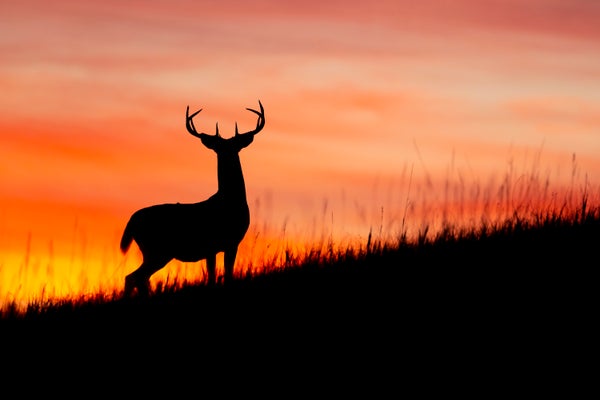
At dawn and dusk, forests often appear muted and nearly monochromatic to human eyes. But white-tailed deer might see a very different landscape: to them, the forest could be aglow.
Since at least the 1970s biologists have understood that deer leave scented signposts—spots where they have rubbed their antlers on trees or urinated on scrapes that they carve out of the ground with their hooves. But one group of researchers wondered whether these marks also provide visual messages.
The scientists used ultraviolet lights to scan and analyze 146 such signposts in Whitehall Forest in the state of Georgia. They found that although these spots look unremarkable in daytime lighting, they reemit blue-green light that deer can see when exposed to UV wavelengths common at dawn and dusk. This glow might happen at antler rubs because the action strips bark away, revealing lignin-rich inner wood that reemits the longer wavelengths in a way bark does not.
On supporting science journalism
If you're enjoying this article, consider supporting our award-winning journalism by subscribing. By purchasing a subscription you are helping to ensure the future of impactful stories about the discoveries and ideas shaping our world today.
“If anyone’s seen a reflector on a tree, a rub is similar to that—though obviously not as stark,” says study lead author Daniel DeRose-Broeckert, a biologist at the University of Georgia.
The visual contrast also intensifies as the breeding season approaches. In their paper describing the findings, published in Ecology and Evolution, the authors found that rubs made later in the season produced stronger photoluminescent signals, a pattern that coincides with rising testosterone levels and associated marking activity. Rubbing can both strip away bark to reveal fluorescent inner wood and deposit glandular secretions, either of which may contribute to the signal.
This shift in light is particularly relevant, the authors say, because the eyes of white-tailed deer have enhanced sensitivity to short- and middle-wavelength colors, which are common under low-light conditions.
Traditionally mammalian biofluorescence, such as the glowing fur of bare-nosed wombats and bandicoots, has been studied as a property of the animal itself. Biological material such as semen is also known to fluoresce under UV light. This work suggests that biofluorescence might be embedded in the environment as well, even if only subtly—contributing a largely unseen layer to how animals might be communicating.
Not everyone is convinced that these fluorescent contrasts would be visible to deer under natural conditions, however. “If humans do not see these markings under natural light, then deer are unlikely to see them,” says Almut Kelber, a sensory biologist at Lund University in Sweden, who was not part of the study. Demonstrating a visual role would require behavioral tests that separate sight from smell, she adds.
DeRose-Broeckert describes the study as a first step—it documents that rubs and scrapes can generate contrast at wavelengths deer can see and lays the groundwork for future experiments with natural lighting.