
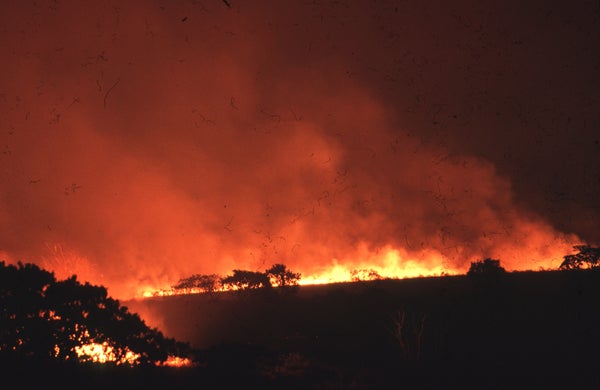
Deforestation in the Cerrado, a vast wooded savannah bordering the southern and eastern Brazilian Amazon, increased by 9% in 2017 compared to 2016, according to satellite data released last month by the National Institute for Space Research (INPE) in São José dos Campos.
In total, an estimated 7,408 square kilometres of land were cleared to make way for cattle pasture and croplands. Although the rate of deforestation in the Cerrado remains well below the annual levels documented from 2013 to 2015, scientists and environmentalists nonetheless warn that the savannah remains the most threatened biome in Brazil today. By comparison, the INPE registered 6,947 km2 of deforestation in the Amazon in 2017, a drop of 12% compared to the previous year (see ‘Cerrado Still Threatened’).
“In the Cerrado, we are talking about a biome that is half the size of the Amazon and has already lost half of its native vegetation,” says Ane Alencar, director of science for the Amazon Environmental Research Institute (IPAM), which is based in Brasilia.
On supporting science journalism
If you're enjoying this article, consider supporting our award-winning journalism by subscribing. By purchasing a subscription you are helping to ensure the future of impactful stories about the discoveries and ideas shaping our world today.
A number of factors are behind the current deforestation trends, including weaker environmental rules in the Cerrado than in the Amazon. Whereas landowners are allowed to clear only 20% of their property in the Amazon forest, they can cut down as much as 80% of the forest in the Cerrado. Scientists and environmentalists also warn that environmental enforcement in the region remains weak.
The bulk of current deforestation stems from massive agricultural expansion in the northeastern Brazilian states of Maranhão, Tocantins, Piauí and Bahia. Much of the land there is being converted to cattle pasture, but scientists say that Brazil’s powerful soya bean industry has become a major player in the deforestation in the Cerrado.
“What we are seeing now is a different pattern of occupation,” says Mercedes Bustamante, an ecologist at the University of Brasilia. “The deforestation frontiers are now being driven by soya beans in a completely new region.”
Protecting forests, biodiversity and water resources in the region will require additional action by state and federal governments in Brazil , as well as by corporations that buy and sell agricultural commodities, Alencar says.
This article is reproduced with permission and was first published on July 12, 2018.