
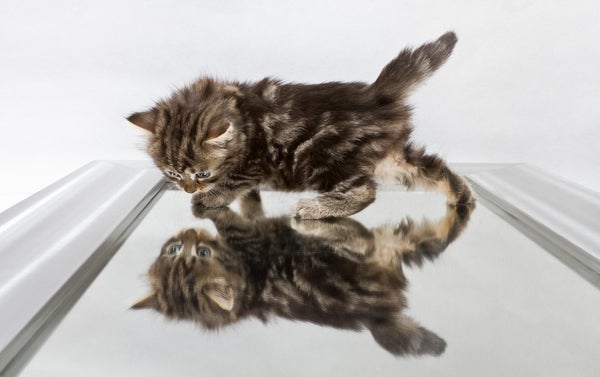
Do animals really know who they are? Experts have been puzzling over this intriguing question for decades, and the responses vary depending on whom you ask and how he or she defines self-awareness.
For years the litmus test was the so-called red spot test, developed by psychologist Gordon Gallup. A researcher applies an odorless red spot to a sedated animal's forehead and then watches what happens when, fully awake, the animal confronts its image in a mirror. If it moves its paw toward the spot, the assumption is that it recognizes itself and has some degree of self-awareness.
But actually the red spot test is far too limited to reach this conclusion. First, it depends on animals knowing that mirrors create reflections—which they may not understand without previous experience. Second, and perhaps more problematic, many animals do not know what they look like; they recognize only what they smell or sound like. For instance, dogs and wolves depend heavily on olfactory cues, more so than visual ones, to navigate the world. In what I called the “yellow snow” experiments, I discovered that my dog, Jethro, could recognize his own urine and responded differently to the smell of his urine compared with that of other dogs. Animals such as Jethro may fail the red dot test but still possess some sense of self or ownership over their body and smells.
On supporting science journalism
If you're enjoying this article, consider supporting our award-winning journalism by subscribing. By purchasing a subscription you are helping to ensure the future of impactful stories about the discoveries and ideas shaping our world today.
The legendary naturalist Charles Darwin believed that humans are not the only self-aware beings. In his theory of evolutionary continuity, he asserted that the differences among species come in degree rather than kind. So if humans display self-awareness, other animals most likely exhibit some form of this trait as well. In my own extensive work observing wild and domestic animals, I have indeed found that many exhibit different levels of self-awareness.
Being self-aware does not necessarily translate into a sense of what I call “I-ness.” When an animal sees its reflection, for instance, it may not understand “That's me!” in the same way as a human would, but it may know that its body is its own and does not belong to someone else. Examples of this type of self-knowledge abound. Many animals know where their body is in space when they run, jump or navigate as a hunting pack or a migrating flock. Animals may also display ownership over their food, territory, family and body parts.
Although there is no easy answer to the question of self-awareness in animals, this line of inquiry leads to some fascinating insights into who animals are, what they know and how they feel. We may not grasp the extent of their self-consciousness, but I believe that an animal's awareness of its body and property ultimately equates to a sense of self.
Question submitted by Jay Jacobus via e-mail
Do you have a question about the brain you would like an expert to answer? Send it to MindEditors@sciam.com