
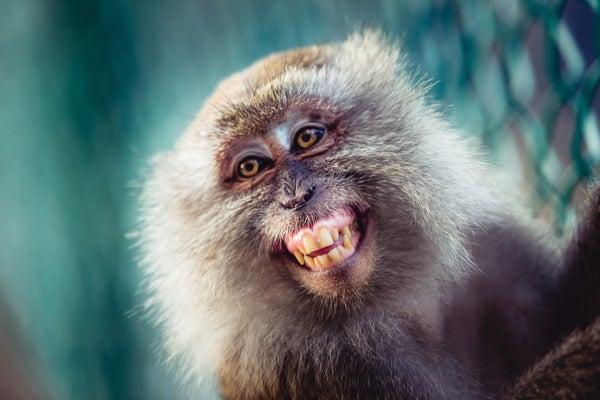
Facial expressions are central to social life, yet scientists still don’t fully understand how the brain produces them. For decades one influential theory has held that what appears on a person’s face is largely an emotional reflex—an honest, automatic readout of what they feel inside. But that view doesn’t explain the fact that we often tailor our countenance to the moment: we’ve all smiled politely through a dull date or tried not to smile while holding a royal flush.
To find out what’s going on in the brain as facial expressions arise, researchers turned to rhesus macaques, Old World monkeys with face musculature and neuroanatomy that are similar to that of humans. They recorded neural activity in the laboratory while the animals interacted with one another, with human experimenters, with digital avatars and with video of other macaques. The team’s results, published recently in Science, came as a surprise: the monkeys’ expressions, from a tooth-baring threatening face to a friendly “lip-smacking” one, were generated by both the medial cortex and the lateral cortex.
These two parts of the brain’s frontal lobe were long thought to operate independently, the medial cortex dealing with spontaneous emotional expressions and the lateral cortex controlling voluntary actions. “Our study did not show that at all,” says co-lead author Geena Ianni, a neurology resident at the University of Pennsylvania. “It showed that all regions participated in the production of all kinds of facial expressions.”
On supporting science journalism
If you're enjoying this article, consider supporting our award-winning journalism by subscribing. By purchasing a subscription you are helping to ensure the future of impactful stories about the discoveries and ideas shaping our world today.
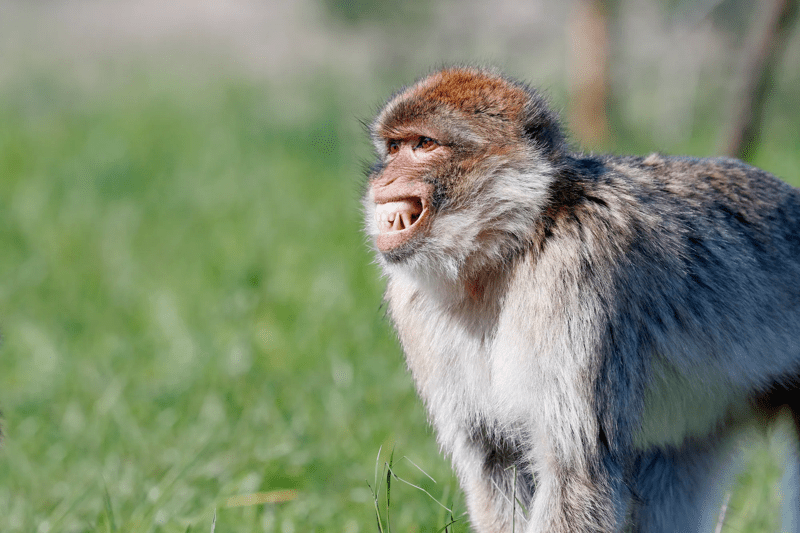
Macaques’ threatening grins and friendly lip-smacks may be partially intentional.
Christophe Lehenaff/Getty Images
The two regions did, however, run at different speeds. “The way they encode information has a distinct tempo,” says co-lead author Yuriria Vázquez, a neuroscientist at the Rockefeller University. Activity in the lateral cortex shifted quickly, over milliseconds, to coordinate the rapid facial movements that make for smooth social interaction. In contrast, things happened at a more leisurely pace in the medial cortex, perhaps allowing it to track slow-changing contextual factors—such as “Has the alpha male stopped threatening me?”—that influence facial expressions. What’s more, both neural patterns showed up before facial movements did, suggesting the brain prepares expressions in advance.
This all raises a question: Do macaques intentionally plan the faces they make? That’s the interpretation that Bridget Waller and Jamie Whitehouse, evolutionary psychologists at Nottingham Trent University in England, explore in a commentary on the study. If facial expressions are partly voluntary, they may be less like emotional mirrors and more like “tools for social influence,” as Waller and Whitehouse put it. At the very least, they seem to result from complex interactions between emotion and cognition.
Alan Fridlund, a social and evolutionary psychologist at the University of California, Santa Barbara, who was not involved in this study, has no trouble believing macaques wield their faces strategically. But he doubts that staged, lab-bound interactions can capture the full reality of primate communications or the neural activity underlying them; ideally, future research would take place in the monkeys’ natural environment. Still, Fridlund says, the exploration “tells us in infinitely more detail how we can investigate the neurology of facial displays.”