
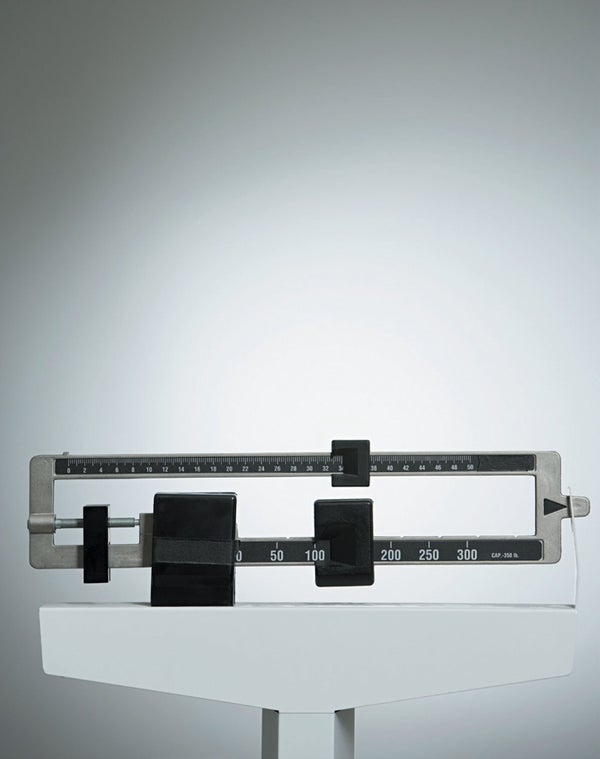
At the start of nearly every doctor's visit, chances are you will be asked to step on a scale and get your weight measured for that day's exam record—and you would be hard-pressed to find a person whose physician has not brought up his or her weight at some point. But many conversations around weight have become a hindrance, not a help, in the campaign to make people healthier. Doctors' recommendations to drop pounds are still extremely common, even though using body size as a one-size-fits-all proxy for health can obscure the complexity of an individual's particular physiology.
Higher body masses are associated with increased risk for hypertension, diabetes and coronary disease. Many epidemiological studies of hundreds of thousands (in some cases, millions) of patients have shown that heavier people are at higher risk for these illnesses. But the big picture is not the whole picture. Researchers have identified a subset of obese people considered to be “metabolically healthy”—meaning they do not exhibit elevated blood pressure or the diabetes precursor called insulin resistance, for example. Although the numbers vary greatly depending on the study, the metabolically healthy population could comprise anywhere from 6 to 75 percent of obese individuals.
One intriguing report published in 2016 found that a higher body mass index (or BMI, the ratio of weight to height) “only moderately increased the risks for diabetes among healthy subjects” and that unhealthy thin people were twice as likely to get diabetes as healthy fat people. Clearly, there is more to the equation than weight. Although the association between excess weight and disease is very real, individual experience can vary greatly and hinges on personal physiology and behavior.
On supporting science journalism
If you're enjoying this article, consider supporting our award-winning journalism by subscribing. By purchasing a subscription you are helping to ensure the future of impactful stories about the discoveries and ideas shaping our world today.
Despite such findings, doctors routinely recommend dieting for weight loss as a means to “treat” poor health indicators such as high cholesterol and insomnia in obese patients—an approach with an abysmal success rate. Virtually no diet works in the long term (diet-peddling companies have weak, if any, data to back up their claims of efficacy). The result: 95 to 98 percent of those who attempt to lose weight fail, and up to two thirds end up heavier than when they began. Spending years trapped in a cycle of losing weight, regaining it, then losing it again is associated with poorer cardiovascular health outcomes and contributes to hypertension, insulin resistance and high cholesterol. It is time that doctors ditch the scale-centric health care practice and focus on behaviors that have proven positive outcomes for health. Lifestyle changes, such as enhancing one's nutrition by eating fruits, vegetables and whole grains, along with increased physical activity and smoking cessation, can improve blood pressure, blood lipid levels and insulin sensitivity—often independently of changes in body weight.
Among the more insidious by-products of weight-centric health care are the increased stigma and shame experienced by the overweight. The well-reported anecdotal experience of innumerable fat people is that doctors often prescribe weight loss without examining them, running tests or performing other normal procedures for conditions that thin people would be screened for automatically. Research over the past two decades has shown that health professionals have negative attitudes toward obese people, as the authors of a large review paper wrote in 2013 in Current Obesity Reports. Not only that but doctors' appointments with fat patients are shorter on average, and physicians routinely use negative words in their medical histories of such people.
Some refuse to see these patients at all, as the South Florida Sun Sentinel reported in 2011. Such biased practices keep people from regular annual exams and prevent the detection of serious underlying conditions. And research suggests that the chronic stress of living with the shame of being a heavy person may underlie metabolic changes that increase the storage of fat, elevate blood pressure and drive up blood lipid levels.
To practice evidence-based medicine untainted by stigma, doctors should stop relying on weight alone as an indicator of health and slavishly prescribing weight loss to treat health ailments. Instead practitioners should focus on behavioral changes to improve health outcomes. People of all sizes are entitled to evidence-based protocols that empower them and keep them healthy.