
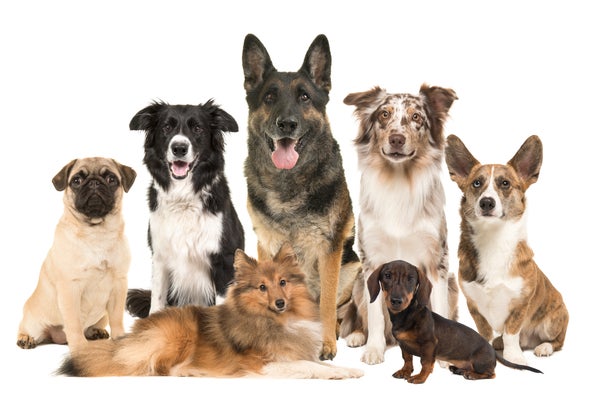
Modern dog breeds come in a mind-boggling array of shapes and sizes—from Chihuahua to Great Dane, corgi to greyhound, pug to German shepherd. In fact, the domestic dog, Canis familiaris, shows more variation in its physical features than any other mammalian species on Earth. Conventional wisdom holds that this extreme variation is the result of humans intensively breeding dogs for particular traits over the past 200 years or so. Now a new analysis of modern and ancient dog and wolf skulls has upended this idea, revealing a far earlier origin for dog diversity.
Archaeologists have long been interested in the evolution of dogs because the species is thought to be the first animal domesticated by humans. Evidence indicates that dogs evolved from wolves and were domesticated at multiple times and in different parts of the world. From there, the story gets harder to discern because the record of ancient dog remains (including any DNA or other molecules that might have been preserved) is patchy. Although some archaeological evidence hints that the first domestic dogs might date back as far as 33,000 years ago or more, analyses of ancient DNA put the origin of our canine companions at more like 11,000 years ago. In any case, scientists didn’t think early dog features were especially variable. It wasn’t until people started intensive breeding programs in the mid-1800s that dogs began to morph into wildly different forms—or so the story went.
In the new study, Allowen Evin of the University of Montpellier in France and her colleagues analyzed hundreds of dog and wolf skulls that spanned the past 50,000 years. The oldest skull in their sample with definitive dog traits dated to nearly 11,000 years ago, which aligned with DNA estimates of when dogs evolved from wolves. What’s surprising is that the researchers found a substantial degree of diversity in the sizes and shapes of dog skulls among the earliest specimens they studied. Although these features didn’t reach the extremes seen in modern breeds, such as bulldogs, with their smushed face, and borzois, with their ultralong snout, these ancient dogs exhibited fully half the diversity of modern dogs—a lot more than expected.
On supporting science journalism
If you're enjoying this article, consider supporting our award-winning journalism by subscribing. By purchasing a subscription you are helping to ensure the future of impactful stories about the discoveries and ideas shaping our world today.
The findings indicate that humans were not the sole driver of dog evolution, as previously thought. Other factors, such as climate or geography, might have contributed significantly to making humanity’s best friend the extraordinarily diverse species that it is today.