
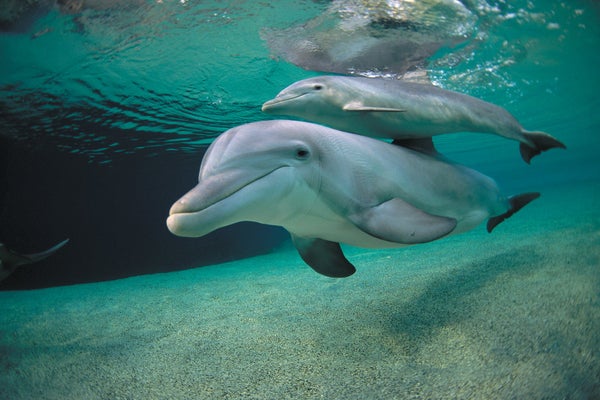
Dolphins’ “signature whistles,” which they use like names to identify themselves to others and convey personal information, have long been known as one of the most complex forms of animal communication ever studied. New research quantifies just how much these calls can vary between individuals and situations.
Experts can determine a dolphin’s signature whistle over time by listening as it calls out to its peers. The animals vary these whistles widely, repeating sections in loops, altering the pitch, and adding and deleting short segments. A new study, published in Frontiers in Marine Science, evaluates these changes through a database of nearly 1,000 recording sessions that collected whistles from around 300 individual dolphins over four decades.*
To calculate the signature whistles’ variability and allow comparison with sounds from other species (particularly birds), the authors used a statistical metric that evaluates 21 different facets of a sound—such as length, frequency, pitch and pattern. The more each individual varied the facets in each call, and the more the calls varied between different individuals, the higher the species scored. Bottlenose dolphins’ identification sounds had the largest audio palette in a recent comparison paper, followed by larks’; researchers do not yet have a consensus on how humans measure up.
On supporting science journalism
If you're enjoying this article, consider supporting our award-winning journalism by subscribing. By purchasing a subscription you are helping to ensure the future of impactful stories about the discoveries and ideas shaping our world today.
This metric is good for comparing across species, says Woods Hole Oceanographic Institution marine biologist Laela Sayigh, the dolphin study’s lead author. But she notes that the 21 facets barely scratch the surface of dolphin whistles’ true complexity. “It’s actually kind of phenomenal,” Sayigh says, that even using this “coarse” metric, “dolphins are the most individually distinctive communicators.”
University of South Bohemia behavioral ecologist Pavel Linhart, who was not involved with the study but led the interspecies comparison, says he is glad the researchers tallied this variability. “I think because it was just so obvious that it’s so easy to identify [individuals], they didn’t quantify it before,” he adds.
Scientists are just beginning to explore dolphins’ reasons for varying their signature whistles—possibly to express emotional states, for one. Future work will help decipher shared, nonsignature whistles that dolphins also exchange, Sayigh says. “We’re really in the infancy of understanding those.”
*Editor’s Note (10/20/22): This sentence was edited after posting to correct the description of 1,000 whistle recording sessions.