
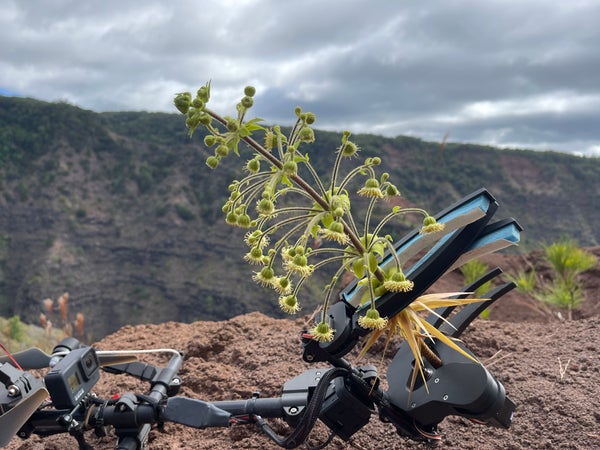
On a knife-edge ridge on Kauai, a delicate little plant with a tuft of yellow flowers sprouts from the rock. The only sounds are the wind, the murmur of waves far below—and the hum of drone propellers. The whine gets louder as another drone suspended from the first encloses the plant with two arms, a blade slicing through the stem. The device then gently lifts the plant, a member of the genus Schiedea, part of the carnation family. As the tiny specimen’s leaves flutter in the air, the drone descends and delivers it directly to researchers waiting below.
This scene—repeated dozens of times with various plants on the Hawaiian island’s tropical cliffsides as part of a new study—shows how drones can help scientists pluck rare and endangered plants from spots that would otherwise be dangerous, if not impossible, for humans to reach. Collecting samples is often necessary to better understand the plights of these species, and how to save them. “It’s a fabulous development and use of technology to get a lot more information than a person trudging around,” says Warren Wagner, a research botanist at the Smithsonian Institution. He was not part of the study but serves as a research associate at the National Tropical Botanical Garden, one of the institutions involved.*
On supporting science journalism
If you're enjoying this article, consider supporting our award-winning journalism by subscribing. By purchasing a subscription you are helping to ensure the future of impactful stories about the discoveries and ideas shaping our world today.
Credit: Outreach Robotics
The study, published recently in Nature Scientific Reports, builds on decades of botanical investigations on Kauai, which has more than 250 native plant species. Historically, botanists have rappelled down the island’s sheer rock faces to reach specific plants, going to extremes for samples that they can raise in a nursery to perpetuate species at risk of extinction. Ben Nyberg, a geographer and drone specialist at the National Tropical Botanical Garden, wanted to try using remote-controlled flying robots in places that are difficult to access.
Nyberg and his team used a commercially available drone to heft a separate robotic unit that they built from scratch and named the Mamba. When conceptualizing the device, the researchers had first tried to figure out how plant-picking arms could be made to reach out horizontally from a hovering drone itself. This idea quickly got complicated, says study co-author Guillaume Charron, an engineer from Outreach Robotics. “That’s when we started brainstorming and we came up with the idea of suspending a remote-controlled robotic arm” on cables beneath a drone. Because the Mamba doesn’t have to lift itself, an operator can use its propellers to keep it steady and maneuver it sideways precisely enough.
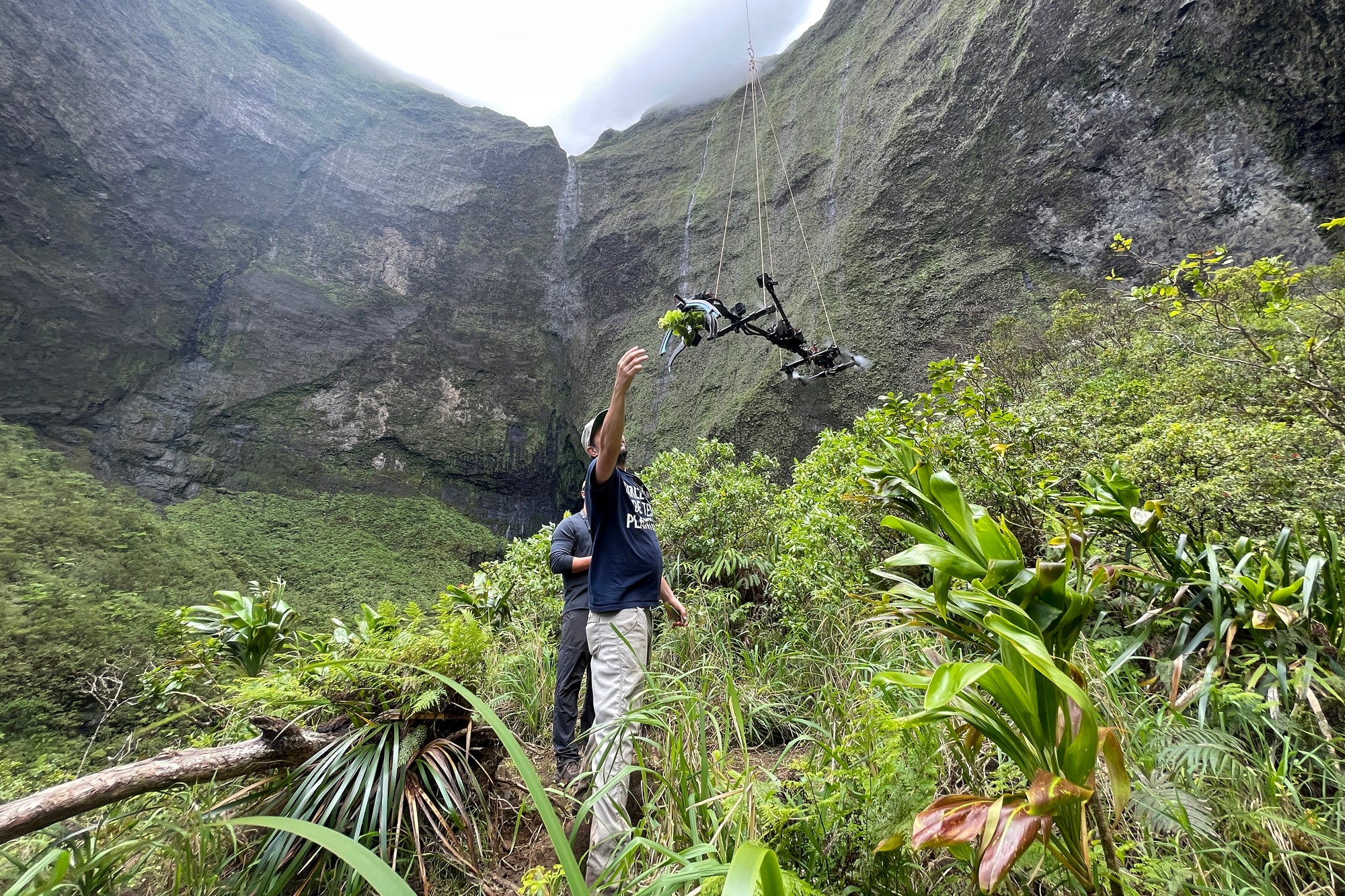
The Mamba handing off a sample of Lysimachia iniki to team member Scott Heintzman. Credit: Ben Nyberg, National Tropical Botanical Garden
The Mamba’s sampling components include a foam-padded grasping arm that can move like a wrist, and a hook that draws a plant’s stem toward a blade. The team is now considering how to equip the Mamba with other tools, such as a vacuum that could suck in plant material or a nozzle that could spray a slurry of seeds and growing medium onto a cliffside for replanting.
Similar drone systems could help researchers reach other forbidding areas such as the tabletop mountains that jut above the Amazon jungle, or the sky islands (isolated mountain ranges rising abruptly from the desert) of the southwestern U.S. “The drone system could be used in a variety of additional applications like tree canopy studies, depositing and [data-collecting devices] in a range of environments, or even planting trees,” says Nyberg, a study co-author who is completing a Ph.D. at the University of Copenhagen. “Basically, this allows users to reach completely inaccessible areas, wherever they may be.”
The carnation species plucked from Kauai’s high ridges appears to be a Schiedea never identified there before. Its seeds are now growing at the University of California, Irvine, with help from botanists Ann Sakai and Steve Weller—a married couple who have studied Schiedea for more than three decades and were impressed by the information gleaned from the drone’s sampling. “They have been able to map in detail the population in a way that we could just never do by rappelling,” Weller says. “I’m impressed, and I certainly think that it’s a really nice new tool to be able to know more about these plants.”
*Editor’s Note (10/13/22): This sentence was edited after posting to correct the description of Warren Wagner’s position at the National Tropical Botanical Garden.
A version of this article with the title “A Daring Collection” was adapted for inclusion in the February 2023 issue of Scientific American.