
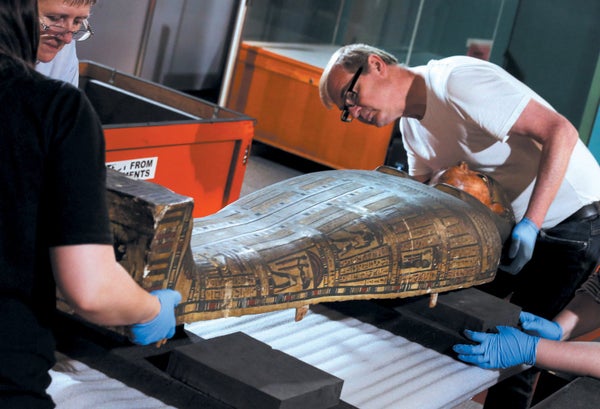
A mysterious mummy’s artificial eyes—placed to help her see in the afterlife—would have shown her quite a lot over the past 2,700 years.
Researchers examining the mummy at the British Museum thought the remains were male after x-ray images from the 1960s revealed dense packing in its crotch area. But a potentially matching trio of beautifully detailed nesting wood coffins, acquired with the mummy as a set, bore hieroglyphics describing a female homemaker named Nestawedjat. She lived in what is today Luxor, in roughly 700 B.C.E. during Egypt’s 25th dynasty, when it was ruled by Kushite pharaohs from Sudan.
For a recent study in the Journal of Archaeological Science: Reports, curator Marie Vandenbeusch and her colleagues set out to verify whether the mummy and coffins really belonged together. Their first clue came from CT scans that revealed the mummy was female, matching the coffins’ description. They then analyzed the chemical makeup of black embalming residue in the innermost coffin’s left shoulder area. This substance’s ingredients—mostly wax, oil and fat—had identical proportions to residue found on the mummy’s left shoulder.
On supporting science journalism
If you're enjoying this article, consider supporting our award-winning journalism by subscribing. By purchasing a subscription you are helping to ensure the future of impactful stories about the discoveries and ideas shaping our world today.
“It’s quite a lot of detective work to bring all that together” and determine a mummy’s origin, Vandenbeusch says. She notes that mummies are commonly found outside of coffins in old collections; this process could make them easier to test for potential matches. (The study’s CT scans also spotted the mummy’s artificial eyes, made from two different materials that might be glass or stone.)
Ronald Beckett, a Quinnipiac University biomedical scientist who was not involved in the study, says this “rigorous methodology” using chemistry “adds clarity to the origins, identities and relationships among ancient remains.” Moreover, “the analysis of the constituents of embalming concoctions contributes to our understanding of ancient methods of preparing the dead.”
It is unclear why Nestawedjat was removed from her coffins, but Vandenbeusch’s archival research suggests that a British colonel acquired the remains in Egypt on his way to India in the mid-19th century. He died in India, but Nestawedjat ended up in London—where she is now reunited with her coffins.