
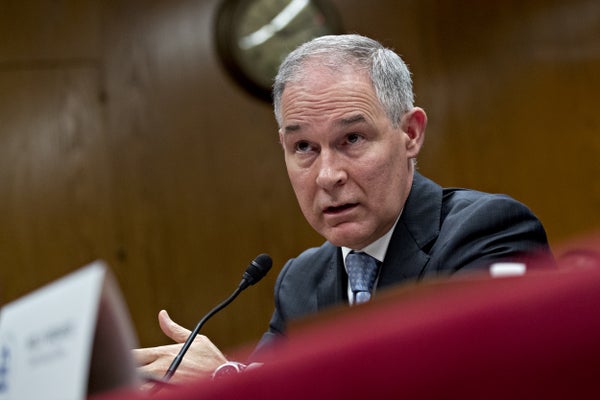
Science advisors to the US Environmental Protection Agency (EPA) voted on 31 May to review a series of controversial rules that the agency has proposed over the past eight months. They include a plan that would limit the types of scientific research that the EPA could use to justify environmental regulations, and proposals to strike down limits on greenhouse-gas emissions.
EPA Administrator Scott Pruitt framed the data rule as part of a push for transparency—and against ‘secret science’—when he released it on 24 April. The policy would prevent the EPA from relying on studies that include any non-public data. The EPA Science Advisory Board (SAB) decision today to review the rule comes after earlier criticism by some of its members. In a 12 May memorandum, an SAB working group chastised the EPA for not submitting the proposal to the board for review.
“The working group is very much in favor of transparency,” said Alison Cullen, an environmental health researcher at the University of Washington in Seattle and chair of the working group, during the SAB meeting. But on this particular proposal, there is a “very real lack of clarity” in how the rule would be applied, she said.
On supporting science journalism
If you're enjoying this article, consider supporting our award-winning journalism by subscribing. By purchasing a subscription you are helping to ensure the future of impactful stories about the discoveries and ideas shaping our world today.
Unseen science
The proposed transparency rule is modeled on a similar bill that Republican lawmakers in the House of Representatives have pushed for years. The House passed the latest version of the legislation in 2017, but it died in the Senate.
Scientists and environmentalists have decried the EPA’s proposal, noting that many important epidemiological studies are based on public-health data that cannot legally be released due to privacy concerns. As a result, critics say, such a rule would prevent the agency from considering some of the best health research, ultimately making it harder to create new environmental regulations.
Under previous presidents, the EPA has typically given the SAB advanced notice of regulatory actions, such as the release of a proposed rule, although that is not required by law. This week’s meeting was the first time that the full panel considered the transparency rule. The EPA is not required to follow the advice of its advisory board, but failing to do so could bolster legal challenges against the agency.
The agency has yet to finalize the transparency rule: the deadline for public comments, originally scheduled to close on 30 May, has been extended to 16 August.
Setting the bar
The science-advisory board also voted to assess the research underlying a series of proposed regulations to limit greenhouse-gas emissions from power plants, vehicles and oil and gas operations.
That includes a review of the research behind Pruitt’s decision to repeal the Clean Power Plan. The plan sought to reduce carbon emissions from existing power plants and was former president Barack Obama’s signature climate change policy. The advisors also intend to look over the EPA’s decision in April to revoke automobile emissions standards for vehicles manufactured between 2022 and 2025.
Separate emissions standards set by the state of California, and followed by a dozen other states, would remain in place; California officials have warned that they will fight any attempt by Pruitt to revoke a waiver that allows the state to set its own regulations in this regard.
The EPA has yet to propose new standards to replace the Clean Power Plan or the Obama administration’s vehicle emissions regulations.
The advisors did what they were supposed to do, said board member Steven Hamburg, chief scientist for the Environmental Defense Fund, an advocacy group based in New York City. “The SAB is a congressionally chartered organization,” he said. “Any administration can reject our advice, but we are part of the record.”
This article is reproduced with permission and was first published on June 1, 2018.