
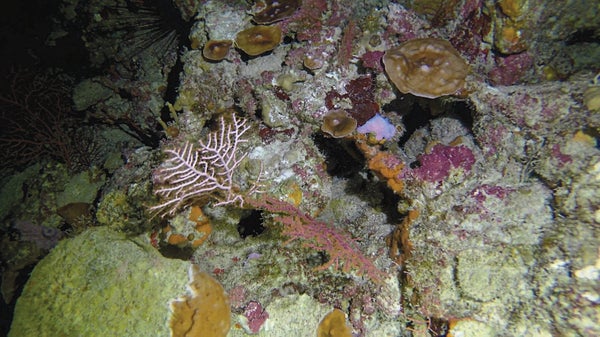
As marine biologist Nicola Foster and her colleagues steered a remote-controlled submersible through the coral reefs of the Indian Ocean's Chagos Archipelago, they saw corals full of color near the surface. But nearly 300 feet below, in the dimmer and colder waters of what oceanographers call the “twilight zone,” some corals had turned ghostly white, leaving them vulnerable to disease and death.
“It wasn't something we were expecting to see,” says Foster, who studies deeper-water coral ecosystems called mesophotic reefs at the University of Plymouth in England. Mesophotic reefs would seem to be buffered from rising sea-surface temperatures that blanch higher-up corals. But this team's 2019 observations, published recently in Nature Communications, show the deepest instance of bleaching ever recorded—suggesting similar reefs are more vulnerable than previously believed.
Bleaching often happens when warming water prompts corals to expel the colorful algae that live in their tissues and help to sustain them. Although surface waters weren't atypically warm when Foster and her team took their measurements, the twilight zone waters neared 84 degrees Fahrenheit (29 degrees Celsius)—far above the 68- to 75-degree range in which mesophotic corals thrive.
On supporting science journalism
If you're enjoying this article, consider supporting our award-winning journalism by subscribing. By purchasing a subscription you are helping to ensure the future of impactful stories about the discoveries and ideas shaping our world today.
The researchers realized that bleaching corresponded with the timing of the Indian Ocean Dipole, a climate pattern similar to El Niño. This phenomenon shifts the region's surface winds and ocean currents, says study co-author Phil Hosegood, a physical oceanographer at the University of Plymouth. Wind and waves stir the upper ocean, keeping it relatively warm and uniform in temperature. But the 2019 dipole deepened this well-mixed upper layer; the thermocline (the slice of ocean that separates warm upper waters from the frigid depths) had plunged deeper than normal. “Those corals were exposed to temperatures that are normally found at the surface,” Hosegood says. Researchers may have missed similar bleaching events in the past by not looking deep enough, he adds.
“This observation is really important,” says Gonzalo Pérez-Rosales, who has studied similar ecosystems as a coral reef ecologist at the Woods Hole Oceanographic Institution, because it suggests mesophotic reefs elsewhere could also be bleaching. For instance, Hosegood says, El Niño may cause similar thermocline deepening in parts of the Pacific.
Fortunately, the corals in this study had largely recovered their color by 2022, Foster notes. But each bleaching stresses the corals and, if prolonged, can starve them. Another Indian Ocean Dipole event had already begun deepening the warm waters in this area by late fall of 2023, Hosegood says. He hopes future studies will reveal the physical processes behind where thermoclines deepen and how long this can last. Future Indian Ocean Dipole patterns are likely to be more severe, he says, noting that data suggest “that these natural cycles are becoming amplified with climate change.”