Everyone Who Has Ever Been to Space, Charted

Space traveler demographics have shifted over time

Detail of a violin chart shows the median going up over time and the range getting larger over time.

Zane Wolf

Join Our Community of Science Lovers!

In 1960 no one had ever traveled beyond Earth. Now more than 700 people have flown past the 50-mile-high mark that was considered the boundary of space when spaceflight first got started. At that time, the Soviet Union and the U.S. were the only teams, and military men around 30 years old were practically the only players. Since then, astronauts have diversified in many ways: men and women from 47 countries have reached space, including residents of every continent, most in the employ of space agencies and some with private companies. Diversity hasn’t been a straightforward march, though: in 1963 the U.S.S.R. launched the first woman into space, but in subsequent years only five more female cosmonauts flew in total, whereas dozens of male cosmonauts went up each decade.

The number of space visitors peaked in the 1990s, when NASA flew an average of six space shuttle missions a year, each usually carrying five to seven astronauts. The first shuttle launched in 1981, but the program took a nearly three-year hiatus after the Challenger disaster in 1986. The shuttle fleet was grounded again for more than two years when Columbia broke up on its return trip to Earth.

Annual Age Distributions of Astronauts sent to Space


On supporting science journalism

If you're enjoying this article, consider supporting our award-winning journalism by subscribing. By purchasing a subscription you are helping to ensure the future of impactful stories about the discoveries and ideas shaping our world today.


The ages of astronauts are shown here for each year when people flew to space. The width of each blob represents the number of fliers for each age. Both the average age of astronauts and the spread in ages have gradually risen over time.
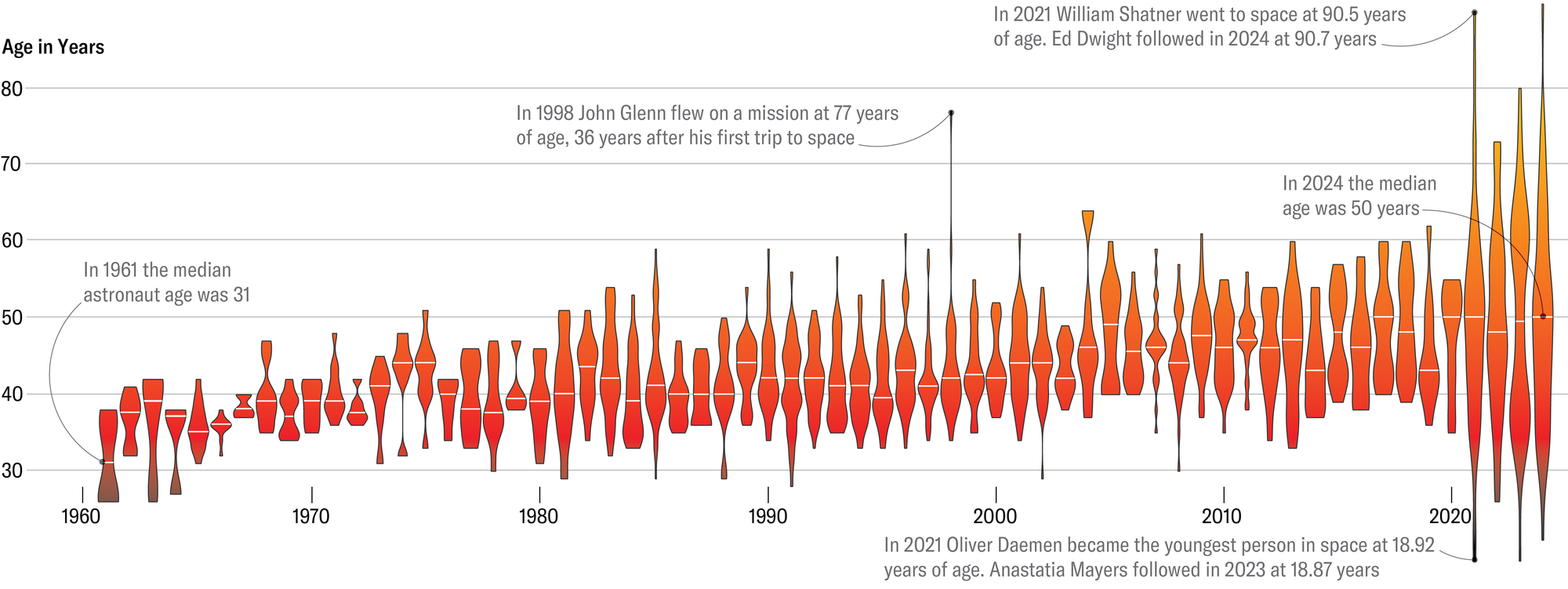
Violin plot shows astronaut ages over time from 1961 to 2024. In 1961 the median age was 31. In 2024 it was 50.

Zane Wolf

Astronauts sent to Space by Operator over time

For many years NASA and Roscosmos, the Russian space agency, were the only spacefaring entities in the world. The Chinese National Space Administration launched its first astronaut in 2003. After NASA’s space shuttles retired in 2011, NASA bought transportation for its astronauts on Russian and then private American spacecraft.
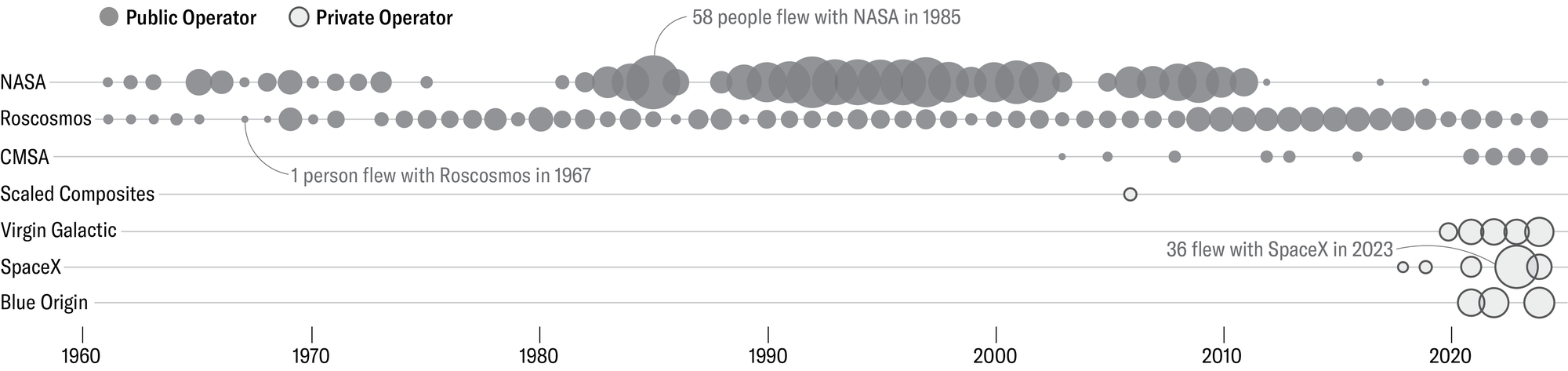
Chart shows number of astronauts that flew with each of seven operators over time. Up through the late 2010s public operators dominated (NASA, Roscosmos and CMSA). Private operators are now in the lead (Virgin Galactic, SpaceX and Blue Origins).

Zane Wolf

Astronauts by Region of Citizenship and gender, by decade

The black jagged line separates decades of space travel. Within each zone, the number of space travelers is shown for each geographic region, broken down by gender (male in solid colors, female in stripes).
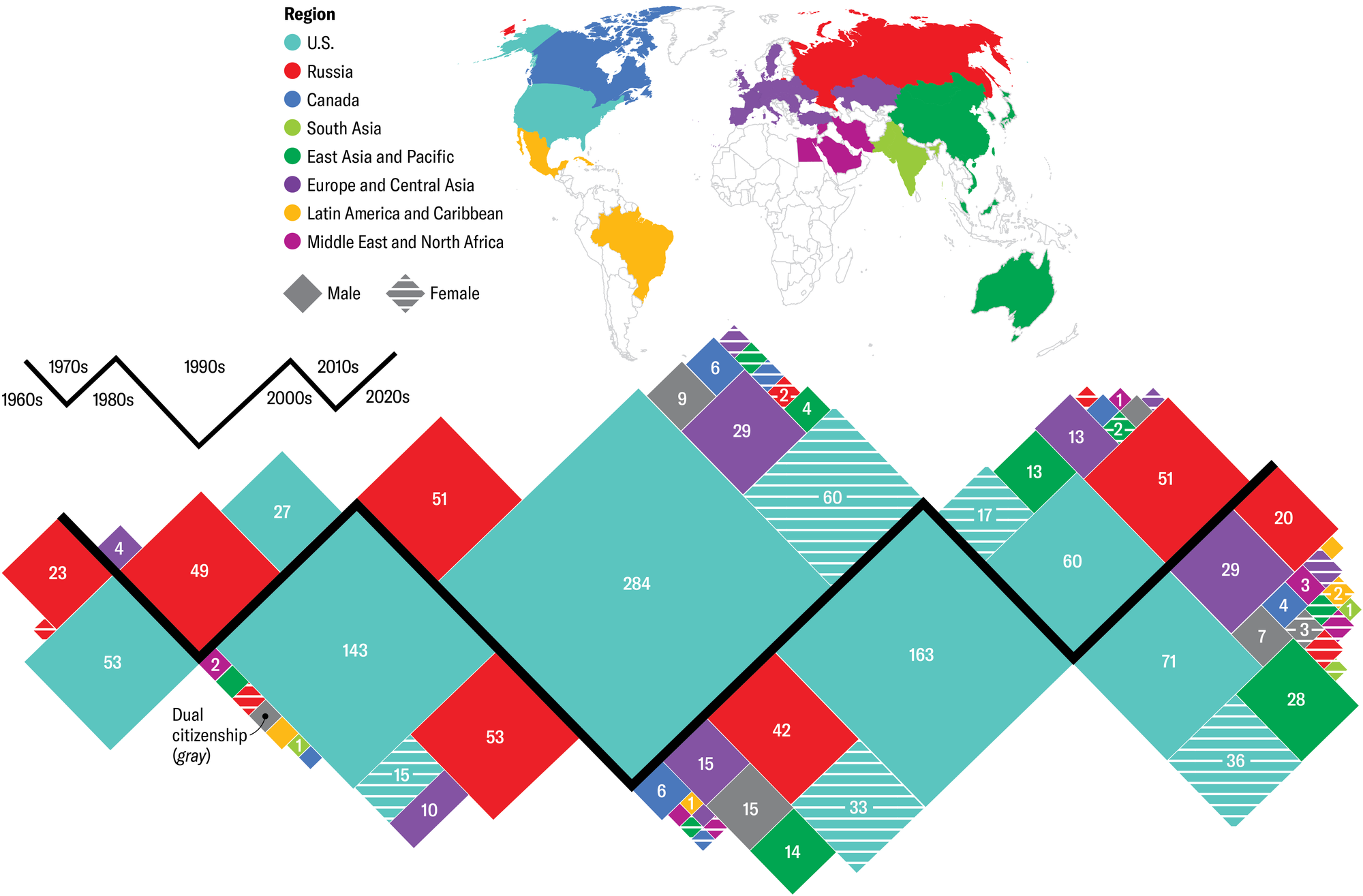
Chart shows space travelers by decade, gender and region of citizenship. Russia and the U.S. were the only players in the 1960s (1 female and 76 male astronauts combined). The 1990s holds the largest number people in space. 2024 is shaping up to be the most diverse decade.

Zane Wolf

Mission Data for Individual Astronauts

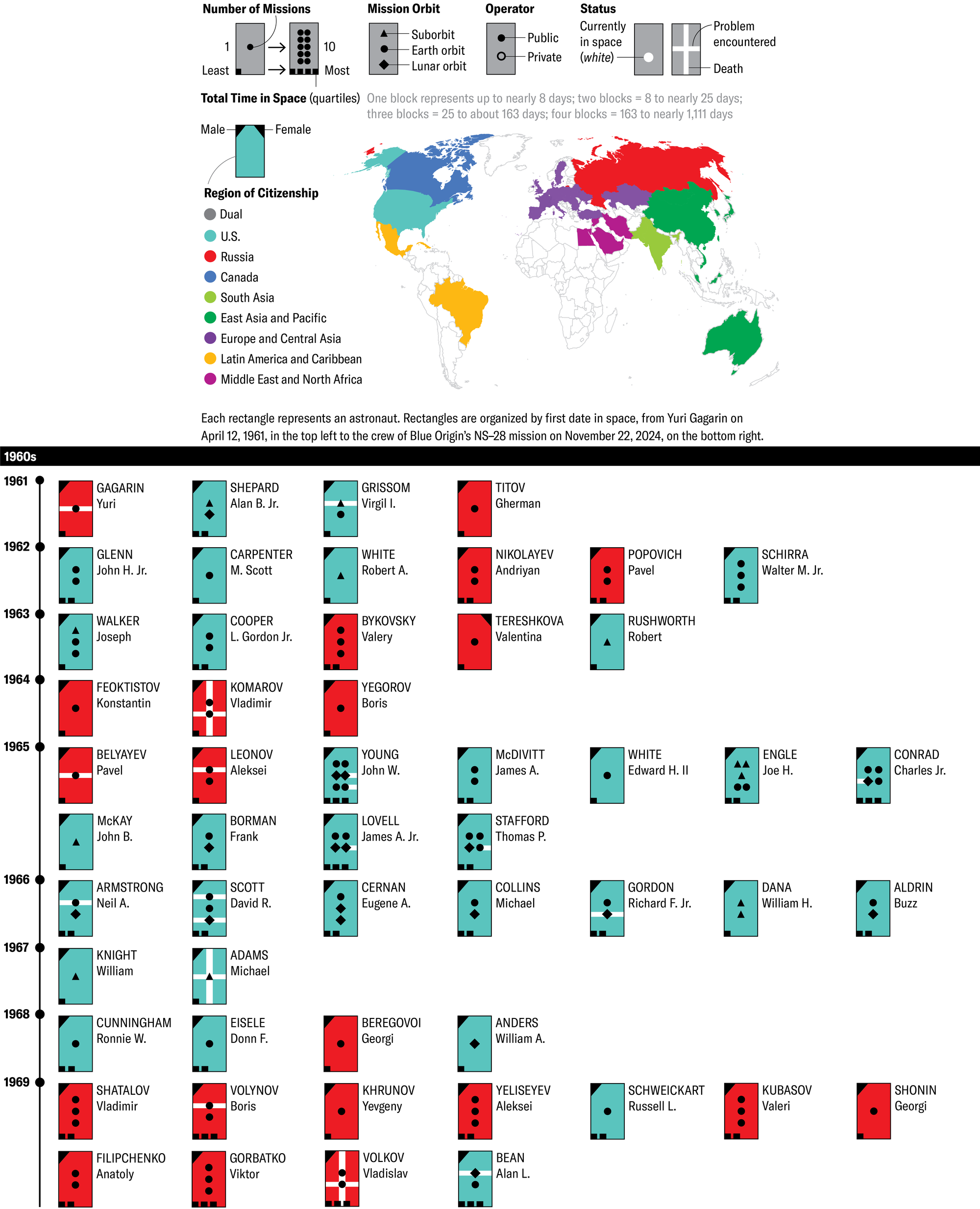
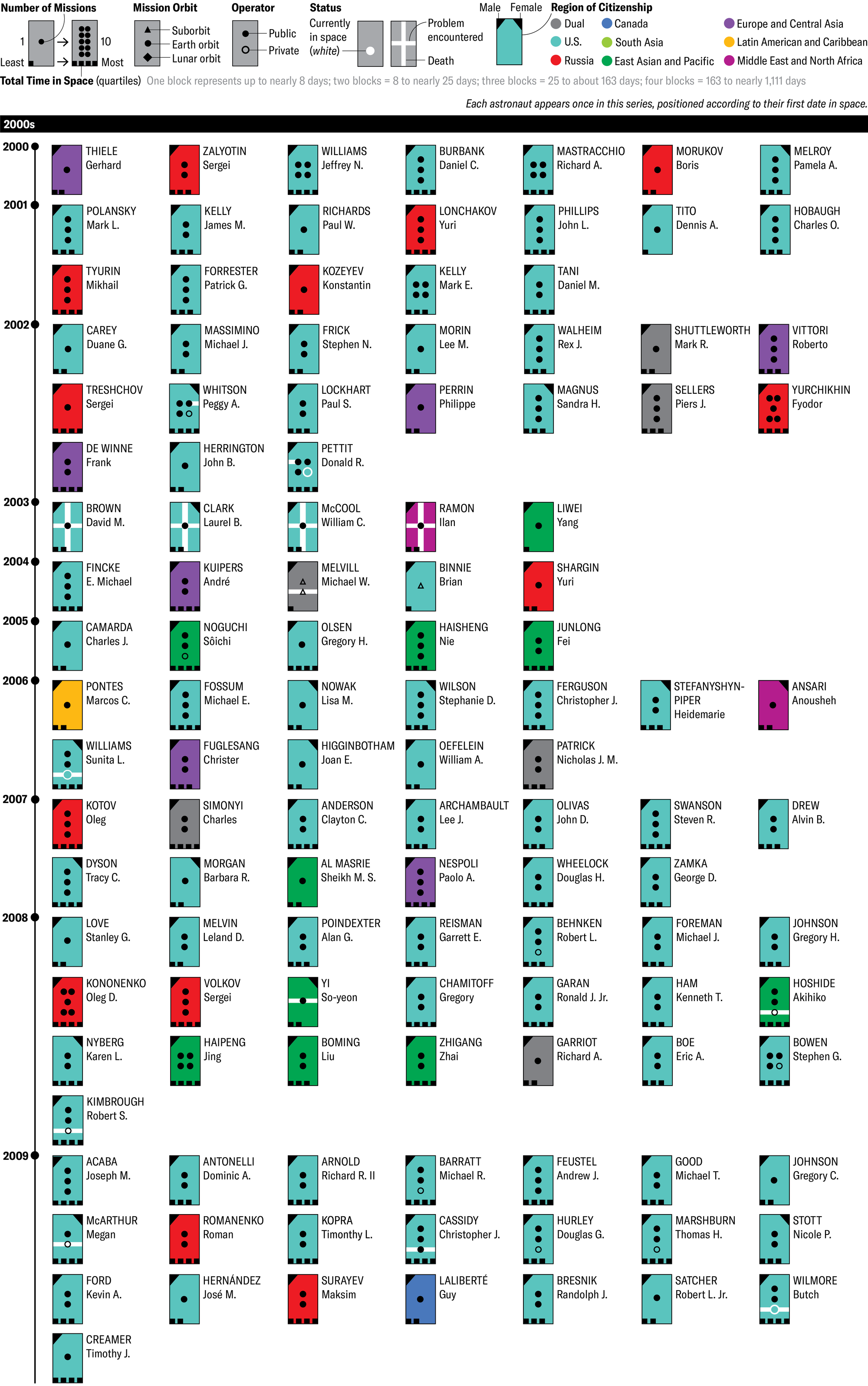
Each tile represents an individual space flier. Color and tile symbols signify each person’s region of citizenship, gender, number of missions, duration in space, type of flight, and public or private status. White lines mark problems encountered and astronauts who died on space missions, and white circles indicate astronauts who were in space at press time (December 2024).

Data for the 1960s is presented in this first in a series of seven charts. In 1961, four people experienced their first spaceflight. Valentina Tereshkova—the first female astronaut—flew in 1963. Three died on missions in this decade—Vladimir Komarov in 1964, Michael Adams in 1967 and Vladislav Volkov in 1969.
Data for the 1970s is presented in this second in a series of seven charts. A total of 47 people experienced their first spaceflight during this decade. All were male. Four were citizens of Europe/Central Asia, 19 were American, and 24 were Russian.
Data for the 1980s is presented in this third in a series of seven charts. Astronauts in this decade expanded to represent America, Russia, Canada, East Asia/Pacific, Europe/Central Asia, Latin America/Caribbean, the Middle East/North Africa and dual citizens.
Data for the 1990s is presented in this fourth in a series of seven charts. This decade holds a total of 172 first time fliers, including American Frederick W. Sturckow, who would eventually complete 4 public missions and 6 private ones.
Data for the 2000s is presented in this fifth in a series of seven charts. Three first time fliers from this decade would go on to several additional missions. Three are currently in space: Donald R. Pettit (on his 4th mission), Sunita L. Williams (3rd) and Butch Wilmore (3rd).
Data for the 2010s is presented in this sixth in a series of seven charts. This decade contains 58 first time fliers, the fewest number since the 1970s, which held 47.
Data for 2020 through 2024 is presented in this seventh in a series of seven charts. This decade ushers in the rise of private operator first-time fliers. 108 (out of 139) made their first flight with a private operator.

Zane Wolf

Editor’s Note (2/10/25): This article was edited after posting to clarify Anastatia Mayers’s age when she went to space in 2023.

Clara Moskowitz is chief of reporters at Scientific American, where she covers astronomy, space, physics and mathematics. She has been at Scientific American for more than a decade; previously she worked at Space.com. Moskowitz has reported live from rocket launches, space shuttle liftoffs and landings, suborbital spaceflight training, mountaintop observatories, and more. She has a bachelor’s degree in astronomy and physics from Wesleyan University and a graduate degree in science communication from the University of California, Santa Cruz.

More by Clara Moskowitz

Zane Wolf was formerly a graphics intern at Scientific American. She has an interdisciplinary research background, including animal behavior, soft robotics and astrophysics, with a current focus on data storytelling as it pertains to scientific communication.

More by Zane Wolf
Scientific American Magazine Vol 332 Issue 2This article was published with the title “The Astronaut Club” in Scientific American Magazine Vol. 332 No. 2 (), p. 88
doi:10.1038/scientificamerican022025-LZ8uxT6kydMF8ej8rDLA4

It’s Time to Stand Up for Science

If you enjoyed this article, I’d like to ask for your support. Scientific American has served as an advocate for science and industry for 180 years, and right now may be the most critical moment in that two-century history.

I’ve been a Scientific American subscriber since I was 12 years old, and it helped shape the way I look at the world. SciAm always educates and delights me, and inspires a sense of awe for our vast, beautiful universe. I hope it does that for you, too.

If you subscribe to Scientific American, you help ensure that our coverage is centered on meaningful research and discovery; that we have the resources to report on the decisions that threaten labs across the U.S.; and that we support both budding and working scientists at a time when the value of science itself too often goes unrecognized.

In return, you get essential news, captivating podcasts, brilliant infographics, can't-miss newsletters, must-watch videos, challenging games, and the science world's best writing and reporting. You can even gift someone a subscription.

There has never been a more important time for us to stand up and show why science matters. I hope you’ll support us in that mission.

Thank you,

David M. Ewalt, Editor in Chief, Scientific American

Subscribe