
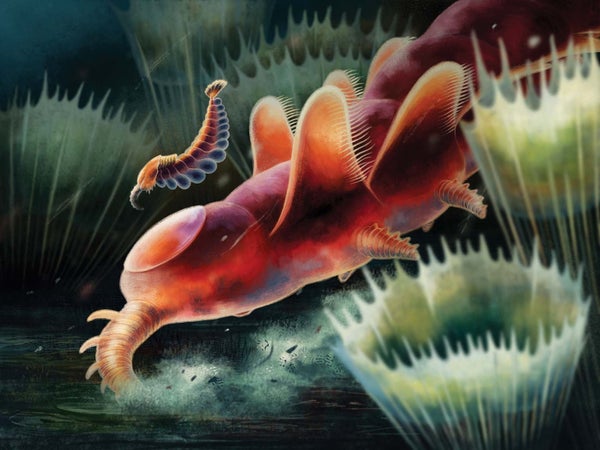
More than a century ago paleontologist Charles Doolittle Walcott uncovered a very strange fossil in Canada. The finger-sized animal was utterly alien compared to anything around today: it looked like a lobster tail with five eyes and a nozzlelike trunk at one end. This 508-million-year-old organism, named Opabinia regalis, seemed an isolated expression of evolution running riot back in the Cambrian period—before a mass extinction swept such oddities away. But now scientists have discovered that such enigmatic creatures survived for tens of millions of years longer than previously thought.
Only last year Harvard University paleontologist Joanna Wolfe and her colleagues described the second such specimen ever found, called Utaurora. This creature, unearthed in Utah, was related to Opabinia and lived at a similar time. But the day this find was published, Wolfe saw a photograph taken by fellow researcher Stephen Pates that would fundamentally change these organisms’ story. Pates had just found a third Opabinia-like creature in Wales—in rocks about 40 million years younger than the first two specimens. This oddball would have lived when more modern-looking animals, such as snails, cephalopods and corals, were on the rise.
“My very first reaction was actually that it couldn’t be,” Wolfe says. The fossil seemed too poorly preserved to immediately identify. But the discovery of another, higher-quality fossil and analysis showing key characteristics in common with Opabinia eventually convinced Wolfe. She, Pates and other researchers recently published the finding in Nature Communications.
On supporting science journalism
If you're enjoying this article, consider supporting our award-winning journalism by subscribing. By purchasing a subscription you are helping to ensure the future of impactful stories about the discoveries and ideas shaping our world today.
At first glance the new fossil resembles a smear on gray stone. But up close, it clearly shares telltale traits with Opabinia. Wolfe and her colleagues called the animal Mieridduryn (“bramble snout” in Welsh) for its spiky proboscis.
Finding such specimens in Wales came as a surprise. “Fossils from the Llandrindod Wells area have been studied for many decades and were thought to contain only shelly fossils like trilobites,” says paleontologist Rich Howard of the Natural History Museum in London, who was not involved with the discovery. No one was looking for small, soft-bodied creatures there. Such fossils are invaluable for understanding the origins and early days of groups such as arthropods and their soft-bodied precursors.
Mieridduryn lived during the Ordovician period, as Earth’s oceans were starting to resemble something a little more familiar to us today. Various other Cambrian oddities are now known to have lived beyond the mass extinction into that new era—and researchers are still investigating how they did so, as well as why they ultimately vanished. “We have more questions now about how opabiniids may have survived and what kinds of environments or life histories they were restricted to,” Wolfe says. And now she has an additional 40’million years’ worth of rocks to examine for clues.