
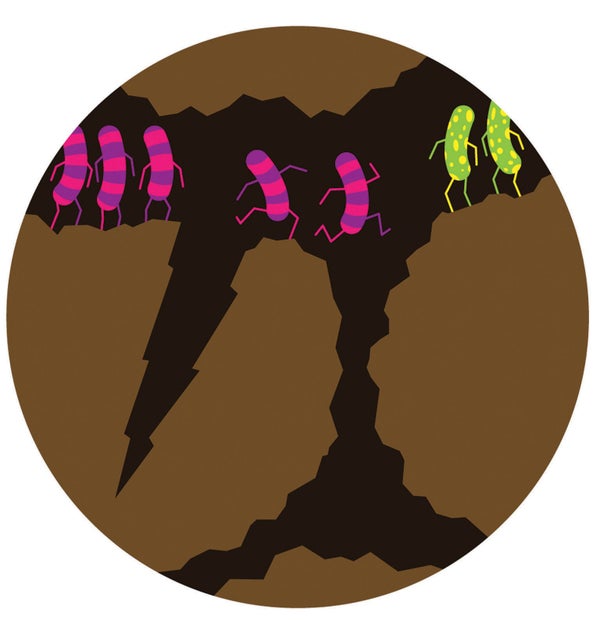
Even a mile underground, our planet is teeming with microbes. Scientists long assumed that these subterranean microbial communities, which dwell in aquifers and geothermal wells, saw little ecological change. But recent research suggests that their populations are actually quite dynamic, shifting species composition within days rather than centuries—and geologic activity, such as when rocks split from compression or expansion, could be behind such changes.
Aquatic bacteria and viruses living below Earth’s surface are insulated from ecological disruptors such as solar radiation, changes in weather and meteorite strikes. With limited access to nutrients and sunlight, they tend to grow and evolve very slowly. Yuran Zhang, an energy resources engineer at Stanford University, was studying the flow of water between geothermal aquifers when she had the idea to use microbes as a tracer. Because pockets of subterranean water are usually isolated from one another, she and her team thought microbial DNA might act as a good “signature” to identify water from each aquifer. Through ongoing engineering work, “we [already] had access to those valuable samples” of water, Zhang says. “So it worked out.”
For a study in the Proceedings of the National Academy of Sciences USA, Zhang and her team analyzed water from three boreholes connected to underground aquifers. They took samples once a week over 10 months, sequencing the DNA in each to determine which microbes were present. At first it seemed like each tiny ecosystem’s microbial makeup was set in stone. But to the researchers’ surprise, those signatures changed rapidly after a rock-fracturing event created cracks at the sampling site.
On supporting science journalism
If you're enjoying this article, consider supporting our award-winning journalism by subscribing. By purchasing a subscription you are helping to ensure the future of impactful stories about the discoveries and ideas shaping our world today.
The team soon realized that by closing and opening tiny channels between these isolated water pockets, fracturing events could completely upend an aquifer’s microbial ecology in a matter of days. “Our results are interesting because they present not only a different mechanism for community assembly but also a much faster mechanism,” says study senior author Anne Dekas, a Stanford microbiologist.
This discovery is exciting, says University of Colorado geomicrobiologist Alexis Templeton, who was not involved in the new research: “There aren’t a lot of studies yet that really understand how water is moving through subsurface environments and how it affects the microbiology.”
Such research could help scientists predict how to better store potentially hazardous materials such as nuclear waste and carbon dioxide, Dekas says. And it could even aid in the search for extraterrestrial life, because watery moons such as Jupiter’s Europa are thought to house similar hard rock aquifers.
It can be tempting to think of geology as completely separate from the realm of life. But according to Templeton, studies like this one “show us how intimately linked the two are.”