
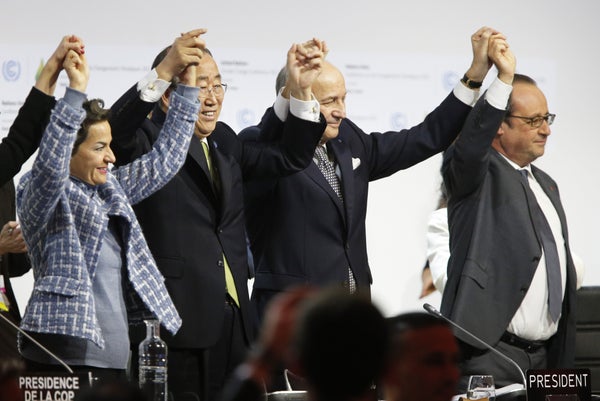
A shadow looms over this year’s United Nations climate change meeting. The 23rd Conference of the Parties—or its shorthand, COP 23—begins Monday in Bonn, Germany. It commences just five months after Pres. Donald Trump announced he would withdraw the U.S. from the Paris climate accord, which aims to limit global temperature rise to 2 degrees Celsius—or ideally, 1.5 degrees C. The international community strongly reprimanded the Trump administration for its decision, and it has vowed to disregard that setback and forge ahead at COP23. No other countries have reneged on the accord.
Nations have a lot to figure out. The 2015 Paris accord “was a landmark agreement,” says Cara Horowitz, co-executive director ofthe Emmett Institute on Climate Change and the Environment at University of California, Los Angeles, School of Law. “But it left many of the details about [implementation] still to be negotiated.” At COP 23, country representatives will work out the nitty-gritty of how to execute the accord, which will ultimately determine its long-term success. “This is quite a consequential meeting,”says Barry Rabe, a professor of public policy at the University of Michigan.“Itrepresents an important early test of [nations’] resolve to honor what they agreed on in Paris.”
The implementation guidelines that country representatives will develop are often collectively referred to as the “Paris rule book.”The numerous rules will address issues such as how countries will track and report their emissions and have them verified,all in a transparent way; how countries will be required to communicate their future emissions-reduction plans as well as their pledges for funding adaptation efforts;and if and how market mechanisms, such as emissions trading between countries, will be applied to national targets. The representatives will also address how nations will assess the gap between global progress made and the Paris agreement’s 2-degree C goal—a collective five-year review named the “global stocktake” that will commence in 2023. Experts say countries likely will not finalize any major guidelines during the two-week COP 23 meeting but will be making crucial progress.
On supporting science journalism
If you're enjoying this article, consider supporting our award-winning journalism by subscribing. By purchasing a subscription you are helping to ensure the future of impactful stories about the discoveries and ideas shaping our world today.
The concerns of small island nations will influence the meeting in a new way. This year’s COP president is Fiji’s prime minister, Frank Bainimarama—the first representative from a small island nation to lead the U.N. climate meeting. “The COP president typically has a fair amount of power to set the tone for negotiations,” Horowitz explains. “I expect we’ll see a lot at this COP that relates to the priorities of small island nations.” These nations are extremely vulnerable to rising oceans—their fate is tied to the success of the Paris accord. “They could be among the first to lose significant sovereign territory,” Horowitz says. They will likely push for greater greenhouse gas reductions as well as emphasize adaptation to climate change and paying for losses and damages.
Some U.S. officials are still attending COP23, but Michael Wara, director of the Climate and Energy Policy Program at Stanford University Law School, worries that without U.S. leadership, the Paris accord rules could end up vague. “The U.S. has strongly favored transparency,” Wara says. “An agreement with a lot more ambiguity is more favorable to countries that are very concerned about showing [they have met their commitments]. They want to preserve some ambiguity around compliance.” That would “really weaken the prospects” for meeting the Paris accord goal, he adds, stressing the importance of transparency. “The more transparent you are, the more you can see whether nations are meeting their commitment, and the greater level of trust.” And if countries trust each other, they can continue to make bigger emissions commitments, which is exactly how the Paris agreement is supposed to work.
Jonathan Elkind,former Department of Energy assistant secretary for international affairsunder the Obama administration, says these concerns about transparency are valid, and he questions the U.S.’s influence at COP23 due to Trump’s decision. “At a minimum, the U.S.’s ability to be persuasive to other parties is really placed under pressure,” says Elkind, who is now a fellow and senior adjunct research scholar at Columbia University’s Center on Global Energy Policy. Horowitz thinks that even without the U.S. leading, others—such as the European Union—will do so.
Although the U.S. government has stepped away from climate leadership, many subnational leaders—governors, mayors, tribal statesmen, CEOs and university heads—have formed a coalition to uphold the U.S.’s Paris accord promise. These groups will have a big presence at COP23, Horowitz says. Among others, governors Jerry Brown (Calif.), Terry McAuliffe (Va.), Kate Brown (Ore.) and Jay Inslee (Wash.) will attend the meeting. Their presence “signals very loudly to the rest of the world that the U.S is not the Trump administration,” Wara says. “While Trump is here for now, that's not forever.”
The world still faces a long, difficult path to achieving its goal. Last Tuesday, the U.N. announced a wide gap remains between nations’ current emissions pledges and the reductions needed to keep the planet’s temperature increase below 2 degrees C. Without greater ambition, the U.N. reported, the global rise could be 3 degrees C or more this century.