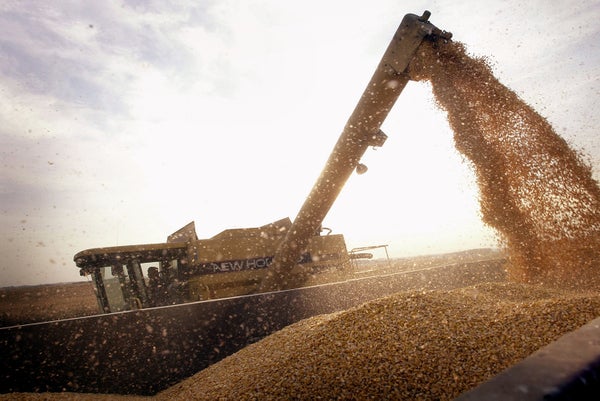
GM Crop Planting Declines for the First Time

The total area sown with genetically modified plants fell 1 percent in 2015

corn crop

Major biotech markets such as the United States — which is the largest grower of genetically modified crops — are approaching saturation, with little potential for future expansion.

Getty Images

Join Our Community of Science Lovers!

The area planted with genetically modified crops globally declined for the first time in 2015.

The 1% decline — the first in the technology’s 20-year global commercial history — was primarily due to an overall decrease in both GM and non-GM crops caused by low commodity prices, says the International Service for the Acquisition of Agri-Biotech Applications (ISAAA), a non-profit biotech industry group that tracks GM crops.

Credit: Nature News, April 19, 2016 doi:10.1038/nature.2016.19766


On supporting science journalism

If you're enjoying this article, consider supporting our award-winning journalism by subscribing. By purchasing a subscription you are helping to ensure the future of impactful stories about the discoveries and ideas shaping our world today.


But the ISAAA also said in its April 13 report that major biotech markets such as the United States — which is the largest grower of genetically modified crops — are approaching saturation, with little potential for future expansion.

Credit: Nature News, April 19, 2016 doi:10.1038/nature.2016.19766

The ISAAA says there is still room for growth in other countries: it estimates that there is the potential to add 100 million hectares globally, 60 million of them in Asia. The pipeline of GM crops is also growing, according to ISAAA, which says that 85 potential new products are being field-tested. More GM crop types are anticipated because gene-editing methods, including the very popular CRISPR-Cas9 are increasingly being used to engineer crops with new traits.

This article is reproduced with permission and was first published on April 19, 2016.

It’s Time to Stand Up for Science

If you enjoyed this article, I’d like to ask for your support. Scientific American has served as an advocate for science and industry for 180 years, and right now may be the most critical moment in that two-century history.

I’ve been a Scientific American subscriber since I was 12 years old, and it helped shape the way I look at the world. SciAm always educates and delights me, and inspires a sense of awe for our vast, beautiful universe. I hope it does that for you, too.

If you subscribe to Scientific American, you help ensure that our coverage is centered on meaningful research and discovery; that we have the resources to report on the decisions that threaten labs across the U.S.; and that we support both budding and working scientists at a time when the value of science itself too often goes unrecognized.

In return, you get essential news, captivating podcasts, brilliant infographics, can't-miss newsletters, must-watch videos, challenging games, and the science world's best writing and reporting. You can even gift someone a subscription.

There has never been a more important time for us to stand up and show why science matters. I hope you’ll support us in that mission.

Thank you,

David M. Ewalt, Editor in Chief, Scientific American

Subscribe