
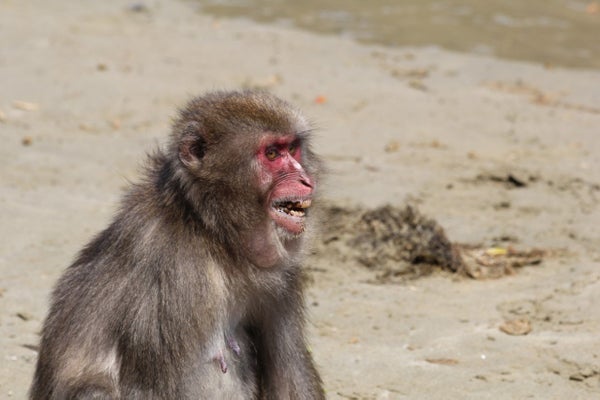
Teeth have a story to tell, and sometimes that story has a surprising twist. Researchers have long studied the arrangement and condition of teeth to determine an animal’s age, diet, health and even technological capabilities—including tool use in early human species. Now a study published in the American Journal of Biological Anthropology offers new insight into the diet and behavior of a world-famous macaque monkey troop.
When Ian Towle, a researcher at the University of Otago in New Zealand, and his colleagues inspected the teeth of a deceased macaque on Koshima Island in Japan, they were startled to discover long, uniform scratches running down the front of the monkey’s incisors. They also found distinct cone-shaped grooves on the back teeth. At first, Towle assumed they were looking at the result of one individual’s weird behavior. “And then I got to the next one, and it was exactly the same,” he says. The marks turned out to be widespread throughout the famously well-studied Koshima troop.
“Teeth are the most resistant part of our skeleton,” says Almudena Estalrrich Albo a paleoanthropologist at the University of Cantabria in Spain, who was not involved in the study. Unlike other bones, which can heal, teeth do not remodel after being chipped or scratched. “Because of that, they collect information about an individual’s life,” Estalrrich Albo adds.
On supporting science journalism
If you're enjoying this article, consider supporting our award-winning journalism by subscribing. By purchasing a subscription you are helping to ensure the future of impactful stories about the discoveries and ideas shaping our world today.
Towle noticed that the markings his team found bore a striking resemblance to wear patterns found on fossilized human teeth. But in humans, similar features are usually associated with tool use such as cleaning teeth with a long, sharp implement or processing animal hides—behaviors that Koshima macaques do not display.
“This population has been studied since 1952,” says study co-author Andrew J. J. MacIntosh, a behavioral primatologist at the Center for International Collaboration and Advanced Studies in Primatology at Kyoto University in Japan. “Nobody has ever mentioned tool use.”
So where did these odd marks come from? In the Koshima macaques, they likely have a surprising dietary origin: eating shellfish. The researchers postulate that when the monkeys pluck mollusks from the island’s rocky coast, they ingest sand along with their meal. This grit scratches the enamel on the front of the monkeys’ teeth as they chew, and it gets stuck in grooves, where it must be removed by jets of saliva. Such marine foraging is extremely rare in monkeys, according to University of California, Davis, primatologist Lynne Isbell, who was not involved in the study. “[Nonhuman] primates, as a rule, don’t live near marine habitats,” she says.
If scientists “found these grooves on the back teeth and these large scratches on the front teeth in a fossil human sample, I genuinely think that most researchers would identify them as tool use,” Towle says.
There are notable differences, however. Paleoanthropologist David Frayer of the University of Kansas points out that the macaque tooth scratches are vertical, whereas most fossilized human tooth markings are more angled. In fact, the angle of scratches on Neandertal teeth has long been used to determine whether fossilized individuals were left- or right-handed. The macaque markings “are impressive, but they don’t resemble any of the kind of scratches that we documented for Neandertals” or other ancient human species, says Frayer, who was not involved in the study.
Estalrrich Albo agrees with Frayer’s assessment, although she emphasizes the value of examining tooth wear in nonhuman primates. “I think it is a contribution with potential,” she says. “Looking at other species is a necessity to make sure we are defining the right topics for study.”
Towle notes that the existence of non-tool-use scratches in macaques does not rule out tool use indicators in other primates, and he does not think that most cases of fossil human tooth scratches came from eating shellfish. But he does think that a closer study of macaque teeth might help refine analysis in the future. “I’m not suggesting that, going forward, it’s not going to be possible to differentiate between the two,” he says.