
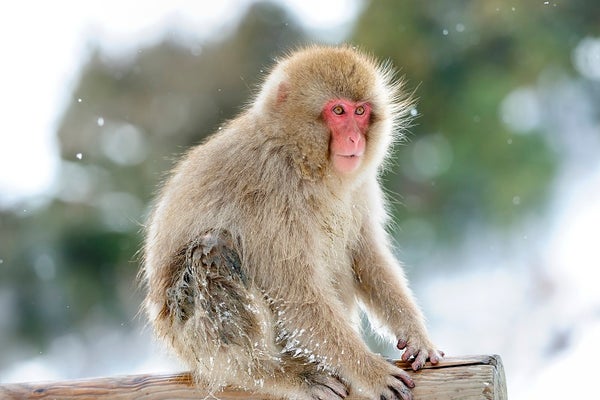

Don’t mess with a monkey. Because if you do, he’s might take revenge—on your family and friends. That’s according to a study of Japanese macaques, which shows that monkeys keep track of each’s others’ associates and make use of that intel when it comes time for payback. The findings are in the Royal Society journal Open Science. [Barbara Tiddi et al., Acquisition and functional consequences of social knowledge in macaques]
Researchers were interested in the question of how primates suss out social relationships, knowledge that can come in handy for maneuvering within a complex society. To assess how the macaques obtain and make use of such social know-how, the researchers decided to focus on episodes of aggression—a common feature of simian interactions.
They went through more than 500 hours of video recordings showing the exchanges that took place in a group of 57 macaques living in the Rome Zoo—monkeys whose genealogical relationships are well known. And they parsed some 15,000 episodes of aggression, noting the relationships among the individuals involved.
On supporting science journalism
If you're enjoying this article, consider supporting our award-winning journalism by subscribing. By purchasing a subscription you are helping to ensure the future of impactful stories about the discoveries and ideas shaping our world today.
First, they confirmed that monkeys that find themselves at the receiving end of aggression tend to turn around and take it out on a third party. And that retaliation is often directed at a relative of the original aggressor.
But how do the monkeys determine who’s kin? Well, one way would be that they’ve been around long enough to have watched each other grow up. But that doesn’t seem to be the case. When researchers looked specifically at conflicts involving older monkeys, it didn’t seem that relatives were singled out for revenge.
What does seem to be true is that victims will target their attacker’s associates—the other monkeys he hangs around with. If they’re not his relatives, they’re probably his cronies. So, close enough.
Interestingly, there’s a benefit to hitting family members when you’re meting out justice. Macaques that sought out the kin of the monkeys they wanted to settle a score with were less likely to be picked on again in the future. Whereas wailing on the friends appeared to offer only present satisfaction, but no such future protection.
Which suggests if you’re gonna beat on someone for payback, it should at least be a monkey’s uncle.
—Karen Hopkin
[The above text is a transcript of this podcast.]
