
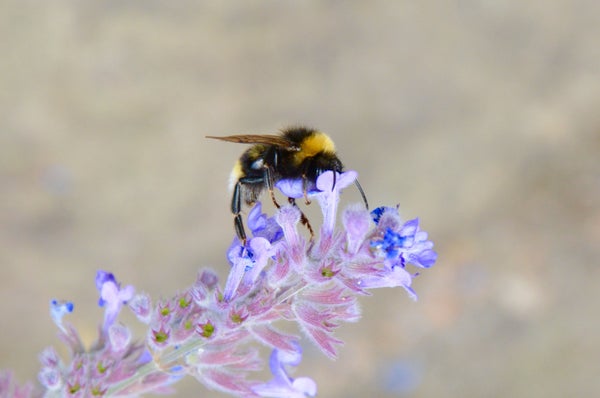
Bumblebees are already stressed by pesticides and habitat loss. Now add global warming. A new, large study of North America and Europe shows that rising atmospheric temperatures are shrinking the geographic range across which wild bumblebees live. The insects are disappearing from their southernmost regions as those places heat up. But they are not migrating farther northward as higher latitudes warm.
“That is the surprise,” says Leif Richardson, a research fellow in ecological economics at the University of Vermont who co-led the research. “We don’t yet understand why the bees are not responding the way other organisms are.” The general pattern among other insects, he says, “is that they are expanding farther north but have not lost much ground in the south.” The same holds true for many types of animals.
Richardson and his fellow investigators examined more than 400,000 historical and current records of bee movements to chart the range of 67 bumblebee species across the past 113 years. In each 10-year period since 1974 the southern limit in both North America and Europe has retreated; it is now about 300 kilometers farther northward than it was during a baseline period of 1901 to 1974.
On supporting science journalism
If you're enjoying this article, consider supporting our award-winning journalism by subscribing. By purchasing a subscription you are helping to ensure the future of impactful stories about the discoveries and ideas shaping our world today.
As the researchers point out in the study, which was published in the July 10 Science, the southern migration and northern stall are independent of changes in land use or pesticide application.
The investigators say no one has a good explanation for either trend. Experts speculate that bees evolved in temperate regions and may therefore be less able to adapt to rising temperatures at either edge of their range. Many insects, such as butterflies, evolved in the tropics, which would explain why they persist as southern climates get warmer and why they move into northern climes that heat up as well.
In hotter southern regions, especially Europe, bumblebees do seem to be moving to higher altitudes in search of cooler climes. But that path is obviously limited. Oddly, at the northern fringes of the ranges, bees are moving down in elevation, even though that would generally be toward even warmer temperatures. Richardson says the bees might be driven out as plants that they prefer, such as flowers, decline at high elevations and are replaced by other vegetation such as trees that bees do not visit.
Wild bees are great pollinators. Losing them in the south could threaten all sorts of flowers and plants, hurting ecosystems and lessening food for animals. Their disappearance would harm agriculture as well; although beekeepers truck cultivated bees from farm to farm, many farmers rely on wild bees to pollinate crops and grazing fields. The worry, of course, is that if temperatures continue to rise, bees will disappear from more and more stretches of North America and Europe. And if the insects do not move northward, it may also be difficult for crops and plants that begin to grow there to flourish.
Some experts say the solution is assisted migration—helping the bees move to a new area they would not normally move to—a tactic that has been discussed and tried with other kinds of animals. “We don't have too much experience with assisted migration for bees, however,” Richardson says, “and it’s bound to be very expensive.” The approach might work for local farming communities, he acknowledges, “but it’s not viable across an entire continent.”
Smaller steps could help local bee populations do better, Richardson says. For example, most bumblebees nest in cavities in the ground, but changing climate might scare off animals that create these cavities. In that case, people could put out nesting boxes or maintain hedgerows and edges of crop fields where the cavities tend to form naturally.
Richardson stresses that the results thus far come from studying existing data. “What we need now are vigorous experiments to see what it is about changing climate that is really affecting the bees,” he says. “Are heat waves the big factor, for example? Or warmer temperatures during a specific period, such as nesting time or dormancy over winter?” These details might reveal other solutions or at least help experts predict when bees might leave an area for good. Some of that work is just beginning.
