
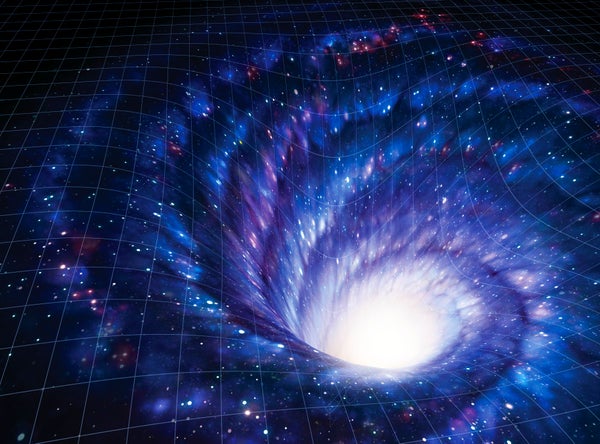
Wormholes are a controversial topic in physics, to say the least. Not only is the idea of traveling through these theoretical passageways between two disparate regions of spacetime debatable, but their very existence is unclear. A forthcoming paper, however, suggests a method to look for a wormhole inside a black hole—and those observations could occur within a decade.
On the preprint server arXiv.org, astrophysicists De-Chang Dai of Yangzhou University in China and Dejan Stojkovic of the University at Buffalo detail a test to determine whether Sagittarius A*, the supermassive black hole at the center of our galaxy, harbors a wormhole. Black holes are thought to be potential homes for wormholes, because of the extreme conditions both types of objects have in common. If such a wormhole does exist, they say, any stars lurking at its other side would conceivably exert a subtle but detectable gravitational influence on those at our end. The researchers’ paper has been accepted for publication in the journal Physical Review D.
“People are talking about wormholes that are traversable,” Stojkovic says. “And we said, ‘Okay, if particles can go through them, the fields can go as well—like the electromagnetic field and the gravitational field. Then if I’m sitting on one side of the wormhole, I can feel what’s on the other one.’”
On supporting science journalism
If you're enjoying this article, consider supporting our award-winning journalism by subscribing. By purchasing a subscription you are helping to ensure the future of impactful stories about the discoveries and ideas shaping our world today.
Stojkovic and Dai say that by monitoring the motions of stars on our side—such as S2, a known star orbiting about 17 light-hours from Sagittarius A*—we could look for tiny but perceptible accelerations caused by a wormhole’s presence. If telescopic observations of S2’s motion reach a precision of 0.000001 meter per second squared, the duo calculate such measurements could reveal the “imprint” of a star not much larger than our sun pulling on S2 from the wormhole’s far side.
If wormholes do exist, there is some question as to whether they link two points in our own universe or in two different parallel universes. For Dai and Stojkovic’s purposes, however, the difference is academic, because either scenario should produce similar detectable effects. Of course, finding a small acceleration that corresponded to a star on the other side would not be proof of the wormhole’s existence, perhaps instead hinting at unseen smaller black holes nearby, for example. But it might point in that direction. If no such acceleration were detected, given the expectation that a supermassive black hole orbited by stars would exist at a wormhole’s other side, then the presence of such a passageway in Sagittarius A* could be seemingly ruled out.
Cosimo Bambi of Fudan University in China, who was not involved in the paper, notes that a failure to find any anomalous motions could carry implications just as large as those for a success. But he cautions that any excitement about such measurements would be somewhat premature. “Of course, [this study] may be too optimistic,” he says. “But in principle, it’s possible. We cannot exclude [wormholes], right now, from current observations. Sometimes you discover something even if you don’t discover anything.”
In order for Stojkovic and Dai’s idea to work, any wormhole within Sagittarius A* must lack an event horizon—the boundary beyond which gravity’s inexorable pull allows nothing, not even light, to escape—so it would be different from the Einstein-Rosen bridge idea of a black hole on one side and a white hole on the other. “Basically, there is no event horizon,” Bambi says. “Here it is just a gate where you can go to the other side and come back. It is true that a black hole, in some cases, can be a wormhole. But in this case, we are talking about traversable wormholes.”
Kirill Bronnikov of the Peoples’ Friendship University of Russia (RUDN University), who was also not involved in the paper, is similarly cautious about the idea. “In general, it is reasonable,” he says. “Bodies moving on one side of a [wormhole] can affect those on the other side.” If such a wormhole were located inside a black hole,inside Sagittarius A*, however, the effects of that black hole’s event horizon mean we would never know for sure that it was there. “If there is a wormhole instead of a black hole [with an event horizon], then the main idea of this study does not work,” he adds.
Stojkovic notes that the for the wormhole to be traversable, its “mouth” must be larger than the black hole’s event horizon. “An observer outside of the wormhole would just see a black hole that supports the structure of the wormhole,” he says. “If the mouth is smaller or equal to the [event horizon], then the wormhole is not traversable, because nothing can come out of the horizon.”
Finding out for sure if there is a wormhole at the center of our galaxy might not be beyond the realm of possibility, though. Stojkovic says that as observational methods improve, we could use instruments such as GRAVITY on the Very Large Telescope in Chile to detect wormhole-induced perturbations in S2 that correspond to this idea sooner rather than later. “All we have to do is a little bit better statistical analysis,” he says. “Let’s say 10 years. It’s not crazy. We are almost there.”