Hidden Patterns in Folk Songs Reveal How Music Evolved

Songs and speech across cultures suggest music developed similar features around the world

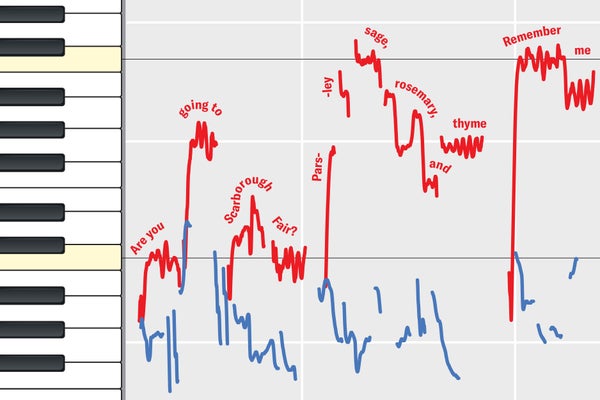
Detail of a chart plotting pitch over time for the song “Scarborough Fair.”

Duncan Geere and Miriam Quick from Loud Numbers

Join Our Community of Science Lovers!

Humans must have learned to sing early in our history because “we can find something we can call music in every society,” says musicologist Yuto Ozaki of Keio University in Tokyo. But did singing evolve as a mere by-product of speaking or with its own unique role in human society? To investigate this question, Ozaki and a large team of collaborators compared samples of songs and speech from around the world. These categories can vary wildly across cultures: songs can be lilting lullabies or rhythmic chants or wailing laments, and some spoken languages have more “musical” qualities, such as tonal languages, which convey meaning through pitch.

Despite this variation, the researchers found three worldwide trends: songs tend to be slower than speech, with higher and slightly more stable pitches. These consistent differences suggest that singing isn’t just a by-product of speech, yet why it evolved is still unknown. Perhaps it developed to unite people, an idea called the social-bonding hypothesis, says co-author Patrick Savage, a musicologist at the University of Auckland in New Zealand. “Slower, more regular and more predictable melodies may allow us to synchronize and to harmonize,” he says, “and through that, to bring us together in a way that language can’t.”

Breaking Down a Song


On supporting science journalism

If you're enjoying this article, consider supporting our award-winning journalism by subscribing. By purchasing a subscription you are helping to ensure the future of impactful stories about the discoveries and ideas shaping our world today.


The chart visualizes two recordings of the English folk song “Scarborough Fair”—one sung, one spoken—by Patrick Savage, a study author and participant. The song unfolds at around half the speed of the spoken version, and its pitches are generally higher. They are also more stable, being centered on fixed musical notes, but with added expressive pitch fluctuations such as scoops and vibrato. In contrast, the spoken performance never settles on a pitch for long.

Chart plots pitch over time for both a spoken and sung version of “Scarborough Fair.” The sung version unfolds more slowly and exhibits more pitch variability than the spoken version.

Duncan Geere and Miriam Quick from Loud Numbers

Different Songs, Similar Patterns

The researchers analyzed 300 audio recordings by 75 collaborators speaking 55 languages. Each person sang a traditional song, recited its lyrics, played an instrumental version of its melody, then described its meaning. The authors showed how pitch height, tempo and pitch stability vary as a person moves from instrumental music to singing to speech, and they found commonalities across cultures.

Map indicates the location of origin for each folk song included in the study. The dots are color-coded by eight language families: Indo-European, Atlantic-Congo, Japonic, Sino-Tibetan, Afro-Asiatic, Austronesian, Turkic and Language families with one representative.
Three slope charts show how pitch height, tempo and pitch stability vary across four ways of representing a song—instrumental, sung lyrics, spoken lyrics and spoken description. The general patterns are consistent across most of the 300 recordings.

Duncan Geere and Miriam Quick from Loud Numbers; Source: “Globally, Songs and Instrumental Melodies Are Slower and Higher and Use More Stable Pitches than Speech: A Registered Report,” by Yuto Ozaki et al., in Science Advances, Vol. 10; May 15, 2024 (data)

Allison Parshall is associate editor for mind and brain at Scientific American and she writes the weekly online Science Quizzes. As a multimedia journalist, she contributes to Scientific American's podcast Science Quickly. Parshall's work has also appeared in Quanta Magazine and Inverse. She graduated from New York University's Arthur L. Carter Journalism Institute with a master's degree in science, health and environmental reporting. She has a bachelor's degree in psychology from Georgetown University.

More by Allison Parshall

Duncan Geere is an information designer and data storyteller, specializing in climate and environmental work.

More by Duncan Geere

Miriam Quick is a data journalist who investigates scientific, environmental, economic and cultural issues. Her analyses and storytelling have been featured by major international media outlets, including the BBC, the New York Times, Scientific American and Sentient Media. Her book I Am a Book. I Am a Portal to the Universe (Particular, 2020), co-authored with Stefanie Posavec, won the Royal Society Young People’s Book Prize 2021.

More by Miriam Quick
Scientific American Magazine Vol 331 Issue 4This article was published with the title “Hidden Patterns in Folk Songs Reveal How Music Evolved” in Scientific American Magazine Vol. 331 No. 4 (), p. 74
doi:10.1038/scientificamerican112024-w054hB4V5cpyBJrbjRx7r

It’s Time to Stand Up for Science

If you enjoyed this article, I’d like to ask for your support. Scientific American has served as an advocate for science and industry for 180 years, and right now may be the most critical moment in that two-century history.

I’ve been a Scientific American subscriber since I was 12 years old, and it helped shape the way I look at the world. SciAm always educates and delights me, and inspires a sense of awe for our vast, beautiful universe. I hope it does that for you, too.

If you subscribe to Scientific American, you help ensure that our coverage is centered on meaningful research and discovery; that we have the resources to report on the decisions that threaten labs across the U.S.; and that we support both budding and working scientists at a time when the value of science itself too often goes unrecognized.

In return, you get essential news, captivating podcasts, brilliant infographics, can't-miss newsletters, must-watch videos, challenging games, and the science world's best writing and reporting. You can even gift someone a subscription.

There has never been a more important time for us to stand up and show why science matters. I hope you’ll support us in that mission.

Thank you,

David M. Ewalt, Editor in Chief, Scientific American

Subscribe