If you're enjoying this article, consider supporting our award-winning journalism by subscribing. By purchasing a subscription you are helping to ensure the future of impactful stories about the discoveries and ideas shaping our world today.
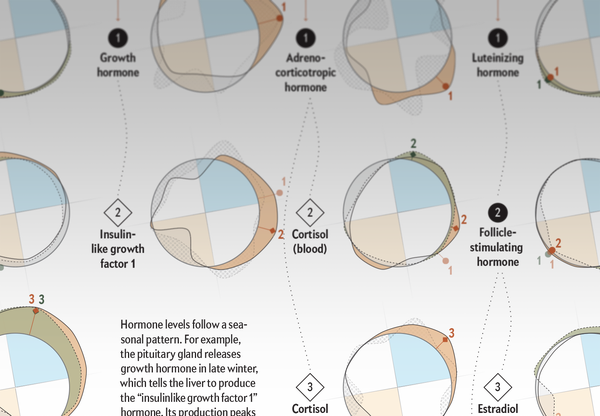
Hormones can surge and drop within minutes to direct many of our daily functions: sleep, digestion, reactions to stress. General hormone levels rise and fall slightly across the year as well. New work shows that the pattern has a seasonal memory of sorts, too, governed by a newly discovered internal clock. By studying millions of blood tests, researchers at the Weizmann Institute of Science in Rehovot, Israel, found that hormone-producing glands grow and shrink in continuous, self-regulating annual cycles. Each maximum or minimum causes hormone levels to rise or fall by several percent—small but significant—though often several months later. The cycles, and lag times, are evident in hormones released by the thyroid, liver, adrenal cortex and gonads, directed by the pituitary gland in the brain. The results support a growing body of work that shows that fertility tends to be higher in midwinter, kids grow faster in spring and moodiness peaks in winter.
Credit: Accurat; Source: “Hormone Seasonality in Medical Records Suggests Circannual Endocrine Circuits,” by Avichai Tendler et al., in Proceedings of the National Academy of Sciences USA, Vol. 118, No. 7; February 16, 2021 (data)
Subscribe to Support Independent Journalism
Great science journalism requires human expertise, time, effort and creativity. And it costs money. That’s why I and the journalists here at Scientific American hope you’ll join our community.
When you subscribe, you are supporting staff and freelance journalists who are passionate about telling science stories that are true, important and compelling. Our editors and reporters are often experts in their fields, which means they understand the nuances of big discoveries and can untangle the breakthroughs from the hype. With a subscription, you are also supporting rigorous fact-checking to ensure the words we publish are precise and accurate. And you’re supporting original illustrations, graphics and photos that bring you closer to an advanced laboratory, an ice sheet in Antarctica or a space mission in orbit. You’re helping us craft other types of high-quality journalism as well: Our newsletters are carefully written, edited and curated by staffers you have or will come to know and love. Our Science Quickly podcast is based on original reporting, collaboration with editors and scientists and exacting production.
Subscriptions keep this engine running so we can continue to deliver thoughtful, rigorous and independent science journalism to you. In an era of viral misinformation, this work is crucial. If you value what we do, I hope you’ll consider joining us as a subscriber
Thank you,
Jeanna Bryner, Editor in Chief, Scientific American