How Earth’s Biggest Mass Extinctions Stack Up

Earth’s deadliest mass extinctions have important commonalities—and significant differences

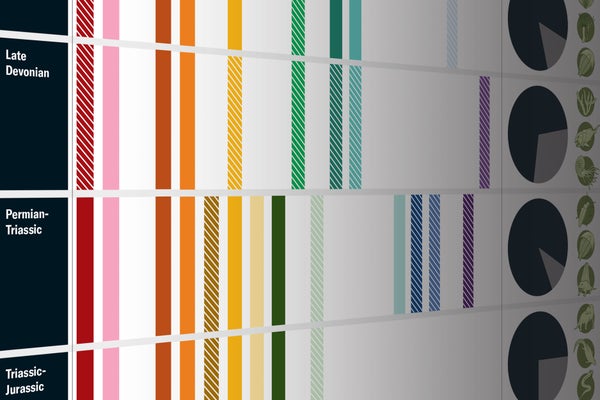
Detail of a table that shows which of 19 extinction causes are associated with each of the five mass extinction events.

Rick Simonson

Join Our Community of Science Lovers!

Life on our planet has experienced many mass extinctions over its 4.5 billion years. Scientists see evidence for at least five major episodes that eradicated creatures great and small. And many experts argue that the Anthropocene age, the current period of human activity altering Earth, is causing a sixth.

Paleontologists track mass extinctions by studying rock samples from different eras. When they reach a point where large numbers of species that had been abundant in the earlier fossil record become scarce, they’ve found an extinction event. The big five extinctions all wiped out more than 70 percent of Earth life at the time—and the most -lethal of them, the Permian-Triassic extinction around 252 million years ago, most likely took down more than 90 percent.

The origins of these extinctions are still being debated, but scientists think that most involved large spates of volcanism—giant rifts opening in Earth’s surface and spewing lava over periods of thousands or even millions of years. The volcanism probably triggered many other changes that led directly to extinctions, including anoxia, or a lack of oxygen, in the oceans as a consequence of ocean warming; ozone depletion, which resulted from volatiles released by volcanism; and wildfires caused by a heated climate.


On supporting science journalism

If you're enjoying this article, consider supporting our award-winning journalism by subscribing. By purchasing a subscription you are helping to ensure the future of impactful stories about the discoveries and ideas shaping our world today.


Studying our geological past can also teach us about the present, says David Bond, a mass extinction expert at the University of Hull in England. “We need to learn lessons from these events and use them to try to understand our potential impending diversity crisis.”

Triggers vs. kill mechanisms

Several of the causes listed here—including volcanism and sea-level change—aren’t necessarily major kill mechanisms in and of themselves. For example, an asteroid is not the actual cause of death beyond individuals that are hit directly by it. Rather it triggers widespread deadly conditions, such as anoxia and acidification.
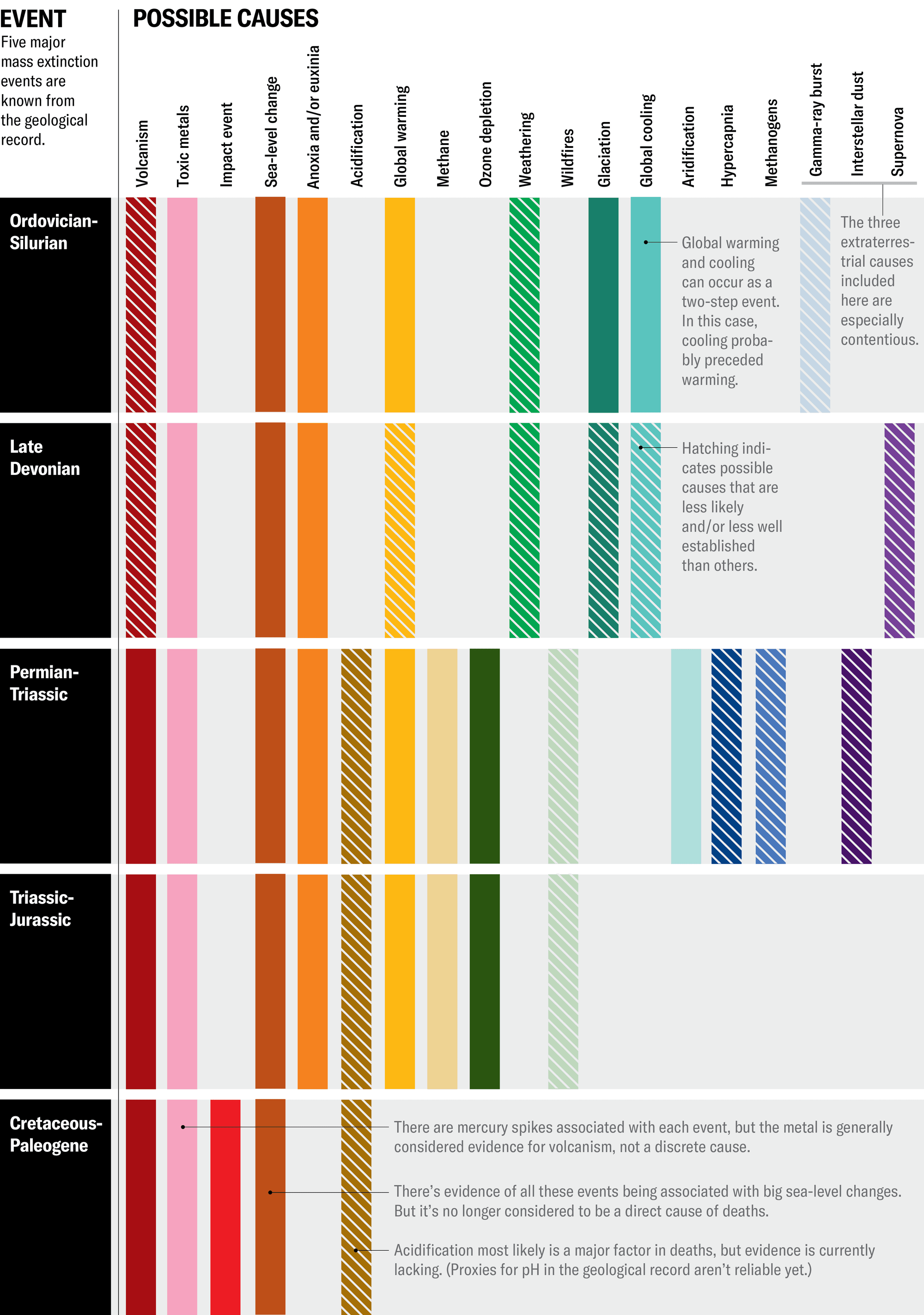
Table shows which of 19 extinction causes are associated with each of the five mass extinction events. Each event is associated with more than one cause. Volcanism, toxic metals and sea level change are associated with all five.

Rick Simonson; David Bond/University of Hull (scientific reviewer)

Magnitude and Victims

Each of the five mass extinction events is characterized by the extinction of 70 percent or more of the species living at the time. Some groups completely died out while others experienced significant declines.
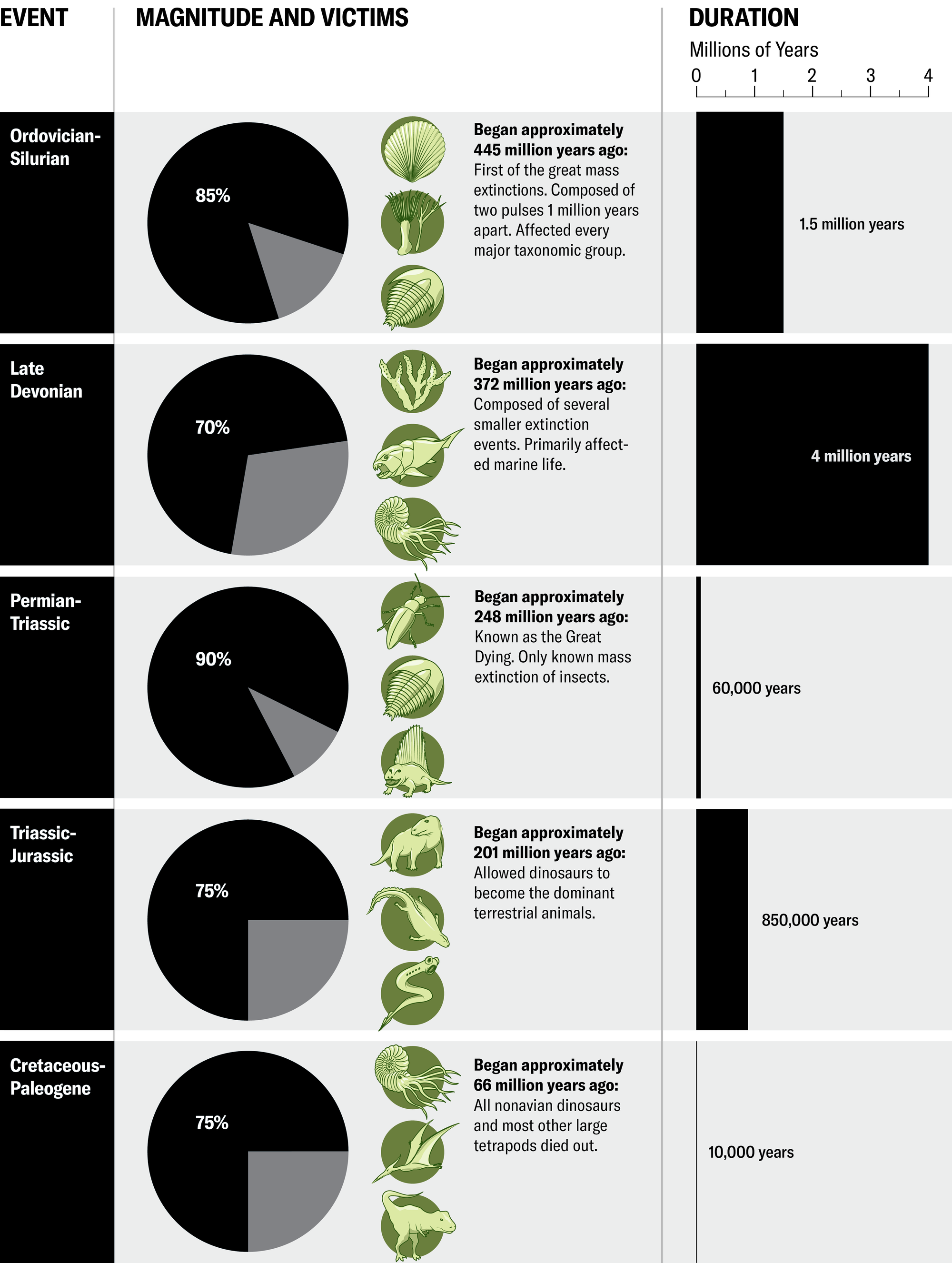
Magnitude, victims and duration of the 5 primary mass extinction events are displayed. Percent of species lost range from 70 (Late Devonian) to 90 (Permian Triassic). Duration ranges from 10,000 years (Cretaceous-Paleogene) to 4 million years (Late Devonian.)

Rick Simonson; David Bond/University of Hull (scientific reviewer)

Clara Moskowitz is chief of reporters at Scientific American, where she covers astronomy, space, physics and mathematics. She has been at Scientific American for more than a decade; previously she worked at Space.com. Moskowitz has reported live from rocket launches, space shuttle liftoffs and landings, suborbital spaceflight training, mountaintop observatories, and more. She has a bachelor’s degree in astronomy and physics from Wesleyan University and a graduate degree in science communication from the University of California, Santa Cruz.

More by Clara Moskowitz

Rick Simonson is a visual science communicator at Science Lab Studios, Inc. His work can be found at www.scilabstudios.com

More by Rick Simonson
Scientific American Magazine Vol 332 Issue 1This article was published with the title “Wipeouts” in Scientific American Magazine Vol. 332 No. 1 (), p. 86
doi:10.1038/scientificamerican012025-6dxYenXcd8jsjEJyKbKZa4

It’s Time to Stand Up for Science

If you enjoyed this article, I’d like to ask for your support. Scientific American has served as an advocate for science and industry for 180 years, and right now may be the most critical moment in that two-century history.

I’ve been a Scientific American subscriber since I was 12 years old, and it helped shape the way I look at the world. SciAm always educates and delights me, and inspires a sense of awe for our vast, beautiful universe. I hope it does that for you, too.

If you subscribe to Scientific American, you help ensure that our coverage is centered on meaningful research and discovery; that we have the resources to report on the decisions that threaten labs across the U.S.; and that we support both budding and working scientists at a time when the value of science itself too often goes unrecognized.

In return, you get essential news, captivating podcasts, brilliant infographics, can't-miss newsletters, must-watch videos, challenging games, and the science world's best writing and reporting. You can even gift someone a subscription.

There has never been a more important time for us to stand up and show why science matters. I hope you’ll support us in that mission.

Thank you,

David M. Ewalt, Editor in Chief, Scientific American

Subscribe